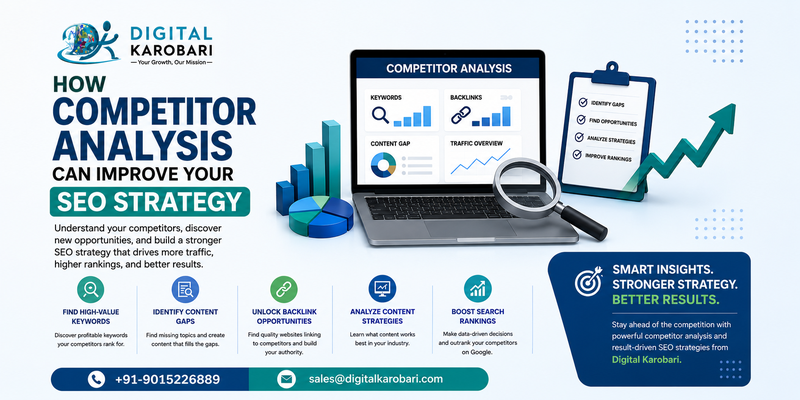
SEO is not only about optimizing your own website. To build a stronger search strategy, businesses also need to understand what competitors are doing, which keywords they target, what type of content they publish, and where they are earning visibility.
Competitor analysis provides valuable insights that can help businesses identify opportunities, avoid common mistakes, and develop a more focused SEO strategy. Instead of copying competitors, the goal is to understand the search landscape and find ways to create something better and more useful.
For businesses working with Digital Karobari, competitor analysis can be an important part of developing a data-driven SEO and digital marketing strategy.
What Is SEO Competitor Analysis?
SEO competitor analysis is the process of researching websites that compete with your business in search engine results.
These competitors may not always be your direct business competitors. A website could compete with you for specific keywords even if it offers a slightly different product or service.
An SEO competitor analysis typically examines:
Target keywords
Search rankings
Content strategy
Website structure
Backlink profiles
Search intent
Featured search results
Internal linking
On-page optimization
Local SEO presence
The information gathered can then be used to identify gaps and opportunities for your own website.
Why Is Competitor Analysis Important for SEO?
Search results are competitive. If several businesses are targeting the same audience, simply publishing content may not be enough to achieve strong rankings.
Competitor analysis can help answer important questions:
Which keywords are competitors ranking for?
What topics are generating visibility for them?
What type of content does Google appear to prefer?
Where are competitors weak?
Which topics have not been covered well?
What backlinks or online mentions are helping competitors?
These insights can make SEO planning more strategic.
- Discover Valuable Keyword Opportunities
One of the biggest benefits of competitor analysis is discovering keywords you may have overlooked.
For example, your competitors may rank for long-tail searches related to your products or services that are not currently included in your SEO strategy.
Instead of targeting only highly competitive keywords, you can identify opportunities across different stages of the customer journey.
These may include:
Informational keywords
Commercial keywords
Transactional keywords
Local search terms
Long-tail keywords
Problem-based searches
The goal is not to copy a competitor’s keyword list but to identify relevant opportunities that align with your own business. - Identify Content Gaps
A content gap occurs when your website does not adequately address a topic that potential customers are searching for.
Suppose three competitors have detailed guides covering a particular customer problem, while your website has no useful resource addressing it. That represents an opportunity.
A competitor content analysis can help you discover:
Missing blog topics
Questions customers are asking
Underdeveloped service pages
Missing comparison content
Frequently discussed industry problems
Topics that deserve more detailed coverage
Once these gaps are identified, businesses can create original content that provides greater value. - Understand Search Intent
Ranking for a keyword is not simply about using that keyword repeatedly.
Search intent describes what a user is actually trying to accomplish when they perform a search.
Competitor analysis can help you understand whether search results for a particular keyword mainly contain:
Blog articles
Product pages
Service pages
Comparison guides
Tutorials
Videos
Category pages
For example, if most top-ranking pages for a keyword are detailed educational guides, creating a short promotional page may not satisfy the user’s intent.
Understanding the current search landscape helps businesses create content that better matches what users expect. - Improve Your Content Strategy
Competitors can provide useful information about the topics and formats receiving search visibility.
You can examine:
Content length
Headings
Topics covered
FAQs
Images and videos
Internal links
Examples
Original research
Calls to action
However, the goal should not be to create a longer version of every competitor article.
Instead, ask:
What information is missing?
Can we explain the topic more clearly?
Can we provide original examples?
Can we make the content easier to understand?
Can we provide more practical value?
This approach helps transform competitor research into a better content strategy. - Find Backlink Opportunities
Backlinks can still play an important role in SEO. Competitor backlink analysis can reveal websites that have already linked to similar businesses or industry content.
These websites may include:
Industry publications
Business directories
Professional organizations
Resource pages
Partner websites
Relevant blogs
Local business websites
Instead of trying to replicate every competitor backlink, businesses should focus on earning relevant, credible, and natural links. - Analyze Competitor On-Page SEO
Competitor analysis can also reveal how successful websites structure their pages.
You can compare factors such as:
Page titles
Meta descriptions
Heading structure
URL structure
Content organization
Internal links
Image optimization
Calls to action
Service page structure
This can help identify areas where your website may need improvement. - Discover Local SEO Opportunities
For businesses serving specific locations, competitor analysis can be especially useful for local SEO.
You can examine competitors’:
Google Business Profile presence
Reviews
Local landing pages
Location-specific content
Business citations
Local backlinks
Service-area targeting
For example, if several competitors are ranking for searches related to a specific city or neighborhood, it may indicate an opportunity to create useful location-focused content or improve your local SEO signals. - Identify Competitor Strengths and Weaknesses
No competitor is perfect.
A competitor may have strong backlinks but outdated content. Another may have excellent content but a poor user experience. Someone else may rank well nationally but have weak local visibility.
A simple SWOT-style analysis can help:
Area Questions to Ask
Content What topics do they cover well?
Keywords Which searches generate visibility?
Backlinks Where are their links coming from?
UX Is their website easy to navigate?
Local SEO How strong is their local presence?
Technical SEO Are there noticeable performance issues?
Conversion How effectively do pages encourage action?
These observations can help you prioritize your own SEO improvements. - Create a Better SEO Roadmap
Competitor research becomes more valuable when it leads to action.
Instead of maintaining a list of competitor keywords without a plan, organize opportunities according to their potential business value.
For example:
Priority 1: High-intent keywords related directly to your services.
Priority 2: Content gaps that can attract relevant organic traffic.
Priority 3: Supporting informational content.
Priority 4: Authority-building and backlink opportunities.
This creates a more structured SEO roadmap.
How to Perform an SEO Competitor Analysis
A practical competitor analysis can follow these steps:
Step 1: Identify Your Search Competitors
Search for your important products, services, and topics. Note the websites consistently appearing in the results.
Step 2: Analyze Their Keywords
Identify relevant keywords where competitors have strong visibility and determine whether those searches are relevant to your business.
Step 3: Review Their Content
Look at their most visible pages and identify what topics, formats, and questions they address.
Step 4: Compare Your Website
Find areas where your content, page structure, internal linking, or user experience can be improved.
Step 5: Analyze Backlinks
Research where competitors are earning relevant backlinks and determine which opportunities may be appropriate for your business.
Step 6: Identify Gaps
Create a list of keywords, topics, services, locations, and customer questions that your website does not adequately cover.
Step 7: Build an Action Plan
Prioritize opportunities based on search intent, business relevance, competition, and potential value rather than simply trying to outperform competitors on every keyword.
Competitor Analysis Does Not Mean Copying
One of the most important principles of competitor research is don’t copy—learn.
Copying another website’s content, structure, branding, or messaging will not create a sustainable SEO advantage.
Instead, competitor research should help you understand the market and discover opportunities to provide something more useful.
Your content should offer your own expertise, examples, insights, experience, and solutions.
Common Competitor Analysis Mistakes
Businesses often make mistakes such as:
Focusing only on competitor rankings
Copying competitor content
Targeting every keyword competitors rank for
Ignoring search intent
Looking only at backlinks
Choosing competitors based only on business type
Ignoring local competitors
Failing to prioritize opportunities
Not connecting SEO research with business goals
Competitor analysis should be a continuous learning process rather than a one-time activity.
How Digital Karobari Can Help
A successful SEO strategy requires more than keyword research. It involves understanding competitors, customers, search intent, content opportunities, technical performance, and business objectives.
Digital Karobari helps businesses develop digital marketing strategies that can strengthen their online presence and connect them with relevant audiences.
By combining competitor research with SEO, content marketing, social media, and other digital strategies, businesses can build a more comprehensive approach to online growth.
Conclusion
Competitor analysis can provide valuable insights for improving an SEO strategy. From finding new keywords and content gaps to understanding search intent, backlinks, local SEO, and on-page optimization, competitor research helps businesses make more informed decisions.
The objective is not to become a copy of your competitors. It is to understand what works, identify what is missing, and create a stronger experience for your target audience.
When competitor insights are combined with quality content, technical SEO, relevant keywords, and a clear business strategy, they can become a powerful part of long-term organic growth.
Want to Outperform Your Competitors in Search Results?
Understanding what your competitors are doing is only the first step. Digital Karobari can help you turn competitor insights into a focused SEO strategy designed around your business goals, target audience, and search opportunities.
📈 Discover new opportunities. Build better content. Strengthen your online visibility.
👉 Connect with Digital Karobari today and take the next step toward a stronger SEO strategy.
Company Name: Digital Karobari
🌐: https://digitalkarobari.
📞: +91-9015226889
FAQs
- What is competitor analysis in SEO?
SEO competitor analysis is the process of researching competing websites to understand their keywords, content, backlinks, rankings, technical structure, and other SEO strategies. - How does competitor analysis improve SEO?
It can help businesses discover keyword opportunities, identify content gaps, understand search intent, find backlink opportunities, and uncover areas where their website can be improved. - Should I target all the keywords my competitors rank for?
No. Competitor keywords should be evaluated based on relevance, search intent, competition, and potential business value before being added to your SEO strategy. - How often should businesses perform competitor analysis?
A detailed analysis can be performed periodically, while important competitor changes can be monitored more regularly. The frequency depends on how competitive and fast-changing the industry is. - Can competitor analysis help with content marketing?
Yes. It can reveal topics, questions, formats, and content gaps that can inform a more useful and relevant content strategy. - Can competitor analysis improve local SEO?
Yes. Reviewing local competitors can reveal opportunities involving location pages, reviews, local content, citations, local backlinks, and Google Business Profile optimization. - Is competitor backlink analysis important?
It can be useful for discovering relevant websites and potential link-building opportunities. However, businesses should focus on earning quality, relevant links rather than copying every competitor backlink. - Does competitor analysis guarantee higher Google rankings?
No. Competitor analysis provides insights, but rankings depend on many factors, including content quality, relevance, technical SEO, authority, user experience, competition, and search engine algorithms.