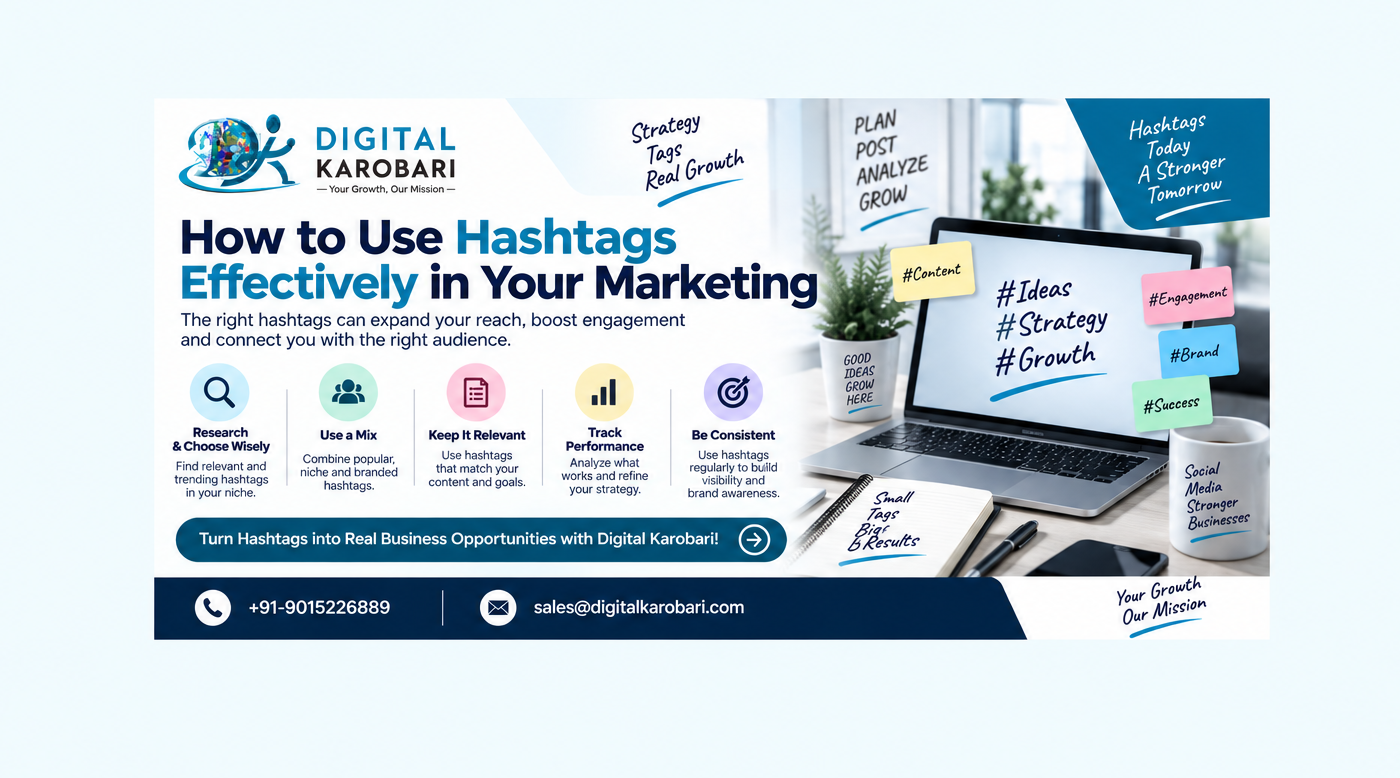
Hashtags are more than just words added to an Instagram or social media post. When used strategically, they can help businesses improve content discovery, reach relevant audiences and build stronger brand visibility.
For businesses in Mumbai, an effective hashtag strategy can be especially valuable. Whether you run a local restaurant, e-commerce brand, professional service, startup or established company, using relevant hashtags can help your content reach people who are genuinely interested in your products or services.
What Are Hashtags?
A hashtag is a word or phrase preceded by the # symbol, such as #DigitalMarketing or #SocialMediaMarketing. Hashtags categorize content and make it easier for users to discover posts related to specific topics.
For businesses, hashtags can support content discovery, brand awareness, campaign promotion, community building, and social media engagement.
Why Are Hashtags Important for Marketing?
Social media platforms contain millions of posts published every day. Relevant hashtags can help businesses make their content easier to discover by users searching for or following particular topics.
A well-planned hashtag strategy can help:
⦁ Improve content discoverability
⦁ Reach a more relevant audience
⦁ Increase brand awareness
⦁ Support social media campaigns
⦁ Build online communities
⦁ Promote events and offers
⦁ Organize branded content
⦁ Connect with industry conversations
Hashtags should complement good content rather than replace it.
- Choose Relevant Hashtags
The most important rule is relevance. Your hashtags should accurately describe your content, business, industry, or target audience.
For example, a digital marketing agency sharing an SEO tips post could consider hashtags such as:
#DigitalMarketing #SEO #SEOTips #ContentMarketing #MarketingStrategy
Avoid adding unrelated trending hashtags simply because they are popular. Irrelevant hashtags can attract the wrong audience and make your content appear less professional.
- Use a Combination of Hashtag Types
A strong strategy can combine different types of hashtags.
Branded Hashtags
These are unique to your business or campaign.
Examples:
#DigitalKarobari #DigitalKarobariTips
Branded hashtags can help organize your company’s content and encourage audiences to associate the hashtag with your brand.
Industry Hashtags
These relate directly to your industry.
Examples:
#DigitalMarketing #SEO #SocialMediaMarketing
Niche Hashtags
Niche hashtags target a narrower audience around a specific topic.
Examples:
#LocalSEOMarketing #SmallBusinessMarketing #B2BMarketing
Campaign Hashtags
Campaign-specific hashtags can be useful for promotions, contests, events, launches, and special campaigns.
Examples:
#DigitalMarketingWorkshop #MarketingCampaign
- Research Hashtags Before Using Them
Don’t select hashtags based solely on assumptions. Search the hashtag on the platform where you plan to publish and examine the type of content associated with it.
Look for:
⦁ Relevance to your content
⦁ Audience quality
⦁ Recent activity
⦁ Competition
⦁ Related hashtags
⦁ Content trends
The ideal hashtag is not necessarily the one with the largest number of posts. A more specific hashtag may help you reach a more relevant audience. - Understand Your Target Audience
Think about what your customers are likely to search for, follow, or discuss.
For example, if you are targeting small business owners, hashtags related to entrepreneurship, business growth, local marketing, and small business solutions may be more relevant than extremely broad marketing hashtags.
Understanding your audience helps you select hashtags based on intent rather than popularity. - Avoid Using Only Highly Popular Hashtags
Popular hashtags can expose your content to large audiences, but they can also be highly competitive.
Instead of relying entirely on broad hashtags such as #Marketing or #Business, combine them with more specific terms related to your niche.
For example:
Broad: #Marketing
Industry: #DigitalMarketing
Niche: #SmallBusinessMarketing
Topic: #SEOForSmallBusiness
This creates a more balanced hashtag strategy. - Create a Branded Hashtag
A branded hashtag can help build a recognizable social media identity.
For Digital Karobari, a branded hashtag such as #DigitalKarobari can be consistently used across relevant posts, campaigns, educational content, and business updates.
A branded hashtag should be:
⦁ Easy to remember
⦁ Relevant to your business
⦁ Easy to spell
⦁ Consistent across campaigns
⦁ Distinctive enough to identify your content - Don’t Use the Same Hashtags for Every Post
Copying and pasting an identical hashtag set into every social media post may limit your ability to target different audiences and topics.
Instead, create different hashtag groups for:
⦁ SEO content
⦁ Social media tips
⦁ Web development
⦁ Digital advertising
⦁ Business growth
⦁ Marketing education
⦁ Industry news
Then select hashtags that genuinely match each individual post. - Consider the Social Media Platform
For businesses targeting Mumbai customers, combining location and industry hashtags can be particularly effective. For example, a Mumbai-based fitness centre could use: #MumbaiFitness #FitnessIndia #MumbaiGym #FitnessTips #HealthyLifestyle Similarly, a digital marketing company could use: #DigitalMarketingMumbai #MumbaiDigitalMarketing #SEOCompanyMumbai #SocialMediaMarketingMumbai #DigitalMarketingIndia The combination helps communicate both what you do and where you operate. - Use Hashtags Naturally
Hashtags should not make your content difficult to read.
Instead of adding a long block of unrelated hashtags, choose a focused selection that supports the post.
For example:
“Want to improve your website’s search visibility? Explore these practical SEO tips for small businesses. #SEO #DigitalMarketing #SmallBusinessMarketing”
The hashtags complement the message without overwhelming the reader. - Track Hashtag Performance
A hashtag strategy should be measured rather than based on guesswork.
Depending on the platform’s analytics capabilities, monitor metrics such as:
⦁ Reach
⦁ Impressions
⦁ Engagement
⦁ Profile visits
⦁ Website traffic
⦁ Leads
⦁ Conversions
Compare different hashtag groups to identify which topics and approaches generate meaningful results.
Common Hashtag Mistakes to Avoid
Businesses often make several mistakes when using hashtags:
⦁ Using irrelevant hashtags
⦁ Adding hashtags only because they are trending
⦁ Using too many hashtags without a strategy
⦁ Using the same hashtag set for every post
⦁ Ignoring niche audiences
⦁ Creating difficult-to-remember branded hashtags
⦁ Focusing on hashtag quantity instead of relevance
⦁ Not tracking performance
⦁ Using hashtags that don’t match the target platform
Avoiding these mistakes can make your social media strategy more focused and professional.
Hashtags Are Only One Part of Your Marketing Strategy
Hashtags can improve content discovery, but they should be combined with other digital marketing activities.
An effective social media strategy should also include:
Quality Content + Audience Research + Consistent Posting + Engagement + Analytics + Paid Promotion Where Appropriate
Businesses should focus on providing useful content and building relationships with their audiences rather than depending entirely on hashtags for reach.
Final Thoughts
Hashtags can play an important role in improving social media discoverability, but they should be treated as part of a broader marketing strategy rather than a shortcut to viral content.
For Mumbai businesses, combining relevant industry hashtags, niche terms, location-based hashtags and branded hashtags can create a more targeted approach to social media marketing.
The key is simple: use hashtags that are relevant to your business, useful to your audience and aligned with your content.
With consistent testing and performance tracking, your hashtag strategy can become a valuable part of your digital marketing efforts in Mumbai and beyond.
Turn Your Hashtags Into a Smarter Marketing Strategy
Using hashtags strategically is just one part of building a successful digital presence. Digital Karobari helps businesses develop effective digital marketing strategies designed around their goals, audience, and industry.
Want to improve your social media reach and build a stronger online presence? Connect with Digital Karobari today and take your digital marketing strategy to the next level.
Plan Smart. Market Better. Grow Digitally with Digital Karobari.
Company Name: Digital Karobari
: https://digitalkarobari.
: +91-9015226889
FAQs
- How many hashtags should I use in a social media post?
There is no universal number that works for every platform or business. Focus on using a relevant selection rather than maximizing the number of hashtags. - Are hashtags still useful for marketing?
Yes. Hashtags can help categorize and discover content, although their effectiveness varies by platform and content type. They work best as part of a broader social media strategy. - Should businesses create their own branded hashtag?
Yes. A simple, memorable branded hashtag can help organize campaigns and make business-related content easier to identify. - Should I use trending hashtags?
Trending hashtags can be useful when they are genuinely relevant to your content. Avoid using unrelated trends simply to gain visibility. - Should I use the same hashtags on every post?
It is better to adapt hashtags according to the topic, audience, and objective of each post rather than using an identical set every time. - How can I find relevant hashtags?
Research hashtags directly on the social platform, review related terms, analyze competitor and industry content, and use platform-specific analytics or research tools where available. - Do hashtags guarantee higher engagement?
No. Hashtags may improve discoverability, but engagement depends on factors such as content quality, audience relevance, timing, creative format, and overall account strategy. - How do I know whether my hashtags are working?
Track available metrics such as reach, impressions, engagement, profile visits, website traffic, leads, and conversions, and compare results across different hashtag approaches.