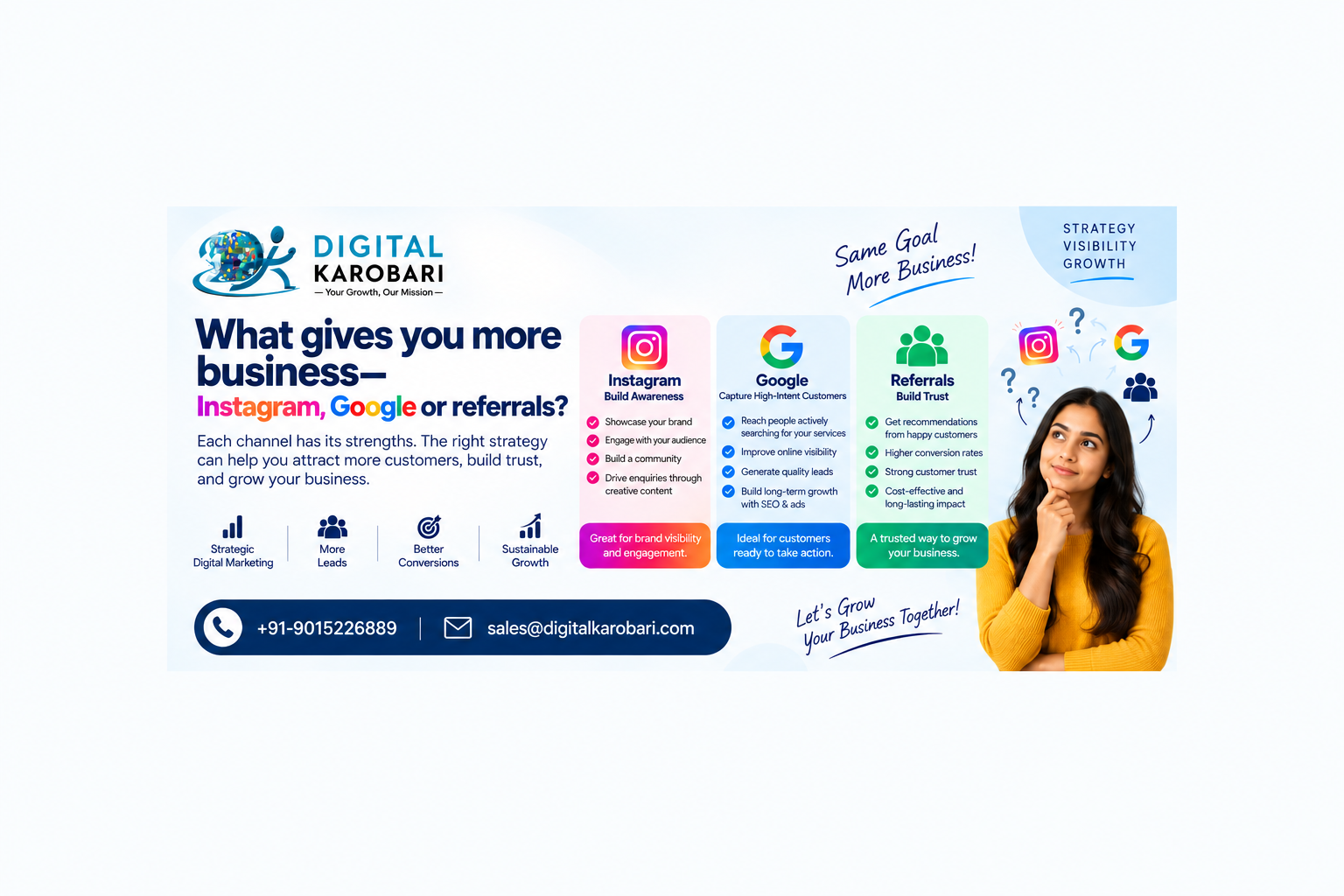
In today’s competitive business environment, getting customers requires more than simply being visible online. Businesses often ask: What brings more business—Instagram, Google, or referrals? The answer depends on your industry, target audience, location, and marketing strategy.
At Digital Karobari, we believe each channel plays a different role in the customer journey. Instagram can create awareness, Google can capture high-intent searches, and referrals can build trust. The right combination can help businesses generate consistent leads and long-term growth.
Instagram: Build Awareness and Connect With Customers 📱
Instagram is a powerful platform for businesses that rely on visual content, engagement, and brand awareness. Through posts, Reels, Stories, and other content formats, businesses can showcase their products, services, expertise, and customer experiences.
Instagram can help you:
Increase brand awareness
Engage directly with potential customers
Showcase products and services
Build a community around your brand
Generate enquiries through social media
Strengthen customer relationships
However, Instagram followers don’t automatically become customers. Your content needs to be relevant, consistent, and connected to a clear conversion strategy.
Google: Reach Customers Who Are Already Searching 🔎
Google is particularly valuable because people often use it when they already have a requirement.
For example, someone searching for “digital marketing agency near me” or “best printing services in Mumbai” is actively looking for a solution.
SEO, Google Business Profile optimization, Google Ads, and high-quality website content can help your business appear when potential customers are searching.
Google can help businesses:
✅ Capture high-intent leads
✅ Improve online visibility
✅ Generate website traffic
✅ Increase local enquiries
✅ Build long-term organic visibility
✅ Reach customers at the right stage of their buying journey
For businesses targeting customers who are actively searching for their services, Google can be one of the most valuable acquisition channels.
Referrals: Turn Trust Into New Business 🤝
Referrals are one of the oldest and most effective ways to acquire customers. When an existing customer recommends your business to someone they know, you’re starting the conversation with a level of trust already established.
A strong referral can lead to:
Higher-quality prospects
Increased customer trust
Better conversion opportunities
Lower customer acquisition costs
Stronger business relationships
The challenge is that referrals can be difficult to predict and scale consistently. That’s why businesses should encourage satisfied customers to recommend their services while also building their digital presence.
So, Which One Gives You More Business?
There isn’t one universal answer.
📱 Instagram is excellent for awareness, engagement, and community building.
🔎 Google is powerful for reaching people actively searching for your products or services.
🤝 Referrals are valuable for trust, credibility, and relationship-driven growth.
Instead of choosing only one, businesses can create a marketing ecosystem where these channels support each other.
For example, a customer may discover your business on Instagram, search for your company on Google, visit your website, and finally choose you because someone they trust recommended your services.
The Best Strategy Is a Combination
A successful digital marketing strategy should focus on the complete customer journey.
Instagram → Awareness
⬇️
Google → Discovery & Intent
⬇️
Website → Information & Conversion
⬇️
Customer Experience → Trust
⬇️
Referrals → New Customers
This creates multiple opportunities for people to discover and choose your business.
How Digital Karobari Can Help
At Digital Karobari, we help businesses strengthen their digital presence through strategic marketing solutions. Instead of focusing only on likes, followers, or website traffic, the goal should be to generate meaningful enquiries and business opportunities.
A well-planned strategy can combine SEO, Google Business Profile optimization, social media marketing, content marketing, paid advertising, and conversion-focused strategies to help your business reach the right audience.
🚀 Ready to Find Your Best Source of Business?
Don’t guess which marketing channel works best—measure it, optimize it, and grow it.
Digital Karobari can help you identify the right mix of Google, Instagram, referrals, SEO, and digital marketing strategies for your business.
📩 Get in touch with Digital Karobari today and build a marketing strategy designed to turn visibility into real business.
Company Name: Digital Karobari
🌐: https://digitalkarobari.
📞: +91-9015226889
FAQs
- Is Instagram better than Google for business?
Not necessarily. Instagram is excellent for brand awareness and engagement, while Google can capture customers who are actively searching for a product or service. The better channel depends on your business and target audience. - Are referrals still important for businesses?
Yes. Referrals can generate highly trusted leads because prospects often receive recommendations from people they already know. - Which platform gives the fastest leads?
Paid Google Ads and social media advertising can generate leads quickly, while SEO and organic social media generally require more time to build consistent results. - Can a business use Instagram and Google together?
Absolutely. Instagram can introduce your brand to potential customers, while Google can help them find your website, reviews, location, or services when they are ready to take action. - How can I get more referrals?
Deliver excellent customer experiences, maintain strong relationships, request reviews, and make it easy for satisfied customers to recommend your business. - Should I focus on SEO or social media marketing?
Ideally, businesses should evaluate both based on their goals. SEO can provide long-term search visibility, while social media can help build awareness and engagement. - How can Digital Karobari help my business grow?
Digital Karobari can help create a customized digital marketing strategy focused on improving visibility, attracting relevant audiences, generating leads, and supporting business growth.