Blog

  • How to Use Hashtags Effectively in Your Marketing Strategy in Mumbai

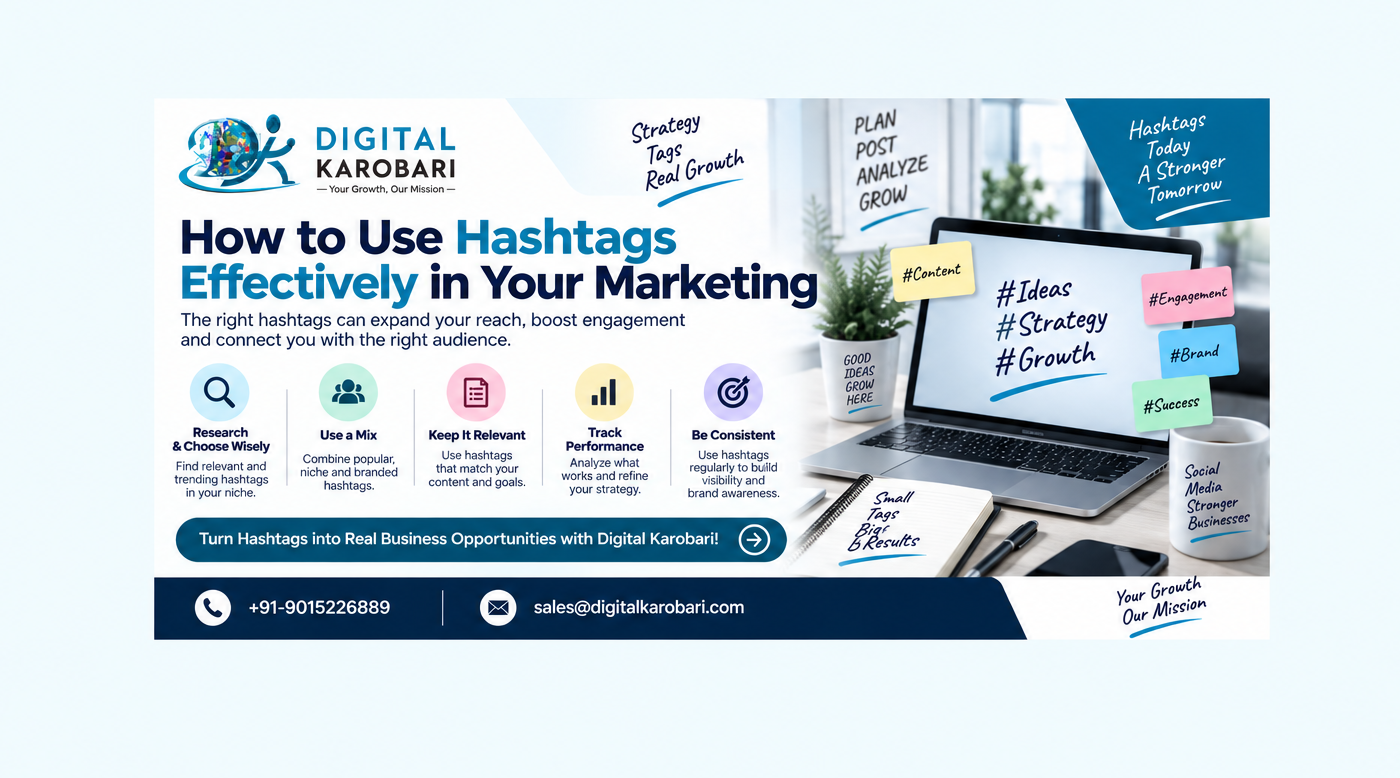
    How to Use Hashtags Effectively in Your Marketing Strategy in Mumbai

    Hashtags are more than just words added to an Instagram or social media post. When used strategically, they can help businesses improve content discovery, reach relevant audiences and build stronger brand visibility.

    For businesses in Mumbai, an effective hashtag strategy can be especially valuable. Whether you run a local restaurant, e-commerce brand, professional service, startup or established company, using relevant hashtags can help your content reach people who are genuinely interested in your products or services.

    What Are Hashtags?

    A hashtag is a word or phrase preceded by the # symbol, such as #DigitalMarketing or #SocialMediaMarketing. Hashtags categorize content and make it easier for users to discover posts related to specific topics.
    For businesses, hashtags can support content discovery, brand awareness, campaign promotion, community building, and social media engagement.

    Why Are Hashtags Important for Marketing?

    Social media platforms contain millions of posts published every day. Relevant hashtags can help businesses make their content easier to discover by users searching for or following particular topics.
    A well-planned hashtag strategy can help:
    ⦁ Improve content discoverability
    ⦁ Reach a more relevant audience
    ⦁ Increase brand awareness
    ⦁ Support social media campaigns
    ⦁ Build online communities
    ⦁ Promote events and offers
    ⦁ Organize branded content
    ⦁ Connect with industry conversations
    Hashtags should complement good content rather than replace it.

    1. Choose Relevant Hashtags
      The most important rule is relevance. Your hashtags should accurately describe your content, business, industry, or target audience.
      For example, a digital marketing agency sharing an SEO tips post could consider hashtags such as:

    #DigitalMarketing #SEO #SEOTips #ContentMarketing #MarketingStrategy
    Avoid adding unrelated trending hashtags simply because they are popular. Irrelevant hashtags can attract the wrong audience and make your content appear less professional.

    1. Use a Combination of Hashtag Types
      A strong strategy can combine different types of hashtags.
      Branded Hashtags
      These are unique to your business or campaign.
      Examples:

    #DigitalKarobari #DigitalKarobariTips
    Branded hashtags can help organize your company’s content and encourage audiences to associate the hashtag with your brand.
    Industry Hashtags
    These relate directly to your industry.
    Examples:
    #DigitalMarketing #SEO #SocialMediaMarketing
    Niche Hashtags
    Niche hashtags target a narrower audience around a specific topic.
    Examples:
    #LocalSEOMarketing #SmallBusinessMarketing #B2BMarketing
    Campaign Hashtags
    Campaign-specific hashtags can be useful for promotions, contests, events, launches, and special campaigns.
    Examples:
    #DigitalMarketingWorkshop #MarketingCampaign

    1. Research Hashtags Before Using Them
      Don’t select hashtags based solely on assumptions. Search the hashtag on the platform where you plan to publish and examine the type of content associated with it.
      Look for:
      ⦁ Relevance to your content
      ⦁ Audience quality
      ⦁ Recent activity
      ⦁ Competition
      ⦁ Related hashtags
      ⦁ Content trends
      The ideal hashtag is not necessarily the one with the largest number of posts. A more specific hashtag may help you reach a more relevant audience.
    2. Understand Your Target Audience
      Think about what your customers are likely to search for, follow, or discuss.
      For example, if you are targeting small business owners, hashtags related to entrepreneurship, business growth, local marketing, and small business solutions may be more relevant than extremely broad marketing hashtags.
      Understanding your audience helps you select hashtags based on intent rather than popularity.
    3. Avoid Using Only Highly Popular Hashtags
      Popular hashtags can expose your content to large audiences, but they can also be highly competitive.
      Instead of relying entirely on broad hashtags such as #Marketing or #Business, combine them with more specific terms related to your niche.
      For example:
      Broad: #Marketing
      Industry: #DigitalMarketing
      Niche: #SmallBusinessMarketing
      Topic: #SEOForSmallBusiness
      This creates a more balanced hashtag strategy.
    4. Create a Branded Hashtag
      A branded hashtag can help build a recognizable social media identity.
      For Digital Karobari, a branded hashtag such as #DigitalKarobari can be consistently used across relevant posts, campaigns, educational content, and business updates.
      A branded hashtag should be:
      ⦁ Easy to remember
      ⦁ Relevant to your business
      ⦁ Easy to spell
      ⦁ Consistent across campaigns
      ⦁ Distinctive enough to identify your content
    5. Don’t Use the Same Hashtags for Every Post
      Copying and pasting an identical hashtag set into every social media post may limit your ability to target different audiences and topics.
      Instead, create different hashtag groups for:
      ⦁ SEO content
      ⦁ Social media tips
      ⦁ Web development
      ⦁ Digital advertising
      ⦁ Business growth
      ⦁ Marketing education
      ⦁ Industry news
      Then select hashtags that genuinely match each individual post.
    6. Consider the Social Media Platform
      For businesses targeting Mumbai customers, combining location and industry hashtags can be particularly effective. For example, a Mumbai-based fitness centre could use: #MumbaiFitness #FitnessIndia #MumbaiGym #FitnessTips #HealthyLifestyle Similarly, a digital marketing company could use: #DigitalMarketingMumbai #MumbaiDigitalMarketing #SEOCompanyMumbai #SocialMediaMarketingMumbai #DigitalMarketingIndia The combination helps communicate both what you do and where you operate.
    7. Use Hashtags Naturally
      Hashtags should not make your content difficult to read.
      Instead of adding a long block of unrelated hashtags, choose a focused selection that supports the post.
      For example:
      “Want to improve your website’s search visibility? Explore these practical SEO tips for small businesses. #SEO #DigitalMarketing #SmallBusinessMarketing”
      The hashtags complement the message without overwhelming the reader.
    8. Track Hashtag Performance
      A hashtag strategy should be measured rather than based on guesswork.
      Depending on the platform’s analytics capabilities, monitor metrics such as:
      ⦁ Reach
      ⦁ Impressions
      ⦁ Engagement
      ⦁ Profile visits
      ⦁ Website traffic
      ⦁ Leads
      ⦁ Conversions
      Compare different hashtag groups to identify which topics and approaches generate meaningful results.

    Common Hashtag Mistakes to Avoid

    Businesses often make several mistakes when using hashtags:
    ⦁ Using irrelevant hashtags
    ⦁ Adding hashtags only because they are trending
    ⦁ Using too many hashtags without a strategy
    ⦁ Using the same hashtag set for every post
    ⦁ Ignoring niche audiences
    ⦁ Creating difficult-to-remember branded hashtags
    ⦁ Focusing on hashtag quantity instead of relevance
    ⦁ Not tracking performance
    ⦁ Using hashtags that don’t match the target platform
    Avoiding these mistakes can make your social media strategy more focused and professional.

    Hashtags Are Only One Part of Your Marketing Strategy

    Hashtags can improve content discovery, but they should be combined with other digital marketing activities.
    An effective social media strategy should also include:
    Quality Content + Audience Research + Consistent Posting + Engagement + Analytics + Paid Promotion Where Appropriate
    Businesses should focus on providing useful content and building relationships with their audiences rather than depending entirely on hashtags for reach.

    Final Thoughts

    Hashtags can play an important role in improving social media discoverability, but they should be treated as part of a broader marketing strategy rather than a shortcut to viral content.

    For Mumbai businesses, combining relevant industry hashtags, niche terms, location-based hashtags and branded hashtags can create a more targeted approach to social media marketing.

    The key is simple: use hashtags that are relevant to your business, useful to your audience and aligned with your content.

    With consistent testing and performance tracking, your hashtag strategy can become a valuable part of your digital marketing efforts in Mumbai and beyond.

    Turn Your Hashtags Into a Smarter Marketing Strategy

    Using hashtags strategically is just one part of building a successful digital presence. Digital Karobari helps businesses develop effective digital marketing strategies designed around their goals, audience, and industry.
    Want to improve your social media reach and build a stronger online presence? Connect with Digital Karobari today and take your digital marketing strategy to the next level.
    Plan Smart. Market Better. Grow Digitally with Digital Karobari.
    Company Name: Digital Karobari
    : https://digitalkarobari.
    : +91-9015226889

    FAQs

    1. How many hashtags should I use in a social media post?
      There is no universal number that works for every platform or business. Focus on using a relevant selection rather than maximizing the number of hashtags.
    2. Are hashtags still useful for marketing?
      Yes. Hashtags can help categorize and discover content, although their effectiveness varies by platform and content type. They work best as part of a broader social media strategy.
    3. Should businesses create their own branded hashtag?
      Yes. A simple, memorable branded hashtag can help organize campaigns and make business-related content easier to identify.
    4. Should I use trending hashtags?
      Trending hashtags can be useful when they are genuinely relevant to your content. Avoid using unrelated trends simply to gain visibility.
    5. Should I use the same hashtags on every post?
      It is better to adapt hashtags according to the topic, audience, and objective of each post rather than using an identical set every time.
    6. How can I find relevant hashtags?
      Research hashtags directly on the social platform, review related terms, analyze competitor and industry content, and use platform-specific analytics or research tools where available.
    7. Do hashtags guarantee higher engagement?
      No. Hashtags may improve discoverability, but engagement depends on factors such as content quality, audience relevance, timing, creative format, and overall account strategy.
    8. How do I know whether my hashtags are working?
      Track available metrics such as reach, impressions, engagement, profile visits, website traffic, leads, and conversions, and compare results across different hashtag approaches.
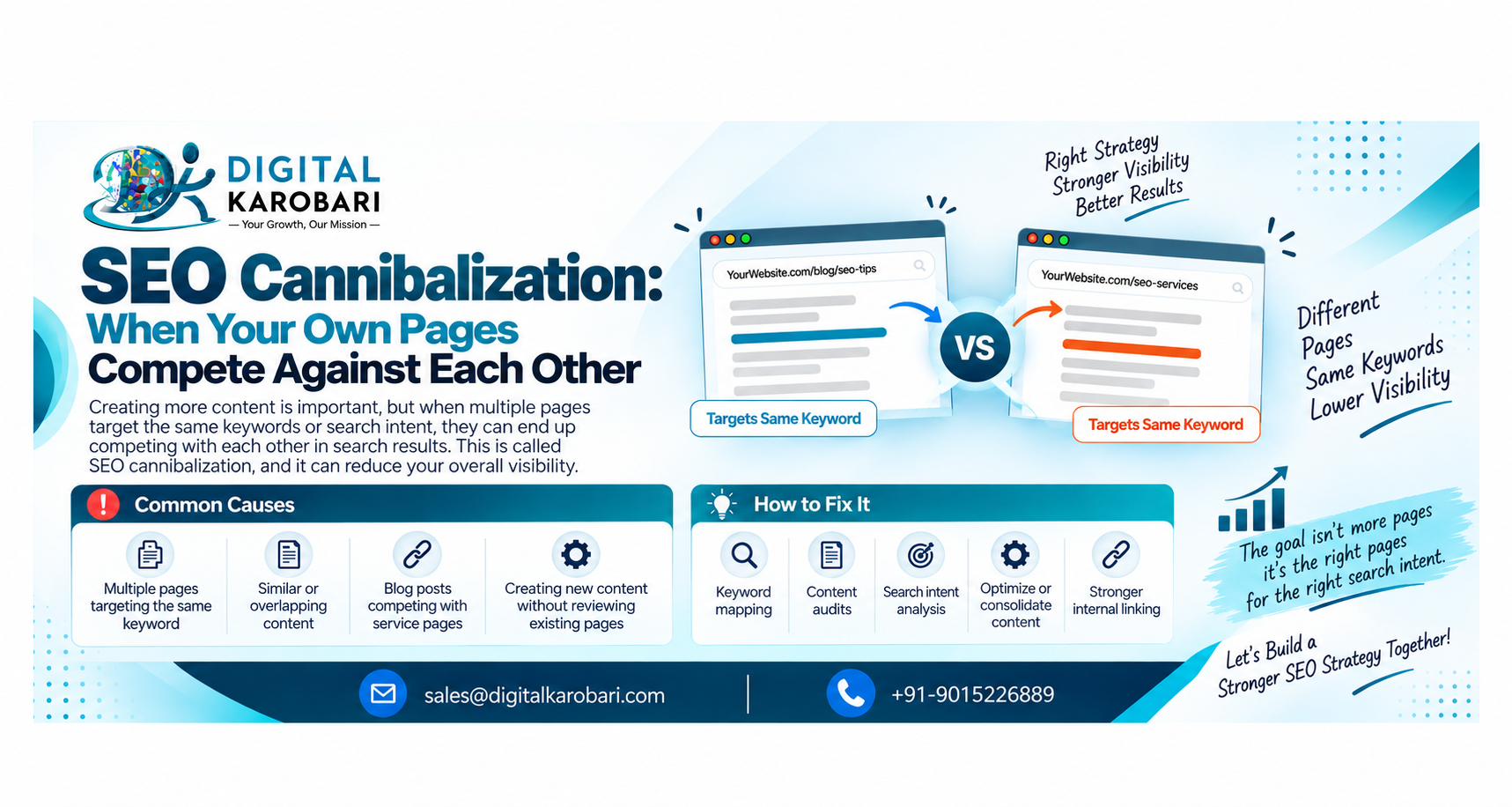
  • SEO Cannibalization: When Your Own Pages Compete Against Each Other

    SEO Cannibalization: When Your Own Pages Compete Against Each Other

    Introduction

    SEO is often treated as a competition between your website and other websites. But sometimes, the competition is happening inside your own website. When multiple pages target the same or very similar keywords and satisfy the same search intent, they can compete for visibility in search results. This situation is commonly known as SEO keyword cannibalization.
    For businesses investing in content marketing and SEO, this can become a serious issue when an older article, service page, category page, or newer blog post starts ranking for the same search intent. Instead of concentrating relevance and authority on the strongest page, your website may have several competing URLs.
    The solution isn’t simply to delete pages or remove keywords. A proper SEO audit should determine whether the pages genuinely compete, which page best satisfies the searcher’s intent, and whether the content should be consolidated, differentiated, redirected, or retained.

    What Is SEO Keyword Cannibalization?

    Keyword cannibalization occurs when two or more pages on the same website target the same or closely related search queries and satisfy substantially the same search intent.
    For example, imagine a digital marketing website has these two blog posts:
    Best SEO Strategies for Small Businesses
    SEO Tips for Small Businesses
    If both pages provide almost the same information and target essentially the same audience and search intent, they may compete with each other.
    However, simply having two pages that mention the same keyword does not automatically mean there is cannibalization. A website can legitimately have multiple pages ranking for related terms when those pages serve different purposes.
    The key question is:
    Are the pages targeting the same keyword AND trying to satisfy the same user intent?
    If yes, you should investigate further.

    Why Does Keyword Cannibalization Happen?

    Cannibalization often develops gradually as a website grows.

    1. Publishing Similar Blog Posts
      A business may publish several articles around the same subject without maintaining a keyword map.
      For example:
      SEO guide for beginners
      SEO basics for beginners
      Beginner’s guide to SEO
      How to start SEO
      If these articles answer essentially the same questions, their purposes may overlap.
    2. Creating Multiple Pages for Similar Services
      Businesses sometimes create separate pages targeting variations such as:
      Digital Marketing Services
      Digital Marketing Agency
      Digital Marketing Company
      Online Marketing Services
      If the pages contain almost identical content and serve the same intent, they need to be reviewed.
    3. Updating Content Without Reviewing Existing URLs
      A new article may be created because an older article appears outdated. Instead of updating the original page, a completely new URL is published.
      This can create two pages competing for the same audience.
    4. Location-Based Pages
      Local businesses can unintentionally create pages with nearly identical content for different locations.
      For example:
      Digital Marketing Agency Mumbai
      Digital Marketing Agency Andheri
      Digital Marketing Agency Navi Mumbai
      Location pages should have a genuine purpose and useful local differentiation rather than simply changing the location name.
    5. E-commerce Product and Category Pages
      E-commerce websites can have hundreds or thousands of URLs targeting similar product terms. Similar product names, filters, categories and variations can create significant overlap.

    How Keyword Cannibalization Can Affect SEO

    When genuine cannibalization exists, several problems can appear.
    Ranking Instability
    Google may choose different URLs for the same search query at different times. This can make it difficult to determine which page should receive organic visibility.
    Lower Organic Performance
    Instead of having one highly relevant page focused on a specific intent, multiple pages may compete for the same opportunity.
    Lower Click-Through Rates
    If search visibility is split between several pages, the page you actually want users to visit may not receive the expected clicks.
    Wrong Page Ranking
    One of the most frustrating situations is when Google ranks an old blog post instead of your newer service or landing page.
    For example, you may want your SEO service page to rank for a commercial query, but an informational blog post starts appearing instead.
    Wasted SEO Effort
    Your SEO team may continue creating backlinks, updating content and optimizing several URLs without realizing that the pages are competing for the same intent.

    How to Identify SEO Cannibalization

    The first step is to avoid assumptions. Multiple URLs appearing for the same keyword isn’t automatically proof of a problem. Look for overlapping intent and evidence of poor performance.

    1. Use Google Search Console
      Google Search Console can help you determine which URLs receive impressions and clicks for particular queries.
      Look for situations where:
      Multiple URLs receive impressions for the same query
      The ranking URL frequently changes
      The wrong URL receives most impressions
      Several pages have similar content and search intent
      One page has strong potential but another URL ranks instead
    2. Perform a Site Search
      A simple search can reveal potentially overlapping pages.
      Search Google using:
      site:yourdomain.com “target keyword”
      This can show which pages on your website contain and potentially target that topic. However, this is only an initial discovery method—it doesn’t prove cannibalization by itself.
    3. Compare Search Intent
      Open the competing pages and ask:
      Would the same person searching this keyword be equally satisfied with either page?
      If the answer is yes, you may have a genuine cannibalization opportunity.
    4. Check Historical Rankings
      Look at how different URLs have performed for the same query over time. If several pages repeatedly switch positions or compete for the same search intent, further investigation is worthwhile.

    How to Fix Keyword Cannibalization

    There isn’t one universal solution. The right action depends on why the pages overlap.

    1. Consolidate Similar Content
      If two articles provide almost the same information, consider combining them into one stronger resource.
      The stronger URL can contain the most useful information from both pages.
      If the old URL no longer needs to exist separately, a properly implemented 301 redirect can send users and search engines to the consolidated page.
      Example:
      Page A: SEO Tips for Small Businesses
      Page B: SEO Strategies for Small Businesses
      Instead of maintaining two nearly identical articles, create one comprehensive resource:
      SEO Strategies and Tips for Small Businesses
    2. Differentiate Search Intent
      Sometimes both pages are valuable and should remain separate.
      In that situation, give each page a distinct purpose.
      For example:
      Page 1:
      SEO Services for Small Businesses → commercial intent
      Page 2:
      SEO Guide for Small Businesses → informational intent
      Now each page has a clearer role.
    3. Improve Internal Linking
      Internal links can help establish relationships between important pages.
      For example, a blog article about SEO strategies can naturally link to your relevant SEO service page using descriptive, contextually appropriate anchor text.
      This helps users navigate your website while creating a clearer site structure.
    4. Update or Remove Outdated Content
      If an old article is no longer useful and substantially overlaps with a newer resource, consider whether it should be updated, consolidated or redirected.
      Don’t delete pages simply because they share a keyword. First evaluate their traffic, backlinks, rankings, conversions and unique value.
    5. Create a Keyword Mapping Strategy
      Prevention is better than repeatedly fixing cannibalization.
      Before publishing a new article, identify:
      Primary keyword
      Secondary keywords
      Search intent
      Target URL
      Existing pages covering the topic
      Internal linking opportunities
      A simple keyword map can prevent multiple pages from being created for the same purpose.

    Keyword Cannibalization vs Duplicate Content

    These concepts are related but not identical.
    Duplicate content generally refers to substantially similar content appearing across multiple URLs.
    Keyword cannibalization is primarily about multiple pages competing for the same or closely related search intent.
    You can have two pages with different content that still compete because they target the same underlying intent. Conversely, multiple pages can mention the same keyword without causing a meaningful cannibalization problem if they serve different purposes.

    Is Keyword Cannibalization Always Bad?

    No.
    This is one of the most important points to understand.
    If two pages rank for the same search query but serve different purposes and collectively generate valuable traffic, there may be no reason to consolidate them.
    For example, an informational article and a commercial service page may both rank for related searches while serving different stages of the customer journey.
    The goal isn’t to force one keyword = one page in every situation.
    The goal is:
    One clear search intent should have one clearly prioritized page whenever multiple competing URLs are hurting performance.
    This intent-based approach is more useful than blindly removing keywords from pages.

    How to Prevent SEO Cannibalization

    Create a Keyword Map
    Assign a primary keyword and search intent to important URLs before creating new content.
    Audit Existing Content
    Regularly review older articles and identify pages covering substantially the same topic.
    Avoid Publishing Similar Articles
    Before creating a new article, search your own website to see whether the topic already exists.
    Build Topic Clusters Carefully
    A pillar page and supporting articles can work together when each page answers a different question.
    Track Search Console Data
    Don’t rely only on keyword rankings. Monitor impressions, clicks, URLs, queries and conversions.
    Review Content Before Creating More
    Sometimes the best SEO opportunity isn’t another new article. It may be improving an existing page that already has authority and visibility.

    Final Thoughts

    SEO cannibalization isn’t simply about having the same keyword on multiple pages. The real issue is overlapping search intent combined with evidence that the pages are competing in a way that limits organic performance.
    For businesses, the solution starts with a detailed content and keyword audit. Identify which pages are competing, understand what users actually want, choose the strongest page for the intent, and then consolidate or differentiate content where appropriate.
    A well-organized website doesn’t need hundreds of pages targeting slightly different versions of the same keyword. It needs clear, useful pages that each have a defined purpose.

    Is Your Website Competing Against Itself?

    Your SEO problem may not always be a lack of content. Sometimes, you already have too many pages targeting the same search intent.
    Digital Karobari can help you audit your website, identify competing pages, refine keyword targeting and build a stronger content structure designed around search intent and business goals.
    Ready to find and fix your SEO cannibalization issues? Contact Digital Karobari today and turn your existing content into a stronger organic growth opportunity.
    Company Name: Digital Karobari
    🌐: https://digitalkarobari.
    📞: +91-9015226889

    FAQs

    1. What is SEO keyword cannibalization?
      SEO keyword cannibalization occurs when multiple pages on the same website target the same or closely related search intent and compete for search visibility.
    2. Is keyword cannibalization always harmful?
      No. Multiple pages can rank for related keywords without creating a problem if they satisfy different search intents and contribute positively to overall organic performance.
    3. How can I find keyword cannibalization?
      You can review Google Search Console, compare ranking URLs for important queries, perform site: searches and analyze whether multiple pages satisfy the same search intent.
    4. Should I delete pages that target the same keyword?
      Not automatically. First check traffic, backlinks, rankings, conversions, content quality and search intent. The pages may serve different purposes.
    5. Can keyword cannibalization lower Google rankings?
      It can contribute to weaker organic performance when multiple pages compete for the same intent and prevent the strongest page from gaining the visibility it could otherwise achieve.
    6. Should I merge two pages with similar content?
      If the pages substantially overlap and one consolidated resource would better satisfy the search intent, merging can be a strong solution.
    7. What is the difference between cannibalization and duplicate content?
      Duplicate content concerns substantially similar content across URLs, while cannibalization concerns competing pages targeting the same or similar search intent. They can overlap, but they are not the same issue.
    8. Does using the same keyword on multiple pages cause cannibalization?
      No. Simply mentioning or ranking for the same keyword isn’t enough. The more important question is whether the pages target the same intent and whether this overlap is negatively affecting organic performance.
    9. Can internal linking help prevent cannibalization?
      Yes. A logical internal-linking structure can help establish relationships between pages and guide users toward the most relevant resources, although internal links alone don’t solve every cannibalization issue.
    10. How often should a website check for keyword cannibalization?
      For an actively growing website, include cannibalization checks as part of regular SEO and content audits. High-priority commercial keywords should be monitored more frequently.
  • The New Digital Workforce: Humans, Automation and AI Working Together

    The New Digital Workforce: Humans, Automation and AI Working Together

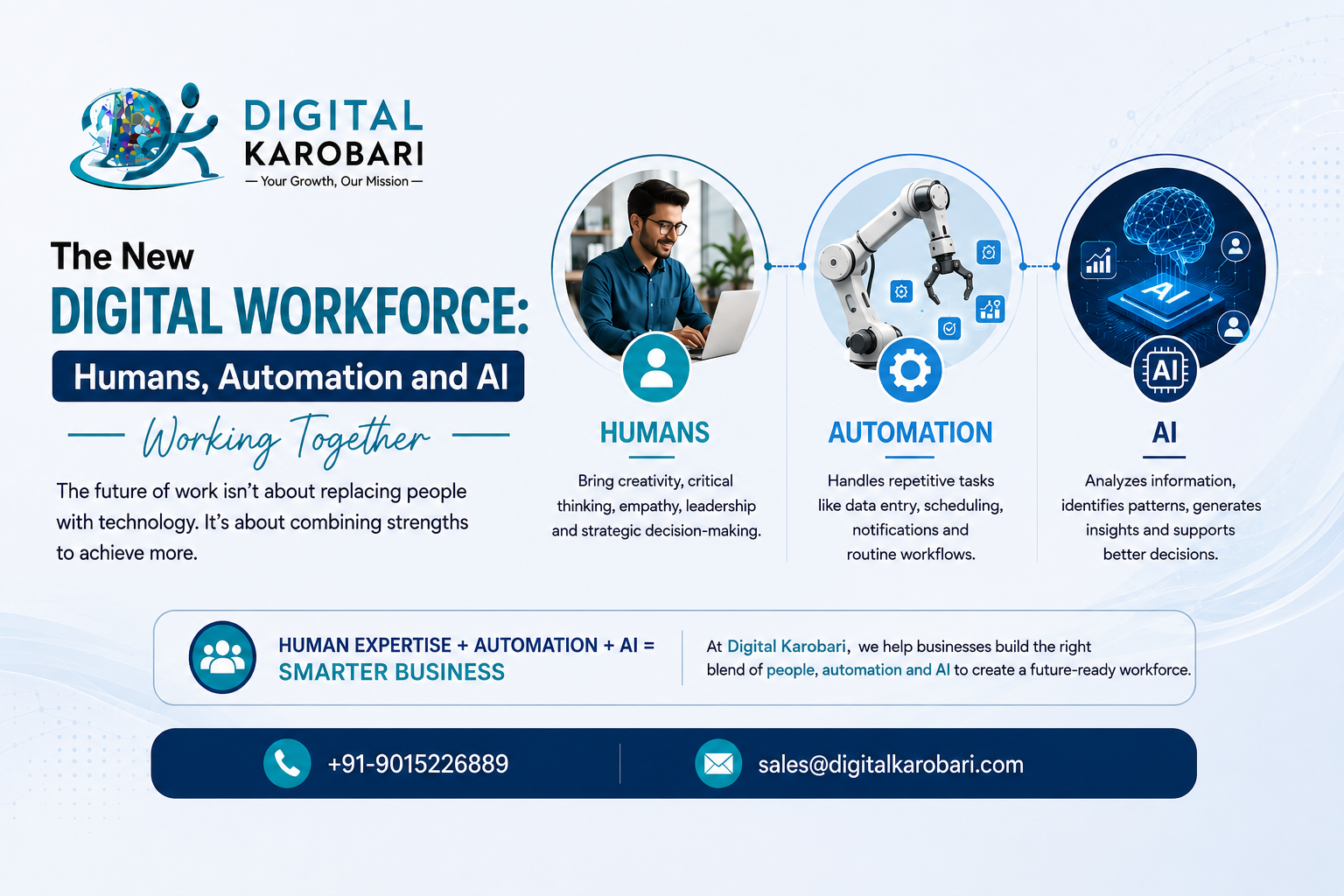
    The workplace is changing faster than ever. Businesses are no longer relying only on human employees to complete everyday tasks. Automation tools, artificial intelligence, cloud platforms and intelligent software are becoming part of the modern workforce.
    But the future of work is not simply about replacing people with machines. The bigger opportunity is bringing humans, automation and AI together so each can do what it does best.
    For businesses, this shift can create faster workflows, better customer experiences, improved decision-making and greater productivity. At the same time, it requires organizations to rethink how teams work, which skills they need and where technology should fit into their operations.

    What Is the New Digital Workforce?

    The new digital workforce is a combination of human employees, automated systems and AI-powered tools working together to achieve business objectives.
    Humans bring creativity, judgment, emotional intelligence, strategic thinking and relationship-building. Automation handles repetitive and rule-based processes. AI can analyze information, identify patterns, generate content, assist with decisions and support employees with complex tasks.
    Instead of thinking about these technologies as replacements for employees, businesses can treat them as digital teammates.
    For example, a sales team could use automation to organize leads, AI to summarize customer interactions and human employees to build relationships and close important deals.

    Humans Still Bring What Technology Cannot Easily Replicate

    Technology can process information at incredible speed, but business decisions often require context.
    A human employee can understand a customer’s frustration, recognize an unusual situation, negotiate with a partner or make a judgment when there is no straightforward answer.
    Human strengths include:
    ⦁ Creativity and original thinking
    ⦁ Emotional intelligence
    ⦁ Leadership
    ⦁ Critical thinking
    ⦁ Relationship building
    ⦁ Strategic decision-making
    ⦁ Ethical judgment
    ⦁ Understanding cultural and business context
    The goal of digital transformation should therefore not be to remove humans from the process. It should be to remove unnecessary work from humans.

    Automation Takes Care of Repetitive Work

    Many employees spend valuable time performing repetitive activities that follow predictable patterns.
    Automation can help businesses handle tasks such as:
    ⦁ Data entry
    ⦁ Appointment scheduling
    ⦁ Email notifications
    ⦁ Report generation
    ⦁ Invoice processing
    ⦁ Lead routing
    ⦁ Customer follow-ups
    ⦁ File organization
    ⦁ Workflow approvals
    When repetitive tasks are automated, employees can spend more time on activities that require communication, creativity and problem-solving.
    This can make technology a productivity multiplier rather than simply another software expense.

    AI Adds a New Layer of Intelligence

    Traditional automation generally follows predefined rules.
    AI can go further by helping systems work with information, recognize patterns and generate useful outputs.
    For example, an AI-powered system could help a business:
    ⦁ Summarize large amounts of information
    ⦁ Analyze customer feedback
    ⦁ Draft business communications
    ⦁ Identify trends
    ⦁ Assist customer service teams
    ⦁ Support marketing research
    ⦁ Generate reports
    ⦁ Help employees find information faster
    However, AI should not automatically be treated as the final decision-maker.
    Human oversight remains important, particularly when decisions involve customers, finances, employees, confidential information or business strategy.

    The Best Model Is Human + Automation + AI

    The most effective digital workforce is not a competition between people and technology.
    It is a collaborative model.
    Consider a customer-support operation.
    Human: Understands complex customer problems and handles sensitive conversations.
    Automation: Routes tickets, sends notifications and performs routine follow-ups.
    AI: Summarizes conversations, suggests responses and identifies recurring issues.
    Together, these three components can create a faster and more responsive customer-support system.
    The same approach can work across marketing, sales, finance, operations, HR and management.

    Businesses Need to Redesign Jobs, Not Just Automate Them

    One of the biggest mistakes businesses can make is adding AI or automation without changing the way work is organized.
    Simply introducing a new tool does not automatically create productivity.
    Businesses should first identify:
    ⦁ Which tasks consume the most employee time?
    ⦁ Which activities are repetitive?
    ⦁ Which decisions require human judgment?
    ⦁ Which processes generate unnecessary delays?
    ⦁ Where could AI provide useful assistance?
    ⦁ Which tasks should remain completely human-led?
    The answers can help organizations create better workflows instead of simply adding more technology to existing processes.

    New Technology Requires New Skills

    As automation takes over repetitive activities, employees may need to develop stronger skills in areas that technology cannot easily replace.
    Future-ready employees may need a combination of:
    ⦁ AI literacy
    ⦁ Data interpretation
    ⦁ Communication
    ⦁ Problem-solving
    ⦁ Critical thinking
    ⦁ Digital collaboration
    ⦁ Creativity
    ⦁ Strategic thinking
    ⦁ Technology awareness
    This means businesses should not view employee training as an optional activity. Upskilling can become an important part of digital transformation.

    The New Competitive Advantage

    Technology itself is becoming easier to access.
    Businesses can purchase AI tools, automation platforms and cloud software without necessarily building everything from scratch.
    The real competitive advantage may therefore come from how effectively a company combines technology with its people and processes.
    Two businesses may use similar AI tools but achieve very different results because one has better processes, better data, better employee training and clearer strategic goals.
    The future belongs to organizations that understand that digital transformation is not just a technology project.
    It is a workforce transformation project.

    What Businesses Should Do Now

    Businesses don’t need to automate everything at once.
    A practical approach is to start small.
    Identify one repetitive process, measure how much time it consumes, determine whether automation or AI can improve it, implement the solution and measure the results.
    Then expand gradually.
    The objective isn’t to use the most technology.
    The objective is to create a workplace where people spend more time doing valuable work and technology handles more of the work that slows them down.

    The Future Is Collaboration, Not Replacement

    The conversation around AI often focuses on whether machines will replace human workers.
    A more useful question is:
    What could employees accomplish if technology removed the repetitive work holding them back?
    The new digital workforce will increasingly combine human creativity and judgment with automation and AI-powered assistance.
    Businesses that embrace this model can build more efficient operations while allowing their people to focus on the work that requires uniquely human capabilities.
    The future of work isn’t simply humans versus machines.
    It is humans working with machines.

    Ready to Build a Smarter Digital Workforce?

    Digital transformation is not about replacing your people with technology. It is about giving your team better tools to work smarter, faster and more efficiently.
    Partner with Digital Karobari to explore how AI, automation and digital solutions can help transform your business.
    Company Name: Digital Karobari
    : https://digitalkarobari.
    : +91-9015226889

    FAQs

    1. What is the new digital workforce?
      The new digital workforce combines human employees with automation, AI and digital technologies to improve productivity and business operations.
    2. Will AI replace human employees?
      AI can automate certain tasks, but many business activities still require human judgment, creativity, communication and emotional intelligence. In many cases, AI is more useful as an employee-support tool.
    3. How can automation help businesses?
      Automation can handle repetitive and rule-based tasks such as data entry, notifications, scheduling, reporting and workflow management, allowing employees to focus on higher-value activities.
    4. What is the difference between AI and automation?
      Automation typically follows predefined rules to perform tasks, while AI can analyze information, identify patterns and generate or recommend outputs based on the information it processes.
    5. What skills will employees need in an AI-driven workplace?
      Employees will increasingly benefit from AI literacy, critical thinking, communication, creativity, data interpretation, problem-solving and strategic decision-making skills.
    6. How should a business start adopting AI and automation?
      Businesses should begin by identifying repetitive or time-consuming processes, selecting a suitable technology, testing it on a small scale and measuring the results before expanding.
    7. Is AI suitable for every business process?
      No. Some processes require human judgment, empathy, accountability or strategic decision-making. Businesses should determine where AI adds genuine value rather than automating processes simply because technology is available.
    8. Why is human oversight important when using AI?
      AI-generated outputs can require verification and contextual judgment. Human oversight helps businesses manage errors, sensitive decisions, privacy concerns and situations where business context matters.
  • The Future of Search: AI, Zero-Click Results and SEO

    The Future of Search: AI, Zero-Click Results and SEO

    Search is changing faster than ever. For years, businesses focused on ranking on the first page of Google, earning clicks, and driving visitors to their websites. Today, the search journey is becoming more complex.
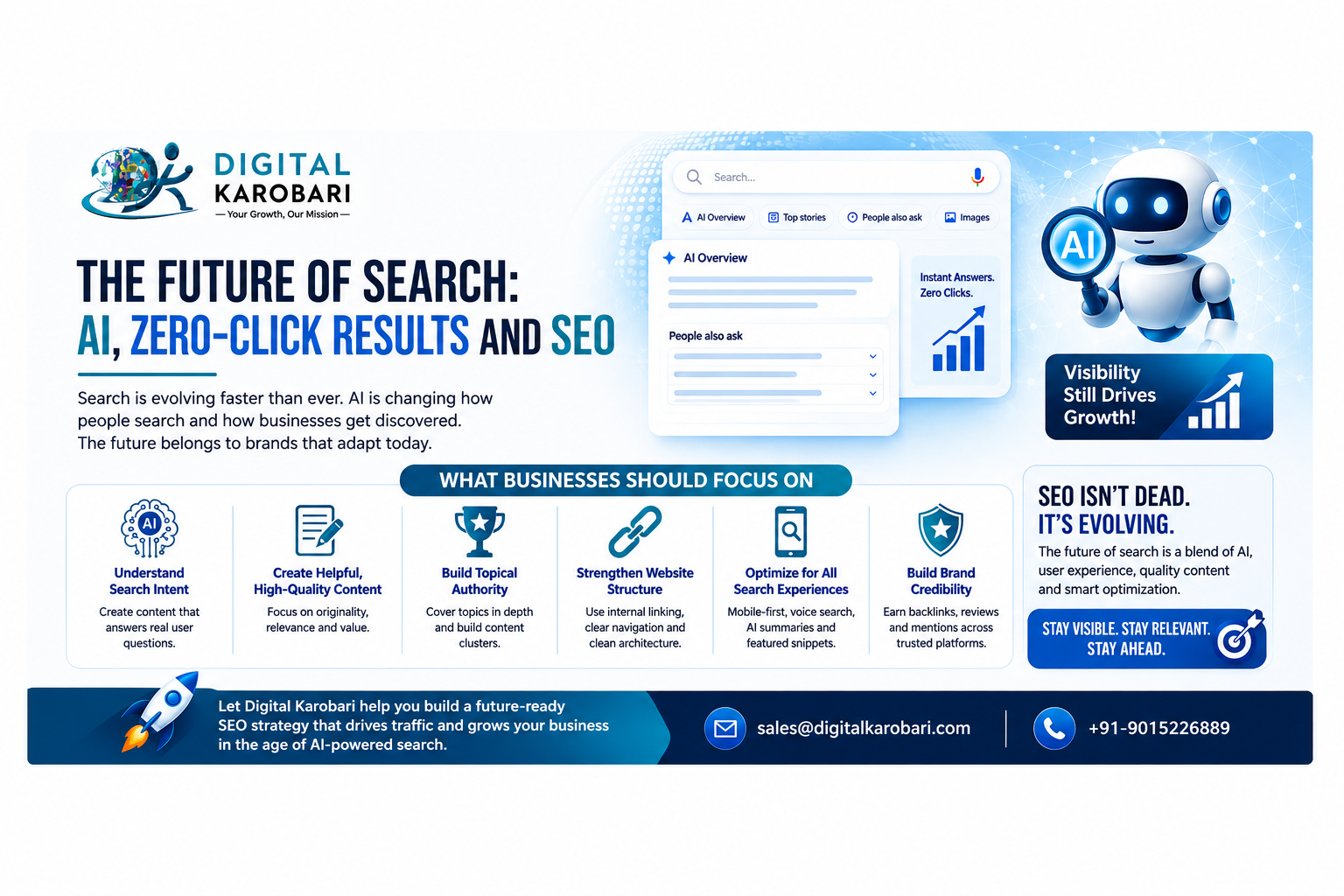
    Users can increasingly receive answers directly within search experiences, including AI-generated summaries and AI-powered search experiences. This means businesses need to think beyond traditional rankings and focus on visibility, relevance, authority, and the ability to become a trusted source of information.
    Google’s current guidance makes an important point: traditional SEO best practices continue to matter for generative AI features because these experiences rely on Google’s existing search ranking and quality systems.
    For businesses, this creates a new question:
    How can you remain visible when users don’t always need to click a traditional search result?
    The answer lies in adapting your SEO strategy for the future.

    What Is Changing in Search?

    Traditional search generally followed a simple journey:
    Search → Results → Website → Conversion
    AI-powered search is making the journey more conversational:
    Question → AI-generated response → Sources → Deeper research → Conversion
    Search engines can now better understand complex questions, context, intent, and relationships between different pieces of information.
    Instead of searching for several individual keywords, users can ask detailed questions such as:
    “What is the best digital marketing strategy for a small business with a limited budget?”
    This changes the role of SEO. Businesses are no longer optimizing only for individual keywords. They need to create content that genuinely answers customer questions and demonstrates expertise.

    What Are Zero-Click Searches?

    A zero-click search occurs when a user gets the information they need directly from the search results without visiting another website.
    This can happen through:
    ⦁ Featured snippets
    ⦁ Knowledge panels
    ⦁ Local results
    ⦁ Direct answers
    ⦁ AI Overviews
    ⦁ Other search features
    For businesses, this can appear concerning because fewer clicks may mean less website traffic.
    However, zero-click visibility isn’t necessarily a negative outcome.
    Being mentioned, cited, or displayed prominently in search can increase brand awareness and credibility, even when the user doesn’t immediately visit the website.
    The goal is therefore shifting from simply “getting the click” to “being visible at the right moment.”

    How AI Is Changing SEO

    AI is changing both how people search and how search engines interpret content.
    Google’s current documentation specifically notes that SEO remains relevant for generative AI features in Search.
    This means businesses shouldn’t abandon SEO because of AI. Instead, they should strengthen the fundamentals.
    Important areas include:

    1. Search Intent
      Understanding what users actually want is becoming more important than simply targeting keywords.
      For example, someone searching:
      “digital marketing course”
      may have very different intentions from someone searching:
      “how to choose a digital marketing agency for a small business.”
      Successful SEO connects content with the user’s actual need.
    2. Helpful, Original Content
      AI can generate huge amounts of content, making originality increasingly valuable.
      Businesses should provide:
      ⦁ Original insights
      ⦁ Real examples
      ⦁ Expert opinions
      ⦁ Case studies
      ⦁ Data
      ⦁ Practical recommendations
      ⦁ First-hand experience
      Google has also warned against scaled content created primarily to manipulate search rankings, including mass-produced AI content that provides little additional value.
    3. Topical Authority
      Instead of publishing dozens of unrelated articles, businesses should build content around topics relevant to their expertise.
      For a digital marketing company, for example, this could include:
      SEO → Local SEO → Technical SEO → Content SEO → AI Search → Conversion Optimization
      This creates a stronger topical ecosystem.
    4. Clear and Structured Information
      AI systems need to understand information efficiently.
      Businesses should use:
      ⦁ Clear headings
      ⦁ Short paragraphs
      ⦁ Lists
      ⦁ Tables where useful
      ⦁ Descriptive titles
      ⦁ Internal links
      ⦁ Relevant structured data
      ⦁ Well-organized content
      Structured data isn’t a special requirement for appearing in Google’s generative AI features, but Google recommends continuing SEO best practices, including structured data where appropriate.

    Is Traditional SEO Dead?

    No.
    SEO is evolving rather than disappearing.
    Traditional SEO still provides the foundation for search visibility. Technical performance, crawlability, useful content, relevant keywords, internal linking, authority, and user experience remain important.
    What is changing is the definition of search visibility.
    Previously, success might have meant:
    “We rank #1 for our target keyword.”
    In the future, success may look more like:
    “Our brand is consistently discovered, mentioned, cited, and trusted across multiple search experiences.”
    Google’s own guidance states that its generative AI search features are built on core Search ranking and quality systems, reinforcing the continuing importance of SEO fundamentals.

    How Businesses Can Prepare for AI Search

    Businesses should start adapting now rather than waiting for traditional organic traffic patterns to change further.

    Create Content Around Real Questions
    Build content around the questions your customers ask before making a purchase.
    For example:
    ⦁ What does digital marketing cost?
    ⦁ How long does SEO take?
    ⦁ Is SEO better than Google Ads?
    ⦁ How can a small business generate leads online?
    ⦁ How do I choose a digital marketing agency?

    Focus on Expertise
    Generic content is easy to replicate.
    Expert content is harder to replace.
    Show your experience through:
    ⦁ Case studies
    ⦁ Client results
    ⦁ Industry insights
    ⦁ Original research
    ⦁ Expert commentary
    ⦁ Practical examples

    Optimize for Multiple Search Formats
    Search is no longer limited to traditional blue links.
    Businesses should consider visibility across:
    ⦁ Traditional search
    ⦁ AI Overviews
    ⦁ AI Mode
    ⦁ Images
    ⦁ Videos
    ⦁ Local search
    ⦁ News
    ⦁ Social platforms
    Google’s latest documentation also highlights the importance of local, shopping, image, and video content when thinking about generative AI search visibility.

    Build a Strong Brand
    A recognizable brand can become an important asset in an AI-driven search environment.
    Users are more likely to trust businesses that demonstrate:
    ⦁ Expertise
    ⦁ Consistency
    ⦁ Transparency
    ⦁ Strong reviews
    ⦁ Useful content
    ⦁ A professional online presence
    Google has also introduced a preferred sources feature that can allow users to identify publications they prefer, with those sources potentially receiving preferred-source treatment in AI Overviews and AI Mode.

    The Future of SEO Is About Visibility, Not Just Rankings

    The biggest mistake businesses can make is treating AI search as simply another SEO algorithm.
    The future is broader.
    Search engines are becoming answer engines, discovery platforms, research assistants, and increasingly conversational interfaces.
    That means businesses need a comprehensive digital strategy that combines:
    SEO + Content + Brand Building + Technical Optimization + User Experience + AI Search Optimization
    The brands that succeed will not necessarily be the ones producing the most content.
    They will be the ones producing the most useful, trustworthy, original, and relevant content.


    Final Thoughts

    The future of search isn’t about choosing between AI and SEO.
    It’s about understanding how they work together.
    AI is changing how people discover information, while SEO continues to provide the foundation that helps search engines understand and evaluate websites.
    For businesses, the opportunity is significant. Instead of chasing every algorithm update, focus on building a website and content ecosystem that genuinely deserves to be found.
    Be useful. Be authoritative. Be visible. And build a brand people remember.
    With the right SEO and digital marketing strategy, your business can stay competitive as search continues to evolve.

    Ready to Future-Proof Your Search Strategy?

    Search is evolving—and your digital marketing strategy should evolve with it. Digital Karobari can help your business build a stronger SEO, content, and digital marketing strategy designed for today’s search landscape.
    Want your business to be more visible in the age of AI-powered search? Get in touch with Digital Karobari today and start building your future-ready digital strategy.
    Company Name: Digital Karobari
    : https://digitalkarobari.
    : +91-9015226889

    Frequently Asked Questions

    1. What is zero-click search?
      Zero-click search occurs when users receive the information they need directly on a search results page without clicking through to another website.
    2. Will AI replace SEO?
      No. SEO remains important because AI-powered search experiences use core search ranking and quality systems. The strategy is evolving toward broader search visibility and useful, authoritative content.
    3. How does AI affect SEO?
      AI changes how users search and how search engines understand content. Businesses should focus more strongly on search intent, original information, topical authority, structured content, and overall content quality.
    4. What is an AI Overview?
      An AI Overview is an AI-generated response that can appear within Google Search to help users understand a topic or question.
    5. Should businesses still invest in SEO?
      Yes. SEO remains an important foundation for organic visibility, including visibility within newer AI-powered search experiences.
    6. How can a website appear in AI search results?
      There is no guaranteed shortcut. Businesses should follow SEO fundamentals and create useful, original, authoritative content that clearly satisfies user intent. Google specifically recommends continuing established SEO best practices for generative AI search.
    7. Is AI-generated content good for SEO?
      AI can assist with content creation, research, and productivity, but automatically producing large amounts of low-value content for search manipulation can violate Google’s spam policies.
    8. What is the future of SEO?
      The future of SEO will increasingly involve traditional organic rankings alongside AI search, conversational queries, multimedia search, local discovery, brand authority, and zero-click visibility.
  • How Consistent Branding Builds Customer Recognition

    How Consistent Branding Builds Customer Recognition

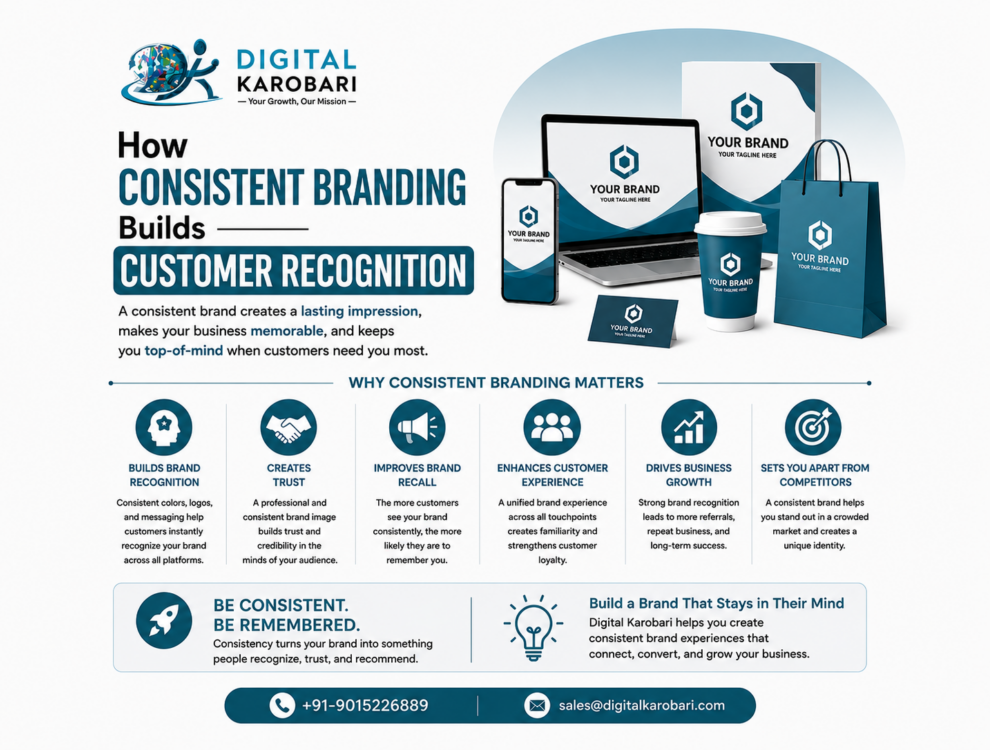
    A strong brand is more than a logo or a memorable tagline. It is the overall identity that customers associate with a business. Consistent branding across your website, social media, advertisements, packaging, and other marketing channels helps customers recognize your business quickly and remember it over time.
    For businesses competing in a crowded digital marketplace, maintaining the same visual style, tone, colors, fonts, messaging, and brand values can make a significant difference. When customers repeatedly see a familiar and consistent brand identity, it becomes easier for them to connect your business with your products or services.

    Why Consistent Branding Matters

    1. Creates Strong Brand Recognition
      Using consistent colors, typography, imagery, logos, and messaging helps customers identify your business without needing to read the company name. Over time, these repeated visual elements become associated with your brand.
    2. Builds Customer Trust
      Professional and consistent branding creates a sense of reliability. When your website, social media profiles, advertisements, and other communication materials have a unified appearance, customers are more likely to view your business as established and trustworthy.
    3. Makes Your Business More Memorable
      Customers interact with many brands every day. A consistent identity makes it easier for your business to stand out and remain memorable. Repeated exposure to the same brand elements strengthens customer recall.
    4. Strengthens Your Digital Presence
      Your website and social media channels are often the first places customers encounter your business. Maintaining a consistent brand identity across these platforms creates a connected experience and makes your online presence look more professional.
    5. Supports Long-Term Customer Loyalty
      Recognition can eventually develop into familiarity, trust, and loyalty. When customers know what to expect from your brand, they may feel more comfortable returning to your business and recommending it to others.

    Key Elements of Consistent Branding

    Businesses should maintain consistency across several important areas:
    Logo: Use the same logo variations appropriately across platforms.
    Brand Colors: Establish a recognizable color palette.
    Typography: Select fonts that complement your brand identity.
    Visual Style: Maintain a similar approach to photography, graphics, and design.
    Brand Voice: Use a consistent tone in website content, social posts, emails, and advertisements.
    Messaging: Communicate your brand’s key values and benefits consistently.
    Customer Experience: Ensure your brand promise is reflected in the actual customer experience.

    How Digital Karobari Can Help

    Building a recognizable brand requires more than creating attractive graphics. It requires a coordinated digital strategy where your website, SEO, social media, content, advertising, and other marketing activities work together.
    Digital Karobari can help businesses develop and maintain a stronger digital identity through strategic digital marketing and branding solutions. A consistent approach can help your business improve recognition, build credibility, and create stronger connections with its target audience.

    Conclusion

    Consistent branding helps turn individual marketing interactions into a recognizable brand experience. When customers repeatedly encounter the same visual identity, messaging, and brand personality, your business becomes easier to recognize and remember. Whether you are a startup or an established company, investing in consistent branding can support long-term visibility, trust, and customer relationships.

    Build a Brand Customers Remember with Digital Karobari

    Create a consistent and professional digital identity that strengthens recognition and builds customer trust. Connect with Digital Karobari today to take your brand presence to the next level.
    Company Name: Digital Karobari
    🌐: https://digitalkarobari.
    📞: +91-9015226889
    How Consistent Branding Builds Customer Recognition

    FAQ

    1. What is consistent branding?
      Consistent branding means using the same visual identity, messaging, tone, colors, fonts, and brand values across different marketing channels.
    2. How does consistent branding improve customer recognition?
      Repeated exposure to the same brand elements helps customers associate those elements with your business, making your brand easier to identify and remember.
    3. Is consistent branding important for small businesses?
      Yes. Consistent branding can help small businesses establish credibility, differentiate themselves from competitors, and create a professional market presence.
    4. Which channels should have consistent branding?
      Branding should generally remain consistent across your website, social media, advertisements, email marketing, brochures, presentations, and other customer-facing channels.
    5. Can Digital Karobari help with digital branding?
      Yes. Digital Karobari can support businesses with digital marketing and online brand-building strategies designed to improve visibility and customer engagement.
  • How Service-Area Businesses Can Rank Without a Physical Store

    How Service-Area Businesses Can Rank Without a Physical Store

    Not every business serves customers from a traditional storefront. Plumbers, electricians, consultants, home-service providers, digital agencies, cleaning companies, repair professionals, photographers, healthcare professionals, and other service providers may travel to customers instead of welcoming them at a fixed location.
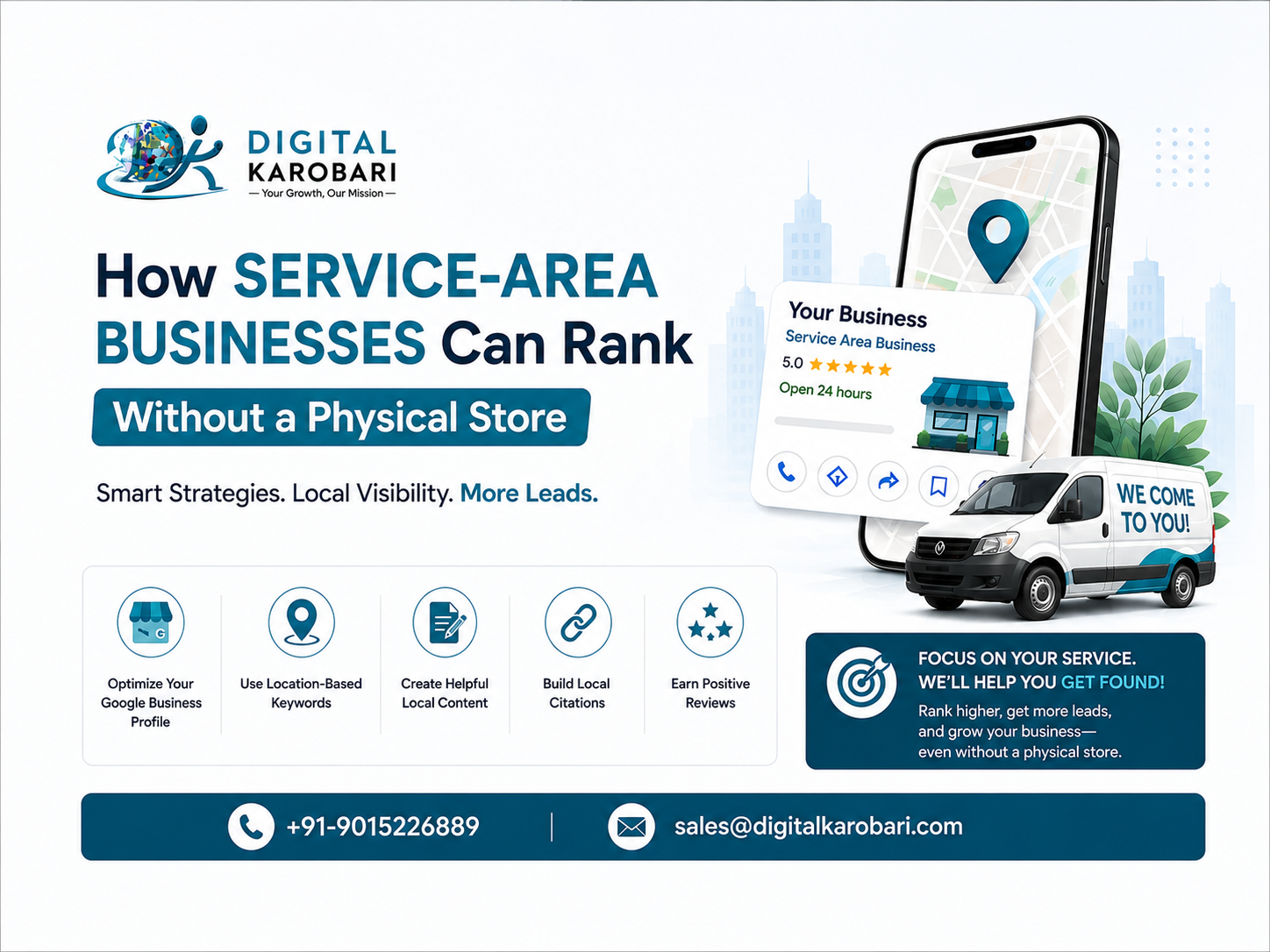
    These businesses are known as service-area businesses (SABs). The good news is that not having a customer-facing physical store does not mean you cannot build strong visibility in local search. With the right Local SEO strategy, a service-area business can improve its visibility for relevant searches and attract customers from the locations it actually serves.
    For businesses such as these, the focus should be on accurately communicating what you offer, where you provide the service, and why customers should trust you.

    What Is a Service-Area Business?

    A service-area business is a business that travels to customers to deliver products or services rather than operating primarily from a customer-facing storefront.
    Examples include:
    Plumbers
    Electricians
    Pest-control companies
    Cleaning services
    Home repair businesses
    Interior designers
    Photographers
    Consultants
    Digital marketing agencies
    IT support providers
    Delivery services
    Mobile repair services
    Construction contractors
    A business can have a physical location internally while choosing not to display that address publicly if customers do not visit the location.

    Can a Service-Area Business Rank on Google?

    Yes.
    A service-area business can establish a local online presence by creating and optimizing its Google Business Profile, developing location-relevant website content, earning reviews, building local authority and maintaining consistent business information.
    However, businesses should not attempt to create fake locations simply to rank in additional cities. Local SEO works best when location targeting reflects the areas the business genuinely serves.

    Optimize Your Google Business Profile

    Your Google Business Profile is one of the most important assets for local search visibility.
    Make sure your profile accurately communicates:
    Business name
    Primary category
    Services
    Service areas
    Business hours
    Phone number
    Website
    Business description
    Photos
    Customer reviews
    For a service-area business, accuracy is especially important. Don’t add locations where you don’t actually provide services simply to expand your potential reach.

    Choose the Right Primary Category

    Your primary Google Business Profile category helps Google understand what your business does.
    For example, a business offering residential electrical services should select the category that most accurately represents its core service rather than choosing a broad category simply because it has more searches.
    Additional relevant categories can be used where appropriate, but businesses should avoid selecting unrelated categories.

    Define Your Actual Service Areas

    Identify the cities, towns, suburbs or regions where your team genuinely provides services.
    For example, a home-service business operating in Mumbai could potentially serve areas such as:
    Andheri
    Bandra
    Powai
    Mulund
    Thane
    Ghatkopar
    The exact areas should reflect the company’s actual operating coverage.
    The goal isn’t to list every nearby location. The goal is to accurately communicate where customers can hire your business.

    Create Location-Specific Website Pages

    If your business genuinely serves multiple locations, dedicated location pages can help search engines and users understand your coverage.
    Instead of creating nearly identical pages by changing only the city name, each page should provide useful information about serving that particular area.
    A good location page can include:
    Services available
    Areas covered
    Local customer needs
    Service process
    Relevant projects or examples
    FAQs
    Customer testimonials
    Contact information
    Clear CTA
    For example, a digital marketing agency serving several Mumbai areas could create useful location-focused pages around its actual service coverage rather than publishing hundreds of low-value city pages.

    Target Service + Location Keywords

    Keyword research should reflect how potential customers search.
    Examples include:
    digital marketing agency in Mumbai
    home cleaning service in Thane
    electrician in Mulund
    pest control service in Andheri
    AC repair service in Powai
    Don’t force location keywords into every sentence. Use them naturally in headings, page titles, content, FAQs and other relevant areas.

    Build Local Citations

    Local citations are online references to your business information.
    Depending on your industry and market, these can include:
    Business directories
    Industry directories
    Local business websites
    Professional associations
    Relevant marketplaces
    The important factor is accuracy and consistency. Business name, phone number, website and other details should be kept consistent across important platforms.

    Collect Genuine Customer Reviews

    Reviews can strengthen credibility and influence how potential customers perceive your business.
    After successfully completing a project, encourage genuine customers to leave honest feedback.
    Avoid:
    Buying reviews
    Creating fake reviews
    Offering misleading incentives
    Asking employees to review the business as customers
    Instead, build a repeatable process for requesting feedback from real customers.
    You can also respond professionally to reviews, including negative ones, to demonstrate that your business takes customer experiences seriously.

    Create Helpful Local Content

    A service-area business can use content marketing to answer questions customers have before hiring a service provider.
    For example, a plumbing company could publish:
    “How to Identify a Water Leak Before It Causes Major Damage”
    A digital marketing agency could publish:
    “Local SEO Strategies for Small Businesses in Mumbai”
    A cleaning company could publish:
    “How Often Should Mumbai Homes Get Professional Deep Cleaning?”
    This type of content can attract relevant searches while demonstrating expertise.

    Build Local Backlinks

    Links from relevant local websites can help establish your business’s local authority.
    Potential opportunities include:
    Local news websites
    Business associations
    Community organizations
    Industry publications
    Local blogs
    Event websites
    Business partnerships
    Focus on earning relevant links rather than purchasing large numbers of low-quality backlinks.

    Add Real Proof of Your Work

    Service businesses can build trust by showing evidence of their work.
    Depending on the industry, this could include:
    Project photographs
    Case studies
    Before-and-after examples
    Client testimonials
    Service videos
    Portfolio pages
    Project outcomes
    For a service-area business, real examples can be particularly useful because customers may not have a storefront they can visit.

    Optimize for Mobile Search

    Many local searches happen on smartphones, especially when customers need a service quickly.
    Your website should make it easy for mobile users to:
    Understand your service
    See whether you serve their area
    Call your business
    Request a quote
    Send an enquiry
    Find important information
    A mobile-friendly website should also load quickly and provide clear navigation.

    Use Structured Data Where Appropriate

    Relevant structured data can help search engines better understand information on your website.
    Depending on the website and business, this may include structured data related to:
    Organization
    Local business
    Services
    FAQs
    Reviews
    Structured data should accurately represent the visible content and follow search-engine guidelines.

    Don’t Create Fake Locations

    One of the biggest mistakes service-area businesses make is creating fake business locations.
    For example, if your company serves Thane but has no legitimate business presence there, creating a fake address simply to rank for “business in Thane” can create trust and policy problems.
    A better strategy is to build genuine service-area relevance through:
    Accurate business information + useful location pages + reviews + local content + relevant authority.

    Track Local SEO Performance

    Ranking is only one part of the picture.
    Businesses should monitor metrics such as:
    Website organic traffic
    Calls
    Form submissions
    Quote requests
    Direction-related actions where applicable
    Search queries
    Leads by location
    Conversion rate
    The objective isn’t simply to receive more website visits. It is to generate qualified local enquiries.

    How Digital Karobari Can Help Service-Area Businesses

    Local SEO requires more than adding city names to website pages. A successful strategy combines Google Business Profile optimization, local keyword research, website optimization, content, reviews, citations, technical SEO and performance tracking.
    Digital Karobari can help service-area businesses develop a location-focused digital marketing strategy designed to increase online visibility and generate relevant enquiries.

    Conclusion

    A service-area business doesn’t need a traditional storefront to compete in local search. What it needs is a clear, accurate and trustworthy online presence that helps Google and potential customers understand what the business offers and where it operates.
    Start with an optimized Google Business Profile, create genuinely useful location content, earn authentic reviews, build relevant local authority and continuously measure your results. With a consistent Local SEO strategy, service-area businesses can reach customers beyond the limits of a physical storefront.

    Reach More Customers in Your Service Area

    Don’t let the lack of a physical storefront limit your online visibility.
    Digital Karobari can help your service-area business build a stronger local presence through Local SEO, Google Business Profile optimization, content marketing, website optimization and digital marketing strategies.
    Want more qualified local enquiries? Get in touch with Digital Karobari and start building your local search strategy today.
    Company Name: Digital Karobari
    🌐: https://digitalkarobari.
    📞: +91-9015226889

    Frequently Asked Questions

    1. Can a service-area business rank on Google without a physical store?
      Yes. Service-area businesses can build local search visibility without displaying a customer-facing storefront, provided they meet applicable Google Business Profile requirements and accurately represent their service areas.
    2. What is a service-area business?
      A service-area business provides products or services at customers’ locations rather than primarily serving customers at a publicly accessible business address.
    3. Can I create a Google Business Profile without showing my address?
      For eligible service-area businesses that don’t serve customers at their business address, Google provides options to hide the address and define the areas they serve.
    4. How many service areas should a business target?
      Target the areas your business genuinely serves. Avoid adding locations solely because you want to rank there.
    5. Should I create a separate page for every city I serve?
      Not necessarily. Create location pages when they provide meaningful, unique value to users. Avoid producing large numbers of nearly identical pages with only location names changed.
    6. How can service-area businesses get local backlinks?
      Businesses can pursue relevant links from local organizations, industry associations, community websites, local publications, partnerships and legitimate business directories.
    7. Are customer reviews important for service-area businesses?
      Yes. Genuine customer reviews can improve credibility and help potential customers evaluate a service provider before making contact.
    8. Can local SEO generate leads without a physical storefront?
      Yes. A strong local SEO strategy can help service-area businesses appear for relevant searches and generate calls, enquiries and quote requests.
    9. Should service-area businesses target multiple cities?
      They can target multiple locations when they genuinely provide services in those areas. The website and business profile should accurately reflect the company’s actual coverage.
    10. How long does local SEO take for a service-area business?
      There is no fixed timeline. Results depend on competition, website authority, location, industry, existing online presence and the quality and consistency of the SEO strategy.
  • Cloud + AI: Building Smarter Business Infrastructure

    Cloud + AI: Building Smarter Business Infrastructure

    Businesses are rapidly moving beyond traditional IT infrastructure by combining cloud computing and artificial intelligence (AI) to create faster, smarter, and more scalable operations. For modern organizations, this combination can simplify data management, automate repetitive processes, improve decision-making, and create more responsive customer experiences. Digital Karobari helps businesses understand and adopt digital technologies that can support long-term growth and operational efficiency.

    How Cloud + AI Are Transforming Businesses

    Cloud platforms provide the computing power, storage, flexibility, and connectivity businesses need to manage digital operations. AI adds intelligence to this infrastructure by analyzing data, identifying patterns, automating tasks, and generating actionable insights.
    When integrated effectively, cloud and AI can help organizations build infrastructure that is not only scalable but also capable of adapting to changing business requirements.

    1. Scalable Business Infrastructure
      Cloud computing allows businesses to increase or reduce computing resources according to demand. Instead of investing heavily in physical servers and infrastructure, organizations can access computing resources through cloud platforms.
      AI workloads can also be scaled through cloud infrastructure, making it easier for businesses to experiment with machine learning, predictive analytics, generative AI, and automation without building an extensive in-house technology environment.
    2. Smarter Data Management
      Data is one of the most valuable resources for modern businesses. Cloud platforms provide centralized environments for storing and accessing business data, while AI can turn that data into useful insights.
      Businesses can use AI-powered analytics to identify customer trends, forecast demand, detect unusual activity, evaluate performance, and support strategic decisions.
    3. Intelligent Automation
      Combining AI with cloud infrastructure enables businesses to automate repetitive and time-consuming processes. From customer support and document processing to data analysis and workflow management, intelligent automation can reduce manual effort.
      Employees can then focus more on creative, strategic, and customer-focused responsibilities rather than repetitive administrative tasks.
    4. Better Customer Experiences
      AI-powered applications hosted on cloud infrastructure can help businesses provide faster and more personalized customer interactions. Chatbots, recommendation engines, virtual assistants, and predictive customer-service systems can operate at scale while using business data to deliver relevant responses.
      This can help organizations improve customer engagement while maintaining operational efficiency.
    5. Improved Business Decision-Making
      Traditional business decisions often depend on historical reports and manually analyzed information. Cloud-based AI systems can process large volumes of data more efficiently and provide insights that help decision-makers respond to market conditions.
      Predictive analytics can support areas such as sales forecasting, inventory planning, customer behavior analysis, risk management, and financial planning.
    6. Enhanced Security and Risk Management
      Cloud and AI can also contribute to stronger cybersecurity strategies. AI-based systems can analyze network activity, identify unusual patterns, and help organizations detect potential security threats.
      Cloud environments can provide centralized security controls, monitoring, access management, and backup capabilities. However, businesses still need appropriate security policies, identity controls, data protection measures, and regular monitoring

    Key Benefits of Cloud + AI


    Scalability: Resources can be adjusted according to business demand
    Automation: Reduces repetitive manual processes
    Data Analytics: Converts business data into actionable insights
    Customer Experience: Enables personalized and responsive interactions
    Cost Efficiency: Reduces dependence on extensive physical infrastructure
    Decision-Making: Supports faster, data-driven business decisions
    Security: Helps identify unusual activities and potential threats
    Innovation: Makes it easier to experiment with emerging AI technologies

    Challenges Businesses Should Consider

    While cloud and AI offer significant opportunities, successful implementation requires proper planning. Businesses should evaluate data privacy, cybersecurity, regulatory requirements, integration with existing systems, employee skills, AI accuracy, and infrastructure costs before deployment.
    Organizations should also determine which business processes genuinely benefit from AI rather than implementing AI simply because it is a growing technology trend. A clearly defined business objective can help ensure that cloud and AI investments deliver measurable value.

    Building a Future-Ready Infrastructure

    The future of business infrastructure will increasingly involve intelligent systems capable of learning from data, automating workflows, and adapting to changing requirements. Cloud computing provides the flexible foundation, while AI adds the intelligence needed to make that infrastructure more responsive.
    For businesses looking to digitally transform their operations, the combination of Cloud + AI can provide a foundation for improved productivity, smarter decision-making, enhanced customer experiences, and sustainable digital growth.
    Digital Karobari can help businesses explore digital transformation strategies and identify technology solutions aligned with their operational and growth objectives.

    Ready to Build a Smarter Digital Business?

    Explore how Digital Karobari can help your business adopt cloud, AI, automation, and other digital solutions to improve efficiency and prepare for the future. Connect with Digital Karobari today and start planning your smarter business infrastructure.
    Company Name: Digital Karobari
    🌐: https://digitalkarobari.
    📞: +91-9015226889

    FAQs

    1. What is Cloud + AI in business?
      Cloud + AI refers to combining cloud computing infrastructure with artificial intelligence technologies. This enables businesses to access scalable computing resources while using AI for automation, analytics, prediction, and intelligent decision-making.
    2. How can Cloud + AI help small businesses?
      Small businesses can use cloud-based AI tools without making major investments in physical infrastructure. They can automate repetitive tasks, analyze customer data, improve marketing activities, and access scalable digital solutions as the business grows.
    3. What are the main benefits of combining Cloud and AI?
      Key benefits include scalability, automation, improved data analysis, faster decision-making, personalized customer experiences, operational efficiency, and easier access to advanced AI technologies.
    4. Is Cloud + AI secure for business data?
      Cloud and AI environments can include advanced security capabilities, but security depends on proper implementation. Businesses should use strong access controls, encryption, monitoring, backup strategies, and appropriate data-governance practices.
    5. How can businesses start implementing Cloud + AI?
      Businesses can begin by identifying a specific operational challenge, assessing their existing infrastructure and data, selecting an appropriate cloud environment, and introducing AI into processes where it can deliver measurable business value.
  • Can AI-Generated Content Rank on Google? What Businesses Should Know

    Can AI-Generated Content Rank on Google? What Businesses Should Know

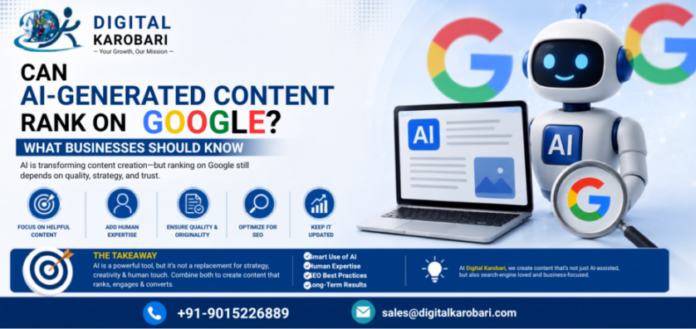
    AI has changed the way businesses create content. From blog posts and product descriptions to social media copy and website pages, artificial intelligence can help brands produce content faster and at scale. But one question continues to concern businesses and marketers: Can AI-generated content rank on Google?
    The short answer is yes, AI-generated content can rank on Google. However, simply using AI to produce large volumes of content does not guarantee rankings. Google’s focus is on whether content is useful, reliable, original and created to satisfy the needs of users.
    For businesses, the real opportunity lies in using AI as a content-support tool rather than treating it as a replacement for strategy, expertise and human judgment.

    Does Google Penalise AI-Generated Content?

    Google does not automatically penalise content simply because AI was used to create it. What matters is the quality and purpose of the content.
    Google’s search systems are designed to prioritise helpful content that provides value to users. Content created primarily to manipulate search rankings, whether written by humans or AI, can perform poorly.
    This means businesses should avoid publishing AI-generated articles without reviewing, editing and improving them. Content should be fact-checked, relevant to the target audience and aligned with the search intent behind the topic.

    What Makes AI Content Rank on Google?

    AI-generated content can perform well when it follows the same principles expected from high-quality human-written content.

    1. Focus on Search Intent
      Before creating content, understand what the user is actually looking for.
      For example, someone searching for “digital marketing agency for small business” may want to compare agencies, understand services or find a suitable provider. A generic article about digital marketing may not satisfy that intent.
      AI can help generate a first draft, but businesses need human input to make sure the content directly answers the user’s questions.
    2. Add Original Insights
      One of the biggest weaknesses of generic AI content is that it can repeat information already available online.
      Businesses should add something unique, such as:
      ⦁ Industry experience
      ⦁ Original examples
      ⦁ Case studies
      ⦁ Expert opinions
      ⦁ Data and research
      ⦁ Practical recommendations
      ⦁ Customer experiences
      ⦁ First-hand observations
      Original insights can make content more valuable and differentiated.
    3. Demonstrate Expertise and Trust
      Content becomes stronger when it reflects genuine knowledge of the subject.
      For example, a healthcare company should provide medically responsible and professionally reviewed information. An engineering company should demonstrate technical expertise. A digital marketing agency should support recommendations with practical experience and measurable results.
      AI can assist with writing, but subject-matter expertise gives the content credibility.
    4. Avoid Keyword Stuffing
      Using AI to insert the same keyword repeatedly can make content unnatural and difficult to read.
      Instead, businesses should focus on covering the topic comprehensively and naturally using related terms, questions and concepts.
      The goal should be to help the reader first and optimise for search engines second.
    5. Fact-Check AI-Generated Content
      AI tools can sometimes produce inaccurate, outdated or misleading information.
      Before publishing an AI-assisted article, businesses should verify:
      ⦁ Statistics
      ⦁ Dates
      ⦁ Names
      ⦁ Industry claims
      ⦁ Product specifications
      ⦁ Regulations
      ⦁ Research references
      ⦁ Links and sources
      Human review is particularly important for technical, financial, legal, healthcare and other sensitive topics.

    AI Content vs Human Content: What Should Businesses Choose?

    The choice does not have to be AI versus humans.
    A better approach is AI + human expertise.
    AI can help businesses with research, content outlines, brainstorming, first drafts, headline ideas, content repurposing and editing. Human writers and subject-matter experts can then add experience, context, accuracy, originality and brand voice.
    This combination can make the content creation process more efficient without sacrificing quality.

    Can AI-Generated Blog Posts Rank?

    Yes. An AI-assisted blog can rank if it provides genuine value and satisfies the user’s search intent.
    However, publishing hundreds of generic AI articles simply because they can be produced quickly is unlikely to be an effective long-term SEO strategy.
    A better process is:
    Research → Search Intent → Content Strategy → AI Assistance → Human Expertise → Fact Checking → SEO Optimisation → Publishing → Performance Analysis
    This approach allows businesses to benefit from AI while maintaining the quality expected from a professional website.

    How Businesses Can Use AI Without Hurting SEO

    Businesses can use AI responsibly throughout their content workflow.

    Use AI for Research and Ideas
    AI can help identify potential topics, questions and content angles. These ideas should then be validated through keyword research and actual audience needs.

    Create Detailed Content Briefs
    Instead of asking AI to “write a 2,000-word SEO article,” provide a detailed brief covering the target audience, search intent, key questions, tone, keywords, internal links and important points to address.

    Add Human Experience
    After generating a draft, add examples from your business, customer questions, project experience and industry knowledge.

    Optimise for Readers
    Use clear headings, short paragraphs, useful examples, bullet points and logical content structure. Good SEO content should be easy to understand and navigate.

    Keep Content Updated
    Industries, products, regulations and search trends change. Businesses should periodically review important content and update outdated information.

    What Businesses Should Avoid When Using AI Content

    AI can become a problem when it is used purely for mass content production.
    Avoid:
    ⦁ Publishing unedited AI-generated articles
    ⦁ Creating content solely to target keywords
    ⦁ Producing large volumes of repetitive pages
    ⦁ Making unsupported claims
    ⦁ Copying competitors’ content
    ⦁ Adding keywords unnaturally
    ⦁ Publishing inaccurate information
    ⦁ Using AI without understanding the target audience
    ⦁ Creating content that provides little value beyond what already exists online
    The objective should not be to publish more content. It should be to publish better content.

    The Future of AI and SEO

    AI is likely to remain an important part of digital marketing and SEO. As AI tools become more advanced, businesses will be able to produce and personalise content more efficiently.
    At the same time, originality, expertise, trust and usefulness will remain important differentiators.
    Businesses that combine AI technology with strong SEO strategy, human expertise and genuine audience understanding will be better positioned to build sustainable organic visibility.

    Final Thoughts

    So, can AI-generated content rank on Google? Yes, it can.
    But ranking should not be the result of simply generating content with AI and publishing it. Businesses need to focus on search intent, originality, accuracy, expertise, user experience and genuine value.
    AI should be viewed as a powerful assistant—not a shortcut around good SEO.
    For businesses, the winning approach is simple: use AI to improve the content creation process, but use human expertise to make the content worth reading.

    Want to turn AI into a smarter part of your SEO strategy?

    At Digital Karobari, we help businesses build SEO and digital marketing strategies designed around visibility, relevant traffic and long-term growth. From content strategy and SEO to performance-focused digital marketing, our team can help you use AI effectively without compromising quality.
    Get in touch with Digital Karobari today and build a smarter content strategy for your business.
    Company Name: Digital Karobari
    🌐: https://digitalkarobari.
    📞: +91-9015226889

    Frequently Asked Questions

    1. Can Google rank AI-generated content?
      Yes. Google can rank AI-generated content when it is useful, relevant, accurate and created to satisfy users’ needs. The use of AI itself does not automatically prevent content from ranking.
    2. Does Google penalise websites for using AI content?
      Google does not automatically penalise content simply because AI was used. However, content created primarily to manipulate search rankings or provide little value can perform poorly regardless of whether it was written by AI or a human.
    3. Is AI-generated content good for SEO?
      AI-generated content can support SEO when it is properly researched, reviewed, fact-checked and enhanced with original insights. Businesses should avoid relying on unedited, generic AI content.
    4. Should businesses disclose that content was created using AI?
      The need for disclosure can depend on the context, industry and applicable requirements. Businesses should prioritise transparency and accuracy, particularly when content could significantly affect users’ decisions.
    5. Can AI-written blogs rank on the first page of Google?
      Yes, AI-assisted blogs can reach the first page when they provide strong value, satisfy search intent, demonstrate expertise and compete effectively with existing search results. There is no guaranteed ranking simply because AI was used.
    6. How can businesses improve AI-generated content?
      Businesses can improve AI-generated content by adding original insights, expert opinions, real examples, accurate data, appropriate internal links, relevant keywords and a strong brand voice. Human editing and fact-checking are also essential.
    7. Is human-written content better than AI content?
      Not necessarily. Quality depends more on usefulness, accuracy, originality and relevance than on whether AI or a human produced the initial draft. A combination of AI assistance and human expertise can be highly effective.
  • Why Your Brand Needs a Search Strategy, Not Just an SEO Strategy

    Why Your Brand Needs a Search Strategy, Not Just an SEO Strategy

    Search has changed. Earlier, businesses mainly focused on ranking their website on Google for important keywords. Today, customers discover brands through traditional search engines, AI-powered search, social platforms, YouTube, reviews, business listings, communities, and other digital touchpoints.
    That means ranking on Google is still important, but it is no longer the entire search journey.
    A modern brand needs a broader search strategy that connects SEO, content, brand authority, user intent, local visibility, digital PR, social discovery and AI search. Recent industry discussions similarly point toward a shift from rankings alone toward broader visibility and how consistently a brand is understood across search and AI-driven discovery.
    For businesses working with an agency such as Digital Karobari, this shift creates an opportunity to move from simply chasing keywords to building long-term digital visibility.

    What Is a Search Strategy?

    A search strategy is a broader plan for making your brand discoverable whenever potential customers are researching a problem, product, service or solution online.
    Traditional SEO often asks:
    “How can we rank this page for this keyword?”
    A search strategy asks:
    “Where is our customer searching, what are they looking for, and how can our brand become the most useful and trustworthy answer?”
    This can include:
    Traditional SEO
    Local SEO
    Content marketing
    Technical SEO
    Brand searches
    AI search optimization
    Answer Engine Optimization (AEO)
    Generative Engine Optimization (GEO)

    Social search
    YouTube optimization
    Digital PR
    Reviews and reputation
    Industry publications
    Conversion optimization
    The objective isn’t simply to generate impressions. It is to build search visibility that supports awareness, trust, leads and revenue.

    SEO Is Still Important — But It Is Only One Part

    This doesn’t mean SEO is becoming irrelevant.
    Google search remains an important discovery channel, and strong technical foundations, useful content, internal linking, structured information and authority still matter.
    The difference is that customers increasingly move between multiple discovery environments before making a decision.
    For example, a potential customer might:
    Search Google for a problem.
    Read an article.
    Watch a YouTube video.
    Search the brand name.
    Check reviews.
    Compare competitors.
    Ask an AI tool for recommendations.
    Visit the company’s website.
    Contact the business.
    If your strategy only focuses on step one, you may miss many of the other opportunities.
    Modern search therefore requires a connected visibility strategy rather than isolated SEO activities.

    Search Behaviour Is No Longer Limited to Google

    People don’t always begin their research on a traditional search engine.
    Depending on the product or service, users may discover information through:
    Google
    YouTube
    Instagram
    LinkedIn
    Reddit and online communities
    Google Maps
    Marketplace platforms
    AI assistants
    Industry websites
    Reviews
    Brand websites
    For example, someone looking for a digital marketing agency might search:
    “best digital marketing agency in Mumbai”
    But they could also search:
    “how to improve website leads”
    or ask an AI assistant:
    “Which digital marketing agencies can help a small business generate leads?”
    These are different search experiences, but they can lead to the same buying decision.
    Your brand needs to be prepared for all of them.

    Search Strategy Starts With Search Intent

    Keywords are useful, but keywords alone don’t explain what a customer wants.
    Consider the search:
    “SEO agency Mumbai”
    This has a strong commercial intent.
    Now compare it with:
    “how does SEO work?”
    This is primarily informational.
    Another search:
    “SEO agency pricing”
    is closer to the consideration stage.
    A strong search strategy maps content and landing pages to different stages of the customer journey.
    Informational Intent
    Users want to learn.
    Examples:
    What is SEO?
    How does PPC work?
    How does digital marketing generate leads?
    Commercial Investigation
    Users are comparing options.
    Examples:
    Best SEO agency for small businesses
    SEO vs PPC
    Digital marketing agency vs freelancer
    Transactional Intent
    Users are ready to take action.
    Examples:
    Hire SEO agency
    Digital marketing services Mumbai
    PPC management company
    Your content strategy should address all three.

    Build a Strong Brand Entity

    Search engines and AI systems need to understand who your brand is, what you offer and why you are relevant.
    Your brand information should be consistent across:
    Website
    About page
    Service pages
    Author profiles
    Social media
    Business listings
    Industry directories
    Reviews
    PR mentions
    Third-party publications
    For example, if one website describes your company as a digital marketing agency, another calls it a web development company, and another describes completely different services, the overall brand signal becomes less consistent.
    Clear positioning helps both users and machines understand your business.
    Industry research increasingly emphasizes entity clarity, semantic relationships and consistent brand information as important components of modern search visibility.

    Create Content Around Topics, Not Just Keywords

    Publishing one article for every keyword isn’t a sustainable content strategy.
    Instead, brands should build topic clusters.
    For example, a digital marketing agency could create a central topic around:
    Digital Marketing
    Then build supporting content around:
    SEO
    Local SEO
    PPC
    Social media marketing
    Content marketing
    Performance marketing
    Conversion optimization
    AI marketing
    Marketing analytics
    These pages can be connected through internal links.
    This creates a clearer relationship between your services and supporting educational content.
    A strategic content structure can also help establish topical authority rather than producing disconnected articles simply to target individual keywords.

    Optimize for AI Search

    One of the biggest reasons brands need a broader search strategy is the growth of AI-powered discovery.
    Users can now ask AI systems questions such as:
    “What are the best digital marketing strategies for a small business?”
    Instead of receiving a traditional list of ten blue links, the user may receive a summarized answer.
    That changes the visibility objective.
    The goal becomes not only:
    “Can my website rank?”
    but also:
    “Does reliable information about my brand exist across the web that AI systems can understand and potentially reference?”
    AI search optimization involves areas such as:
    Clear and useful content
    Strong topical relevance
    Structured information
    Consistent brand descriptions
    Author expertise
    First-hand experience
    Third-party mentions
    Digital PR
    Reviews
    Internal linking
    Structured data
    Strong website architecture
    AI search is increasingly being treated as a broader discovery environment rather than simply another variation of traditional rankings.

    Your Website Should Answer Real Customer Questions

    A search strategy should connect your content directly to customer problems.
    Instead of creating an article simply because a keyword has search volume, ask:
    What does the customer need to know before contacting us?
    For a digital marketing company, that might include:
    Why isn’t my website generating leads?
    SEO or PPC — which should I choose?
    How much should I spend on digital marketing?
    How long does SEO take?
    How can I reduce my cost per lead?
    How can I improve my website conversion rate?
    How can AI improve my marketing?
    These questions can become:
    Blog posts
    FAQs
    Guides
    Comparison pages
    Case studies
    Videos
    Social posts
    Landing pages
    One useful piece of information can therefore support multiple search channels.

    Don’t Ignore Branded Search

    One of the strongest signals that people know and trust your company is branded search.
    Compare:
    “SEO agency Mumbai”
    with:
    “Digital Karobari SEO services”
    The second query shows that the user already knows the brand.
    Building branded search demand requires more than SEO. It can involve:
    Content marketing
    Social media
    PR
    Thought leadership
    Video marketing
    Customer reviews
    Partnerships
    Case studies
    Consistent brand messaging
    The long-term goal is to move customers from discovering a generic category to actively searching for your brand.

    Build Authority Beyond Your Website

    Your website isn’t the only place where your brand reputation is built.
    Third-party sources can influence how customers perceive your business and can contribute to broader search visibility.
    Consider building a presence through:
    Industry publications
    Business directories
    Guest contributions
    PR coverage
    Interviews
    Podcasts
    Reviews
    Professional communities
    Social platforms
    Relevant business listings
    This is particularly important in an AI-driven search environment, where systems may synthesize information from multiple sources rather than relying exclusively on a single website.

    Connect Search Visibility With Conversion

    Getting discovered is only the first step.
    Imagine your website ranks well but has:
    Weak messaging
    Slow pages
    Confusing navigation
    Poor CTAs
    No trust signals
    Difficult contact forms
    Traffic may increase without meaningful business growth.
    That’s why a search strategy should connect SEO with CRO — Conversion Rate Optimization.
    A successful journey looks more like:
    Search → Click → Understand → Trust → Engage → Convert
    Rather than:
    Keyword → Ranking → Traffic
    This is why search performance should ultimately be evaluated against business outcomes, not rankings alone.

    Measure More Than Keyword Rankings

    Keyword rankings remain useful, but they shouldn’t be the only measurement.
    A broader search strategy can track:
    Visibility
    Organic impressions
    Keyword visibility
    Branded searches
    Local visibility
    AI search mentions/citations where measurable
    Engagement
    Organic traffic
    Engaged sessions
    Content engagement
    Returning visitors
    Business Performance
    Qualified leads
    Conversion rate
    Cost per acquisition
    Revenue
    Customer acquisition cost
    Brand Growth
    Brand searches
    Reviews
    Mentions
    Referrals
    Third-party coverage
    The more your measurement connects search activity to business results, the easier it becomes to identify which strategies actually deserve more investment.

    SEO Strategy vs Search Strategy

    SEO Strategy Search Strategy
    Primarily focuses on search engines Focuses on the complete discovery journey
    Keyword rankings are central Visibility and business outcomes are central
    Website-focused Website + AI + social + third-party platforms
    Mostly organic search Organic, AI, local, social and other discovery channels
    Focuses heavily on rankings Focuses on visibility, trust and conversions
    Content targets keywords Content targets customer questions and intent
    Backlinks are important Authority, mentions, reputation and citations all matter
    Traffic is a major KPI Qualified leads and revenue become important KPIs
    The takeaway: SEO should be a component of your search strategy—not the entire strategy.

    How Digital Karobari Can Help Build a Modern Search Strategy

    A modern search strategy requires multiple digital marketing disciplines working together.
    Digital Karobari can help businesses build a connected strategy around:
    SEO
    Content marketing
    Performance marketing
    Social media marketing
    Website optimization
    Conversion optimization
    Brand visibility
    AI-focused search strategies
    Instead of treating each channel as a separate activity, businesses can connect these channels around a common objective: being discovered, trusted and chosen by the right customers.

    Conclusion

    The future of search isn’t simply about ranking number one for a keyword.
    It’s about being visible wherever your customers are researching, being clearly understood when they discover you, and providing enough value and credibility to become part of their final decision.
    Traditional SEO remains an important foundation. But as discovery expands across AI platforms, social networks, video, reviews, local search and other digital environments, brands need a much broader approach.
    The winning question is no longer:
    “How do we rank for this keyword?”
    It is:
    “How do we become the brand customers discover and trust throughout their entire search journey?”
    That is the difference between an SEO strategy and a modern search strategy.

    Ready to Move Beyond Traditional SEO?

    Don’t let your brand compete only for keyword rankings. Build a search strategy designed for Google, AI search, social discovery and the complete customer journey.
    Partner with Digital Karobari to build a stronger, more connected digital visibility strategy.
    Get in touch with Digital Karobari today and turn search visibility into meaningful business growth.
    Company Name: Digital Karobari
    🌐: https://digitalkarobari.
    📞: +91-9015226889

    Frequently Asked Questions

    1. What is a search strategy?
      A search strategy is a comprehensive approach to making a brand discoverable across search engines, AI platforms, social media, local search, content platforms and other places where customers research products and services.
    2. Is SEO still important in 2026?
      Yes. SEO remains an important foundation for organic visibility. However, brands can benefit from combining SEO with content, brand building, local visibility, AI search optimization, digital PR and conversion optimization.
    3. What is the difference between SEO and search strategy?
      SEO primarily focuses on improving visibility in search engines. A search strategy takes a broader approach by considering multiple discovery channels, customer intent, brand visibility, AI search, content and conversions.
    4. Does AI search replace SEO?
      No. AI search changes the discovery environment but does not eliminate the need for strong SEO foundations. Technical accessibility, useful content, authority and clear information remain important.
    5. What is GEO?
      GEO, or Generative Engine Optimization, refers to strategies designed to improve a brand’s visibility and representation within AI-generated search experiences.
    6. Why is branded search important?
      Branded searches indicate that users are actively looking for your company rather than simply searching for a generic product or service. Growing branded demand can strengthen awareness and help create a more durable brand presence.
    7. How can businesses prepare for AI search?
      Businesses should create clear, authoritative content, maintain consistent brand information, demonstrate expertise, improve technical accessibility, build relevant third-party authority and structure content so that important information is easy to understand.
    8. How long does it take to build search visibility?
      There is no fixed timeline. Results depend on competition, website authority, content quality, technical health, industry, existing brand awareness and the scope of the strategy. SEO and brand visibility are generally long-term investments.
    9. Should a business focus on SEO or PPC?
      It doesn’t have to be either/or. SEO can support long-term organic visibility, while PPC can provide targeted visibility and data more quickly. The right mix depends on business goals, competition, budget and customer journey.
    10. Can a digital marketing agency help with a search strategy?
      Yes. A digital marketing agency can combine SEO, content, paid advertising, social media, website optimization, brand visibility and other channels into a coordinated search strategy.
  • How Competitor Analysis Can Improve Your SEO Strategy

    How Competitor Analysis Can Improve Your SEO Strategy

    SEO is not only about optimizing your own website. To build a stronger search strategy, businesses also need to understand what competitors are doing, which keywords they target, what type of content they publish, and where they are earning visibility.
    Competitor analysis provides valuable insights that can help businesses identify opportunities, avoid common mistakes, and develop a more focused SEO strategy. Instead of copying competitors, the goal is to understand the search landscape and find ways to create something better and more useful.
    For businesses working with Digital Karobari, competitor analysis can be an important part of developing a data-driven SEO and digital marketing strategy.

    What Is SEO Competitor Analysis?

    SEO competitor analysis is the process of researching websites that compete with your business in search engine results.
    These competitors may not always be your direct business competitors. A website could compete with you for specific keywords even if it offers a slightly different product or service.
    An SEO competitor analysis typically examines:
    Target keywords
    Search rankings
    Content strategy
    Website structure
    Backlink profiles
    Search intent
    Featured search results
    Internal linking
    On-page optimization
    Local SEO presence
    The information gathered can then be used to identify gaps and opportunities for your own website.

    Why Is Competitor Analysis Important for SEO?

    Search results are competitive. If several businesses are targeting the same audience, simply publishing content may not be enough to achieve strong rankings.
    Competitor analysis can help answer important questions:
    Which keywords are competitors ranking for?
    What topics are generating visibility for them?
    What type of content does Google appear to prefer?
    Where are competitors weak?
    Which topics have not been covered well?
    What backlinks or online mentions are helping competitors?
    These insights can make SEO planning more strategic.

    1. Discover Valuable Keyword Opportunities
      One of the biggest benefits of competitor analysis is discovering keywords you may have overlooked.
      For example, your competitors may rank for long-tail searches related to your products or services that are not currently included in your SEO strategy.
      Instead of targeting only highly competitive keywords, you can identify opportunities across different stages of the customer journey.
      These may include:
      Informational keywords
      Commercial keywords
      Transactional keywords
      Local search terms
      Long-tail keywords
      Problem-based searches
      The goal is not to copy a competitor’s keyword list but to identify relevant opportunities that align with your own business.
    2. Identify Content Gaps
      A content gap occurs when your website does not adequately address a topic that potential customers are searching for.
      Suppose three competitors have detailed guides covering a particular customer problem, while your website has no useful resource addressing it. That represents an opportunity.
      A competitor content analysis can help you discover:
      Missing blog topics
      Questions customers are asking
      Underdeveloped service pages
      Missing comparison content
      Frequently discussed industry problems
      Topics that deserve more detailed coverage
      Once these gaps are identified, businesses can create original content that provides greater value.
    3. Understand Search Intent
      Ranking for a keyword is not simply about using that keyword repeatedly.
      Search intent describes what a user is actually trying to accomplish when they perform a search.
      Competitor analysis can help you understand whether search results for a particular keyword mainly contain:
      Blog articles
      Product pages
      Service pages
      Comparison guides
      Tutorials
      Videos
      Category pages
      For example, if most top-ranking pages for a keyword are detailed educational guides, creating a short promotional page may not satisfy the user’s intent.
      Understanding the current search landscape helps businesses create content that better matches what users expect.
    4. Improve Your Content Strategy
      Competitors can provide useful information about the topics and formats receiving search visibility.
      You can examine:
      Content length
      Headings
      Topics covered
      FAQs
      Images and videos
      Internal links
      Examples
      Original research
      Calls to action
      However, the goal should not be to create a longer version of every competitor article.
      Instead, ask:
      What information is missing?
      Can we explain the topic more clearly?
      Can we provide original examples?
      Can we make the content easier to understand?
      Can we provide more practical value?
      This approach helps transform competitor research into a better content strategy.
    5. Find Backlink Opportunities
      Backlinks can still play an important role in SEO. Competitor backlink analysis can reveal websites that have already linked to similar businesses or industry content.
      These websites may include:
      Industry publications
      Business directories
      Professional organizations
      Resource pages
      Partner websites
      Relevant blogs
      Local business websites
      Instead of trying to replicate every competitor backlink, businesses should focus on earning relevant, credible, and natural links.
    6. Analyze Competitor On-Page SEO
      Competitor analysis can also reveal how successful websites structure their pages.
      You can compare factors such as:
      Page titles
      Meta descriptions
      Heading structure
      URL structure
      Content organization
      Internal links
      Image optimization
      Calls to action
      Service page structure
      This can help identify areas where your website may need improvement.
    7. Discover Local SEO Opportunities
      For businesses serving specific locations, competitor analysis can be especially useful for local SEO.
      You can examine competitors’:
      Google Business Profile presence
      Reviews
      Local landing pages
      Location-specific content
      Business citations
      Local backlinks
      Service-area targeting
      For example, if several competitors are ranking for searches related to a specific city or neighborhood, it may indicate an opportunity to create useful location-focused content or improve your local SEO signals.
    8. Identify Competitor Strengths and Weaknesses
      No competitor is perfect.
      A competitor may have strong backlinks but outdated content. Another may have excellent content but a poor user experience. Someone else may rank well nationally but have weak local visibility.
      A simple SWOT-style analysis can help:
      Area Questions to Ask
      Content What topics do they cover well?
      Keywords Which searches generate visibility?
      Backlinks Where are their links coming from?
      UX Is their website easy to navigate?
      Local SEO How strong is their local presence?
      Technical SEO Are there noticeable performance issues?
      Conversion How effectively do pages encourage action?
      These observations can help you prioritize your own SEO improvements.
    9. Create a Better SEO Roadmap
      Competitor research becomes more valuable when it leads to action.
      Instead of maintaining a list of competitor keywords without a plan, organize opportunities according to their potential business value.
      For example:
      Priority 1: High-intent keywords related directly to your services.
      Priority 2: Content gaps that can attract relevant organic traffic.
      Priority 3: Supporting informational content.
      Priority 4: Authority-building and backlink opportunities.
      This creates a more structured SEO roadmap.

    How to Perform an SEO Competitor Analysis

    A practical competitor analysis can follow these steps:
    Step 1: Identify Your Search Competitors
    Search for your important products, services, and topics. Note the websites consistently appearing in the results.
    Step 2: Analyze Their Keywords
    Identify relevant keywords where competitors have strong visibility and determine whether those searches are relevant to your business.
    Step 3: Review Their Content
    Look at their most visible pages and identify what topics, formats, and questions they address.
    Step 4: Compare Your Website
    Find areas where your content, page structure, internal linking, or user experience can be improved.
    Step 5: Analyze Backlinks
    Research where competitors are earning relevant backlinks and determine which opportunities may be appropriate for your business.
    Step 6: Identify Gaps
    Create a list of keywords, topics, services, locations, and customer questions that your website does not adequately cover.
    Step 7: Build an Action Plan
    Prioritize opportunities based on search intent, business relevance, competition, and potential value rather than simply trying to outperform competitors on every keyword.
    Competitor Analysis Does Not Mean Copying
    One of the most important principles of competitor research is don’t copy—learn.
    Copying another website’s content, structure, branding, or messaging will not create a sustainable SEO advantage.
    Instead, competitor research should help you understand the market and discover opportunities to provide something more useful.
    Your content should offer your own expertise, examples, insights, experience, and solutions.

    Common Competitor Analysis Mistakes

    Businesses often make mistakes such as:
    Focusing only on competitor rankings
    Copying competitor content
    Targeting every keyword competitors rank for
    Ignoring search intent
    Looking only at backlinks
    Choosing competitors based only on business type
    Ignoring local competitors
    Failing to prioritize opportunities
    Not connecting SEO research with business goals
    Competitor analysis should be a continuous learning process rather than a one-time activity.

    How Digital Karobari Can Help

    A successful SEO strategy requires more than keyword research. It involves understanding competitors, customers, search intent, content opportunities, technical performance, and business objectives.
    Digital Karobari helps businesses develop digital marketing strategies that can strengthen their online presence and connect them with relevant audiences.
    By combining competitor research with SEO, content marketing, social media, and other digital strategies, businesses can build a more comprehensive approach to online growth.

    Conclusion

    Competitor analysis can provide valuable insights for improving an SEO strategy. From finding new keywords and content gaps to understanding search intent, backlinks, local SEO, and on-page optimization, competitor research helps businesses make more informed decisions.
    The objective is not to become a copy of your competitors. It is to understand what works, identify what is missing, and create a stronger experience for your target audience.
    When competitor insights are combined with quality content, technical SEO, relevant keywords, and a clear business strategy, they can become a powerful part of long-term organic growth.

    Want to Outperform Your Competitors in Search Results?

    Understanding what your competitors are doing is only the first step. Digital Karobari can help you turn competitor insights into a focused SEO strategy designed around your business goals, target audience, and search opportunities.
    📈 Discover new opportunities. Build better content. Strengthen your online visibility.
    👉 Connect with Digital Karobari today and take the next step toward a stronger SEO strategy.
    Company Name: Digital Karobari
    🌐: https://digitalkarobari.
    📞: +91-9015226889

    FAQs

    1. What is competitor analysis in SEO?
      SEO competitor analysis is the process of researching competing websites to understand their keywords, content, backlinks, rankings, technical structure, and other SEO strategies.
    2. How does competitor analysis improve SEO?
      It can help businesses discover keyword opportunities, identify content gaps, understand search intent, find backlink opportunities, and uncover areas where their website can be improved.
    3. Should I target all the keywords my competitors rank for?
      No. Competitor keywords should be evaluated based on relevance, search intent, competition, and potential business value before being added to your SEO strategy.
    4. How often should businesses perform competitor analysis?
      A detailed analysis can be performed periodically, while important competitor changes can be monitored more regularly. The frequency depends on how competitive and fast-changing the industry is.
    5. Can competitor analysis help with content marketing?
      Yes. It can reveal topics, questions, formats, and content gaps that can inform a more useful and relevant content strategy.
    6. Can competitor analysis improve local SEO?
      Yes. Reviewing local competitors can reveal opportunities involving location pages, reviews, local content, citations, local backlinks, and Google Business Profile optimization.
    7. Is competitor backlink analysis important?
      It can be useful for discovering relevant websites and potential link-building opportunities. However, businesses should focus on earning quality, relevant links rather than copying every competitor backlink.
    8. Does competitor analysis guarantee higher Google rankings?
      No. Competitor analysis provides insights, but rankings depend on many factors, including content quality, relevance, technical SEO, authority, user experience, competition, and search engine algorithms.