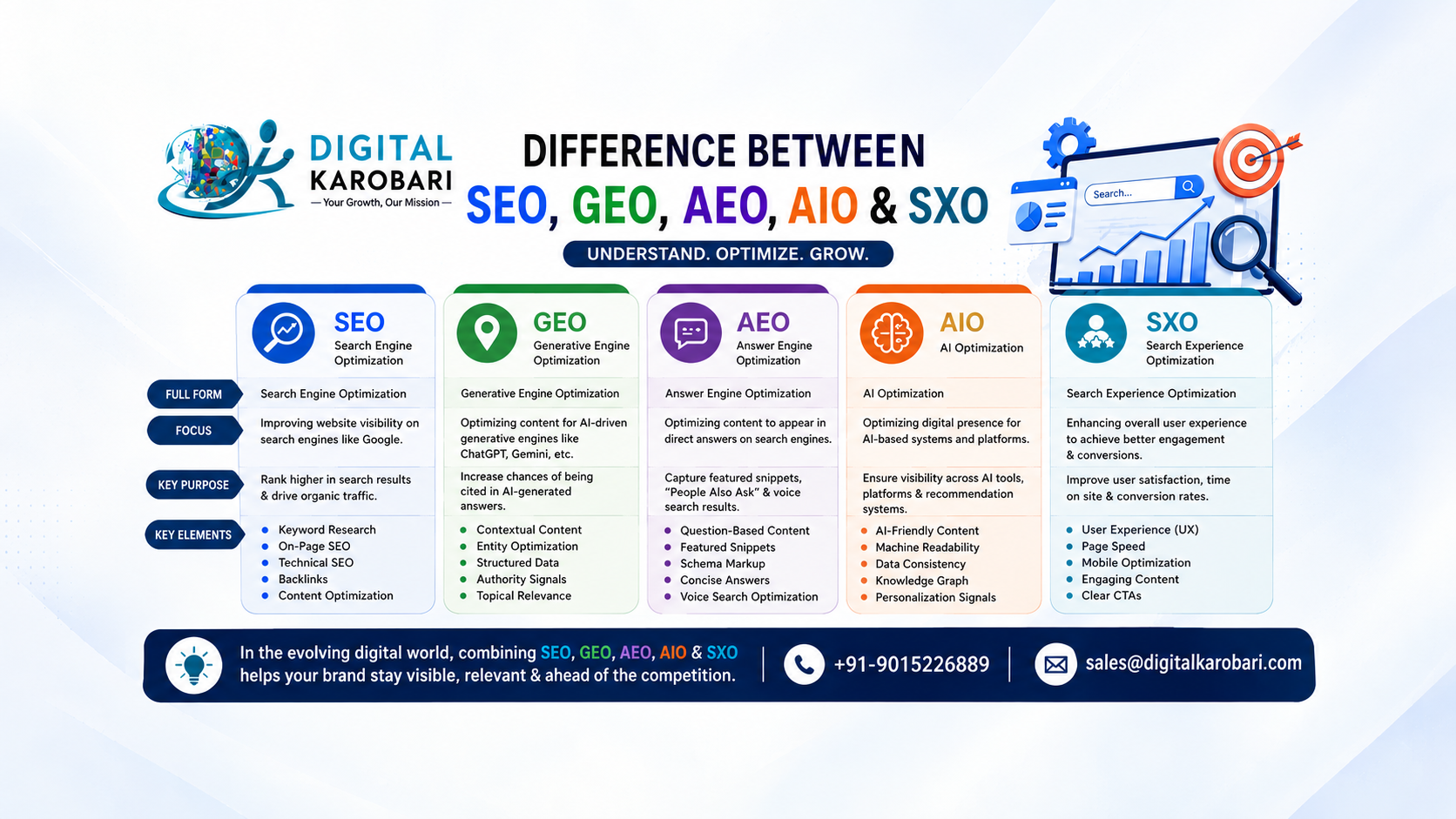
Search is changing rapidly. People no longer rely only on traditional Google searches. They now use AI tools, voice assistants, featured snippets, AI-generated answers, and conversational search platforms to find information. As a result, digital marketers need to understand several search optimization approaches, including SEO, GEO, AEO, AIO, and SXO.
Although these terms sound similar, each focuses on a different aspect of search visibility and user experience. Understanding their differences can help businesses create a stronger digital marketing strategy and reach potential customers across traditional and AI-powered search platforms.
What Is SEO?
SEO (Search Engine Optimization) is the process of improving a website so that its pages can rank higher in traditional search engine results.
SEO focuses on factors such as keyword targeting, high-quality content, technical website performance, backlinks, internal linking, search intent, and website authority.
For example, if someone searches for “best digital marketing agency in Mumbai,” an SEO strategy aims to help a relevant webpage appear prominently in Google’s organic search results.
Key SEO activities include:
Keyword research
On-page optimization
Technical SEO
Content creation
Internal linking
Link building
Local SEO
Website performance optimization
Main goal: Increase organic visibility and website traffic from search engines.
What Is GEO?
GEO (Generative Engine Optimization) focuses on improving a brand’s visibility in AI-generated search results.
Instead of simply trying to rank a webpage among traditional blue links, GEO aims to make a brand or website more likely to be mentioned, cited, or represented accurately in AI-generated answers.
AI-powered search experiences can summarize information from multiple sources before presenting an answer to users. Therefore, businesses need authoritative, trustworthy, well-structured and contextually relevant content.
GEO strategies can include:
Creating authoritative content
Providing clear and factual answers
Building brand authority
Using structured information
Demonstrating expertise and credibility
Covering topics comprehensively
Creating content that AI systems can easily interpret
Main goal: Increase visibility within generative and AI-powered search experiences.
What Is AEO?
AEO (Answer Engine Optimization) focuses on optimizing content to provide direct answers to users’ questions.
Search engines increasingly display answers through featured snippets, People Also Ask sections, voice assistants, and other answer-focused search features.
For example, if a user searches “What is performance marketing?”, a concise and well-structured explanation may be selected as an answer.
AEO content often uses:
Frequently asked questions
Question-based headings
Concise answers
Structured content
Lists and tables
Clear definitions
Natural-language queries
Main goal: Make your content suitable for direct answers in search results.
What Is AIO?
AIO (AI Optimization) is a broader approach focused on making digital content, websites, and brand information easier for AI systems to understand, process, retrieve, and use.
While GEO specifically emphasizes visibility in generative search experiences, AIO can be considered a broader AI-focused optimization approach. Depending on the context, the term AIO may also be used differently by marketers, so businesses should define what they mean when using it.
AIO can involve:
Structuring information clearly
Creating authoritative content
Improving entity and brand understanding
Using structured data
Maintaining consistent business information
Producing machine-readable and human-friendly content
Optimizing content for AI-driven discovery
Main goal: Make your digital presence easier for AI systems to understand and surface.
What Is SXO?
SXO (Search Experience Optimization) combines SEO with user experience (UX).
Getting visitors to your website is only the first step. Once users arrive, they should be able to quickly find what they need, understand your offering, and take the desired action.
SXO therefore considers both search visibility and the experience users receive after clicking a search result.
Important SXO factors include:
Page speed
Mobile usability
Website navigation
Content readability
Search intent
Clear calls-to-action
Page layout
Conversion experience
Overall user satisfaction
Main goal: Attract the right visitors and provide an experience that encourages engagement and conversion.
SEO vs GEO vs AEO vs AIO vs SXO
Approach Full Form Primary Focus Main Goal
SEO Search Engine Optimization Traditional search engines Improve organic rankings
GEO Generative Engine Optimization AI-generated search Increase AI visibility and mentions
AEO Answer Engine Optimization Direct answers Become a useful answer source
AIO AI Optimization AI understanding and discovery Make content easier for AI systems to interpret
SXO Search Experience Optimization Search + user experience Improve engagement and conversions
How Are These Strategies Connected?
These approaches should not necessarily be treated as competitors. They can work together as part of a modern search strategy.
A business might use SEO to improve traditional organic visibility, AEO to target question-based searches, GEO/AIO to strengthen visibility in AI-powered experiences, and SXO to ensure visitors have a strong experience after reaching the website.
For example, a digital marketing agency could create a comprehensive article about SEO services. SEO helps the article target relevant search terms. AEO can structure sections around common questions. GEO and AIO can help make the information more understandable and useful in AI-powered search environments. SXO ensures that visitors can easily navigate the page and contact the agency.
Which One Should Your Business Focus On?
The best approach is not to choose only one.
Instead, businesses should build a comprehensive search strategy around quality content, technical accessibility, authority, search intent, structured information, and excellent user experience.
SEO remains an important foundation, while AEO, GEO, AIO and SXO address newer ways people discover and interact with information.
A modern strategy could look like this:
SEO → Get discovered in search
AEO → Answer user questions
GEO → Improve visibility in generative search
AIO → Make information AI-friendly
SXO → Deliver a better experience and convert visitors
Conclusion
The search landscape is evolving beyond traditional rankings. Businesses now need to think about where users search, how search engines answer questions, how AI systems interpret information, and what happens after users visit a website.
SEO, GEO, AEO, AIO and SXO each address a different part of this ecosystem. Rather than treating them as separate marketing techniques, businesses can combine them to build a comprehensive and future-ready digital presence.
For Digital Karobari, this means helping businesses move beyond simply “ranking on Google” toward becoming visible, useful, trustworthy and easy to interact with across modern search experiences.
Ready to Make Your Business Visible Across Modern Search?
Don’t optimize only for rankings. Build a digital presence that users, search engines and AI-powered platforms can understand and trust.
Talk to Digital Karobari today and discover how our SEO, SMO, content and digital marketing strategies can help your business improve online visibility and generate better opportunities.
Company Name: Digital Karobari
🌐: https://digitalkarobari.
📞: +91-9015226889
Frequently Asked Questions
- What is the difference between SEO and GEO?
SEO focuses primarily on improving visibility in traditional search engine results, while GEO focuses on improving a brand’s visibility and representation in generative AI search experiences. - Is AEO replacing SEO?
No. AEO complements SEO by focusing on direct answers and question-based search experiences. A strong SEO foundation can support an effective AEO strategy. - What is the difference between GEO and AIO?
GEO generally focuses on visibility within generative search experiences, whereas AIO is a broader term for optimizing information and digital assets for AI systems. - What does SXO mean in digital marketing?
SXO stands for Search Experience Optimization. It combines search optimization with user experience to improve both website visibility and what users experience after clicking a search result. - Which is more important: SEO or GEO?
Both can be valuable. SEO remains essential for traditional search visibility, while GEO is increasingly relevant as users adopt AI-powered search and answer experiences. - How can businesses prepare for AI search?
Businesses should publish authoritative content, answer customer questions clearly, maintain accurate brand information, improve technical website quality, demonstrate expertise, and create useful content that satisfies user intent. - Can SEO, GEO, AEO, AIO and SXO be used together?
Yes. Combining these approaches can create a broader search strategy that addresses traditional search, direct answers, AI-powered discovery and website user experience.
Leave a Reply