Tag: organic traffic growth

  • Can AI-Generated Content Rank on Google? What Businesses Should Know

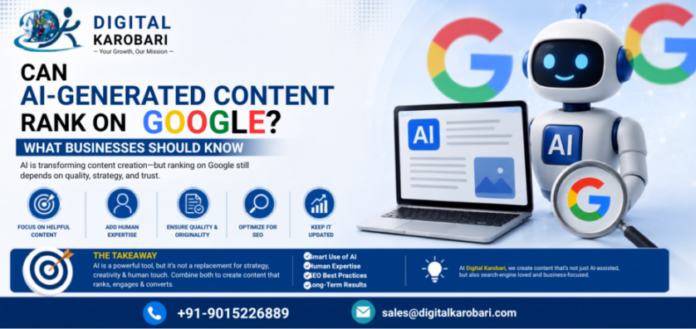
    Can AI-Generated Content Rank on Google? What Businesses Should Know

    AI has changed the way businesses create content. From blog posts and product descriptions to social media copy and website pages, artificial intelligence can help brands produce content faster and at scale. But one question continues to concern businesses and marketers: Can AI-generated content rank on Google?
    The short answer is yes, AI-generated content can rank on Google. However, simply using AI to produce large volumes of content does not guarantee rankings. Google’s focus is on whether content is useful, reliable, original and created to satisfy the needs of users.
    For businesses, the real opportunity lies in using AI as a content-support tool rather than treating it as a replacement for strategy, expertise and human judgment.

    Does Google Penalise AI-Generated Content?

    Google does not automatically penalise content simply because AI was used to create it. What matters is the quality and purpose of the content.
    Google’s search systems are designed to prioritise helpful content that provides value to users. Content created primarily to manipulate search rankings, whether written by humans or AI, can perform poorly.
    This means businesses should avoid publishing AI-generated articles without reviewing, editing and improving them. Content should be fact-checked, relevant to the target audience and aligned with the search intent behind the topic.

    What Makes AI Content Rank on Google?

    AI-generated content can perform well when it follows the same principles expected from high-quality human-written content.

    1. Focus on Search Intent
      Before creating content, understand what the user is actually looking for.
      For example, someone searching for “digital marketing agency for small business” may want to compare agencies, understand services or find a suitable provider. A generic article about digital marketing may not satisfy that intent.
      AI can help generate a first draft, but businesses need human input to make sure the content directly answers the user’s questions.
    2. Add Original Insights
      One of the biggest weaknesses of generic AI content is that it can repeat information already available online.
      Businesses should add something unique, such as:
      ⦁ Industry experience
      ⦁ Original examples
      ⦁ Case studies
      ⦁ Expert opinions
      ⦁ Data and research
      ⦁ Practical recommendations
      ⦁ Customer experiences
      ⦁ First-hand observations
      Original insights can make content more valuable and differentiated.
    3. Demonstrate Expertise and Trust
      Content becomes stronger when it reflects genuine knowledge of the subject.
      For example, a healthcare company should provide medically responsible and professionally reviewed information. An engineering company should demonstrate technical expertise. A digital marketing agency should support recommendations with practical experience and measurable results.
      AI can assist with writing, but subject-matter expertise gives the content credibility.
    4. Avoid Keyword Stuffing
      Using AI to insert the same keyword repeatedly can make content unnatural and difficult to read.
      Instead, businesses should focus on covering the topic comprehensively and naturally using related terms, questions and concepts.
      The goal should be to help the reader first and optimise for search engines second.
    5. Fact-Check AI-Generated Content
      AI tools can sometimes produce inaccurate, outdated or misleading information.
      Before publishing an AI-assisted article, businesses should verify:
      ⦁ Statistics
      ⦁ Dates
      ⦁ Names
      ⦁ Industry claims
      ⦁ Product specifications
      ⦁ Regulations
      ⦁ Research references
      ⦁ Links and sources
      Human review is particularly important for technical, financial, legal, healthcare and other sensitive topics.

    AI Content vs Human Content: What Should Businesses Choose?

    The choice does not have to be AI versus humans.
    A better approach is AI + human expertise.
    AI can help businesses with research, content outlines, brainstorming, first drafts, headline ideas, content repurposing and editing. Human writers and subject-matter experts can then add experience, context, accuracy, originality and brand voice.
    This combination can make the content creation process more efficient without sacrificing quality.

    Can AI-Generated Blog Posts Rank?

    Yes. An AI-assisted blog can rank if it provides genuine value and satisfies the user’s search intent.
    However, publishing hundreds of generic AI articles simply because they can be produced quickly is unlikely to be an effective long-term SEO strategy.
    A better process is:
    Research → Search Intent → Content Strategy → AI Assistance → Human Expertise → Fact Checking → SEO Optimisation → Publishing → Performance Analysis
    This approach allows businesses to benefit from AI while maintaining the quality expected from a professional website.

    How Businesses Can Use AI Without Hurting SEO

    Businesses can use AI responsibly throughout their content workflow.

    Use AI for Research and Ideas
    AI can help identify potential topics, questions and content angles. These ideas should then be validated through keyword research and actual audience needs.

    Create Detailed Content Briefs
    Instead of asking AI to “write a 2,000-word SEO article,” provide a detailed brief covering the target audience, search intent, key questions, tone, keywords, internal links and important points to address.

    Add Human Experience
    After generating a draft, add examples from your business, customer questions, project experience and industry knowledge.

    Optimise for Readers
    Use clear headings, short paragraphs, useful examples, bullet points and logical content structure. Good SEO content should be easy to understand and navigate.

    Keep Content Updated
    Industries, products, regulations and search trends change. Businesses should periodically review important content and update outdated information.

    What Businesses Should Avoid When Using AI Content

    AI can become a problem when it is used purely for mass content production.
    Avoid:
    ⦁ Publishing unedited AI-generated articles
    ⦁ Creating content solely to target keywords
    ⦁ Producing large volumes of repetitive pages
    ⦁ Making unsupported claims
    ⦁ Copying competitors’ content
    ⦁ Adding keywords unnaturally
    ⦁ Publishing inaccurate information
    ⦁ Using AI without understanding the target audience
    ⦁ Creating content that provides little value beyond what already exists online
    The objective should not be to publish more content. It should be to publish better content.

    The Future of AI and SEO

    AI is likely to remain an important part of digital marketing and SEO. As AI tools become more advanced, businesses will be able to produce and personalise content more efficiently.
    At the same time, originality, expertise, trust and usefulness will remain important differentiators.
    Businesses that combine AI technology with strong SEO strategy, human expertise and genuine audience understanding will be better positioned to build sustainable organic visibility.

    Final Thoughts

    So, can AI-generated content rank on Google? Yes, it can.
    But ranking should not be the result of simply generating content with AI and publishing it. Businesses need to focus on search intent, originality, accuracy, expertise, user experience and genuine value.
    AI should be viewed as a powerful assistant—not a shortcut around good SEO.
    For businesses, the winning approach is simple: use AI to improve the content creation process, but use human expertise to make the content worth reading.

    Want to turn AI into a smarter part of your SEO strategy?

    At Digital Karobari, we help businesses build SEO and digital marketing strategies designed around visibility, relevant traffic and long-term growth. From content strategy and SEO to performance-focused digital marketing, our team can help you use AI effectively without compromising quality.
    Get in touch with Digital Karobari today and build a smarter content strategy for your business.
    Company Name: Digital Karobari
    🌐: https://digitalkarobari.
    📞: +91-9015226889

    Frequently Asked Questions

    1. Can Google rank AI-generated content?
      Yes. Google can rank AI-generated content when it is useful, relevant, accurate and created to satisfy users’ needs. The use of AI itself does not automatically prevent content from ranking.
    2. Does Google penalise websites for using AI content?
      Google does not automatically penalise content simply because AI was used. However, content created primarily to manipulate search rankings or provide little value can perform poorly regardless of whether it was written by AI or a human.
    3. Is AI-generated content good for SEO?
      AI-generated content can support SEO when it is properly researched, reviewed, fact-checked and enhanced with original insights. Businesses should avoid relying on unedited, generic AI content.
    4. Should businesses disclose that content was created using AI?
      The need for disclosure can depend on the context, industry and applicable requirements. Businesses should prioritise transparency and accuracy, particularly when content could significantly affect users’ decisions.
    5. Can AI-written blogs rank on the first page of Google?
      Yes, AI-assisted blogs can reach the first page when they provide strong value, satisfy search intent, demonstrate expertise and compete effectively with existing search results. There is no guaranteed ranking simply because AI was used.
    6. How can businesses improve AI-generated content?
      Businesses can improve AI-generated content by adding original insights, expert opinions, real examples, accurate data, appropriate internal links, relevant keywords and a strong brand voice. Human editing and fact-checking are also essential.
    7. Is human-written content better than AI content?
      Not necessarily. Quality depends more on usefulness, accuracy, originality and relevance than on whether AI or a human produced the initial draft. A combination of AI assistance and human expertise can be highly effective.
  • How Competitor Analysis Can Improve Your SEO Strategy

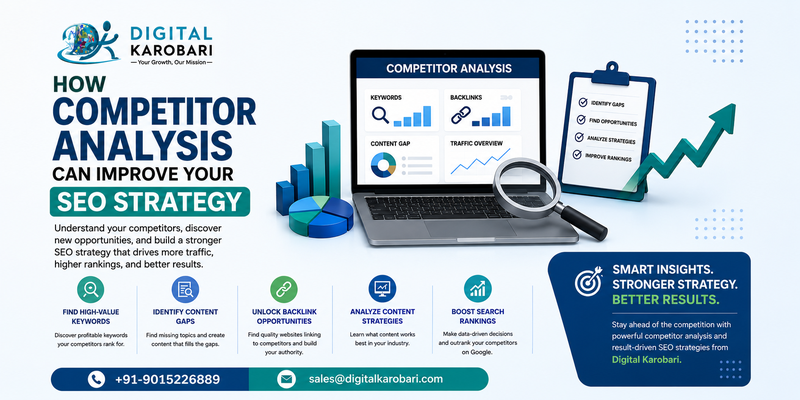
    How Competitor Analysis Can Improve Your SEO Strategy

    SEO is not only about optimizing your own website. To build a stronger search strategy, businesses also need to understand what competitors are doing, which keywords they target, what type of content they publish, and where they are earning visibility.
    Competitor analysis provides valuable insights that can help businesses identify opportunities, avoid common mistakes, and develop a more focused SEO strategy. Instead of copying competitors, the goal is to understand the search landscape and find ways to create something better and more useful.
    For businesses working with Digital Karobari, competitor analysis can be an important part of developing a data-driven SEO and digital marketing strategy.

    What Is SEO Competitor Analysis?

    SEO competitor analysis is the process of researching websites that compete with your business in search engine results.
    These competitors may not always be your direct business competitors. A website could compete with you for specific keywords even if it offers a slightly different product or service.
    An SEO competitor analysis typically examines:
    Target keywords
    Search rankings
    Content strategy
    Website structure
    Backlink profiles
    Search intent
    Featured search results
    Internal linking
    On-page optimization
    Local SEO presence
    The information gathered can then be used to identify gaps and opportunities for your own website.

    Why Is Competitor Analysis Important for SEO?

    Search results are competitive. If several businesses are targeting the same audience, simply publishing content may not be enough to achieve strong rankings.
    Competitor analysis can help answer important questions:
    Which keywords are competitors ranking for?
    What topics are generating visibility for them?
    What type of content does Google appear to prefer?
    Where are competitors weak?
    Which topics have not been covered well?
    What backlinks or online mentions are helping competitors?
    These insights can make SEO planning more strategic.

    1. Discover Valuable Keyword Opportunities
      One of the biggest benefits of competitor analysis is discovering keywords you may have overlooked.
      For example, your competitors may rank for long-tail searches related to your products or services that are not currently included in your SEO strategy.
      Instead of targeting only highly competitive keywords, you can identify opportunities across different stages of the customer journey.
      These may include:
      Informational keywords
      Commercial keywords
      Transactional keywords
      Local search terms
      Long-tail keywords
      Problem-based searches
      The goal is not to copy a competitor’s keyword list but to identify relevant opportunities that align with your own business.
    2. Identify Content Gaps
      A content gap occurs when your website does not adequately address a topic that potential customers are searching for.
      Suppose three competitors have detailed guides covering a particular customer problem, while your website has no useful resource addressing it. That represents an opportunity.
      A competitor content analysis can help you discover:
      Missing blog topics
      Questions customers are asking
      Underdeveloped service pages
      Missing comparison content
      Frequently discussed industry problems
      Topics that deserve more detailed coverage
      Once these gaps are identified, businesses can create original content that provides greater value.
    3. Understand Search Intent
      Ranking for a keyword is not simply about using that keyword repeatedly.
      Search intent describes what a user is actually trying to accomplish when they perform a search.
      Competitor analysis can help you understand whether search results for a particular keyword mainly contain:
      Blog articles
      Product pages
      Service pages
      Comparison guides
      Tutorials
      Videos
      Category pages
      For example, if most top-ranking pages for a keyword are detailed educational guides, creating a short promotional page may not satisfy the user’s intent.
      Understanding the current search landscape helps businesses create content that better matches what users expect.
    4. Improve Your Content Strategy
      Competitors can provide useful information about the topics and formats receiving search visibility.
      You can examine:
      Content length
      Headings
      Topics covered
      FAQs
      Images and videos
      Internal links
      Examples
      Original research
      Calls to action
      However, the goal should not be to create a longer version of every competitor article.
      Instead, ask:
      What information is missing?
      Can we explain the topic more clearly?
      Can we provide original examples?
      Can we make the content easier to understand?
      Can we provide more practical value?
      This approach helps transform competitor research into a better content strategy.
    5. Find Backlink Opportunities
      Backlinks can still play an important role in SEO. Competitor backlink analysis can reveal websites that have already linked to similar businesses or industry content.
      These websites may include:
      Industry publications
      Business directories
      Professional organizations
      Resource pages
      Partner websites
      Relevant blogs
      Local business websites
      Instead of trying to replicate every competitor backlink, businesses should focus on earning relevant, credible, and natural links.
    6. Analyze Competitor On-Page SEO
      Competitor analysis can also reveal how successful websites structure their pages.
      You can compare factors such as:
      Page titles
      Meta descriptions
      Heading structure
      URL structure
      Content organization
      Internal links
      Image optimization
      Calls to action
      Service page structure
      This can help identify areas where your website may need improvement.
    7. Discover Local SEO Opportunities
      For businesses serving specific locations, competitor analysis can be especially useful for local SEO.
      You can examine competitors’:
      Google Business Profile presence
      Reviews
      Local landing pages
      Location-specific content
      Business citations
      Local backlinks
      Service-area targeting
      For example, if several competitors are ranking for searches related to a specific city or neighborhood, it may indicate an opportunity to create useful location-focused content or improve your local SEO signals.
    8. Identify Competitor Strengths and Weaknesses
      No competitor is perfect.
      A competitor may have strong backlinks but outdated content. Another may have excellent content but a poor user experience. Someone else may rank well nationally but have weak local visibility.
      A simple SWOT-style analysis can help:
      Area Questions to Ask
      Content What topics do they cover well?
      Keywords Which searches generate visibility?
      Backlinks Where are their links coming from?
      UX Is their website easy to navigate?
      Local SEO How strong is their local presence?
      Technical SEO Are there noticeable performance issues?
      Conversion How effectively do pages encourage action?
      These observations can help you prioritize your own SEO improvements.
    9. Create a Better SEO Roadmap
      Competitor research becomes more valuable when it leads to action.
      Instead of maintaining a list of competitor keywords without a plan, organize opportunities according to their potential business value.
      For example:
      Priority 1: High-intent keywords related directly to your services.
      Priority 2: Content gaps that can attract relevant organic traffic.
      Priority 3: Supporting informational content.
      Priority 4: Authority-building and backlink opportunities.
      This creates a more structured SEO roadmap.

    How to Perform an SEO Competitor Analysis

    A practical competitor analysis can follow these steps:
    Step 1: Identify Your Search Competitors
    Search for your important products, services, and topics. Note the websites consistently appearing in the results.
    Step 2: Analyze Their Keywords
    Identify relevant keywords where competitors have strong visibility and determine whether those searches are relevant to your business.
    Step 3: Review Their Content
    Look at their most visible pages and identify what topics, formats, and questions they address.
    Step 4: Compare Your Website
    Find areas where your content, page structure, internal linking, or user experience can be improved.
    Step 5: Analyze Backlinks
    Research where competitors are earning relevant backlinks and determine which opportunities may be appropriate for your business.
    Step 6: Identify Gaps
    Create a list of keywords, topics, services, locations, and customer questions that your website does not adequately cover.
    Step 7: Build an Action Plan
    Prioritize opportunities based on search intent, business relevance, competition, and potential value rather than simply trying to outperform competitors on every keyword.
    Competitor Analysis Does Not Mean Copying
    One of the most important principles of competitor research is don’t copy—learn.
    Copying another website’s content, structure, branding, or messaging will not create a sustainable SEO advantage.
    Instead, competitor research should help you understand the market and discover opportunities to provide something more useful.
    Your content should offer your own expertise, examples, insights, experience, and solutions.

    Common Competitor Analysis Mistakes

    Businesses often make mistakes such as:
    Focusing only on competitor rankings
    Copying competitor content
    Targeting every keyword competitors rank for
    Ignoring search intent
    Looking only at backlinks
    Choosing competitors based only on business type
    Ignoring local competitors
    Failing to prioritize opportunities
    Not connecting SEO research with business goals
    Competitor analysis should be a continuous learning process rather than a one-time activity.

    How Digital Karobari Can Help

    A successful SEO strategy requires more than keyword research. It involves understanding competitors, customers, search intent, content opportunities, technical performance, and business objectives.
    Digital Karobari helps businesses develop digital marketing strategies that can strengthen their online presence and connect them with relevant audiences.
    By combining competitor research with SEO, content marketing, social media, and other digital strategies, businesses can build a more comprehensive approach to online growth.

    Conclusion

    Competitor analysis can provide valuable insights for improving an SEO strategy. From finding new keywords and content gaps to understanding search intent, backlinks, local SEO, and on-page optimization, competitor research helps businesses make more informed decisions.
    The objective is not to become a copy of your competitors. It is to understand what works, identify what is missing, and create a stronger experience for your target audience.
    When competitor insights are combined with quality content, technical SEO, relevant keywords, and a clear business strategy, they can become a powerful part of long-term organic growth.

    Want to Outperform Your Competitors in Search Results?

    Understanding what your competitors are doing is only the first step. Digital Karobari can help you turn competitor insights into a focused SEO strategy designed around your business goals, target audience, and search opportunities.
    📈 Discover new opportunities. Build better content. Strengthen your online visibility.
    👉 Connect with Digital Karobari today and take the next step toward a stronger SEO strategy.
    Company Name: Digital Karobari
    🌐: https://digitalkarobari.
    📞: +91-9015226889

    FAQs

    1. What is competitor analysis in SEO?
      SEO competitor analysis is the process of researching competing websites to understand their keywords, content, backlinks, rankings, technical structure, and other SEO strategies.
    2. How does competitor analysis improve SEO?
      It can help businesses discover keyword opportunities, identify content gaps, understand search intent, find backlink opportunities, and uncover areas where their website can be improved.
    3. Should I target all the keywords my competitors rank for?
      No. Competitor keywords should be evaluated based on relevance, search intent, competition, and potential business value before being added to your SEO strategy.
    4. How often should businesses perform competitor analysis?
      A detailed analysis can be performed periodically, while important competitor changes can be monitored more regularly. The frequency depends on how competitive and fast-changing the industry is.
    5. Can competitor analysis help with content marketing?
      Yes. It can reveal topics, questions, formats, and content gaps that can inform a more useful and relevant content strategy.
    6. Can competitor analysis improve local SEO?
      Yes. Reviewing local competitors can reveal opportunities involving location pages, reviews, local content, citations, local backlinks, and Google Business Profile optimization.
    7. Is competitor backlink analysis important?
      It can be useful for discovering relevant websites and potential link-building opportunities. However, businesses should focus on earning quality, relevant links rather than copying every competitor backlink.
    8. Does competitor analysis guarantee higher Google rankings?
      No. Competitor analysis provides insights, but rankings depend on many factors, including content quality, relevance, technical SEO, authority, user experience, competition, and search engine algorithms.
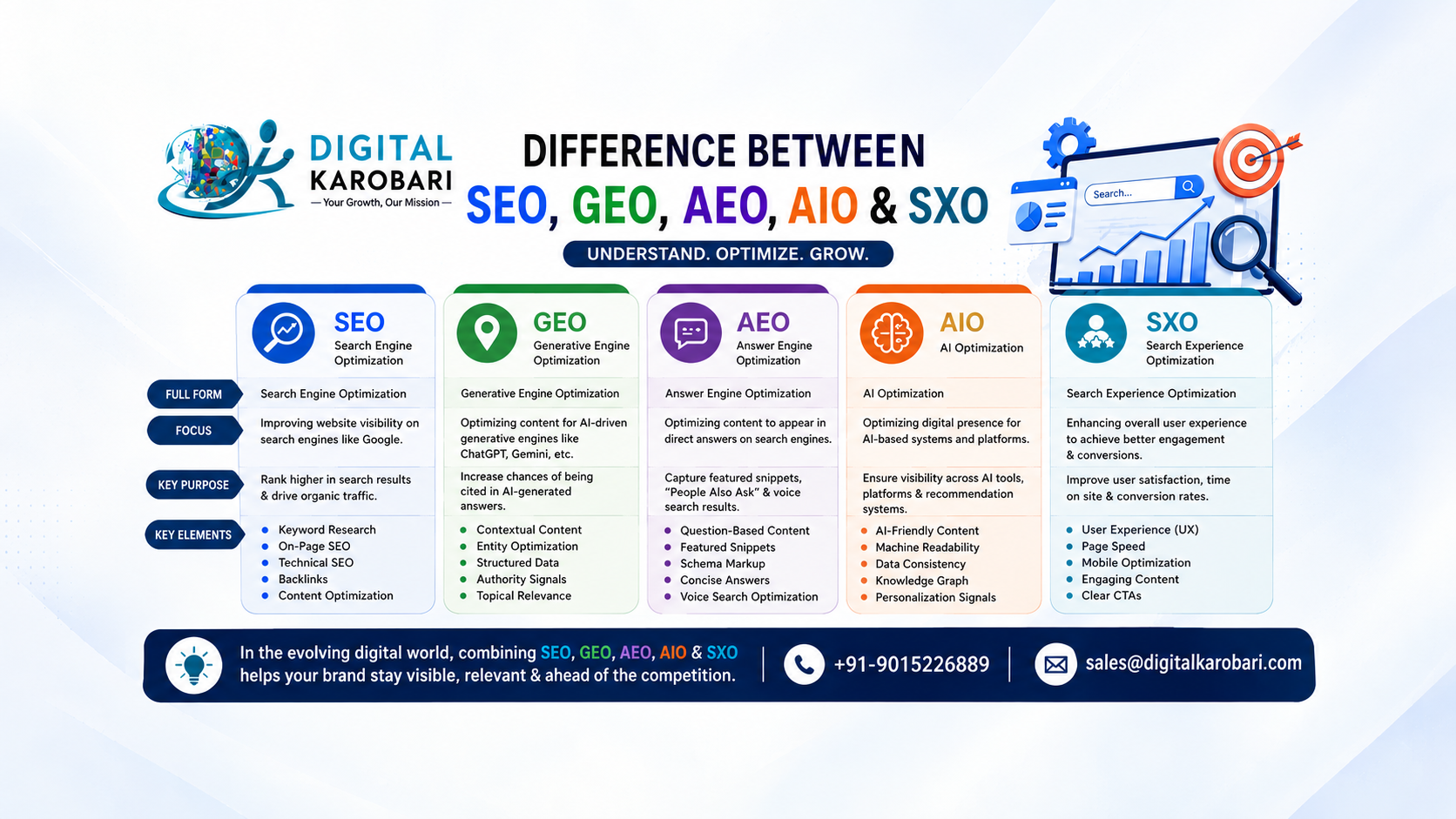
  • Difference Between SEO, GEO, AEO, AIO & SXO: A Complete Guide for Modern Search

    Difference Between SEO, GEO, AEO, AIO & SXO: A Complete Guide for Modern Search

    Search is changing rapidly. People no longer rely only on traditional Google searches. They now use AI tools, voice assistants, featured snippets, AI-generated answers, and conversational search platforms to find information. As a result, digital marketers need to understand several search optimization approaches, including SEO, GEO, AEO, AIO, and SXO.
    Although these terms sound similar, each focuses on a different aspect of search visibility and user experience. Understanding their differences can help businesses create a stronger digital marketing strategy and reach potential customers across traditional and AI-powered search platforms.

    What Is SEO?

    SEO (Search Engine Optimization) is the process of improving a website so that its pages can rank higher in traditional search engine results.
    SEO focuses on factors such as keyword targeting, high-quality content, technical website performance, backlinks, internal linking, search intent, and website authority.
    For example, if someone searches for “best digital marketing agency in Mumbai,” an SEO strategy aims to help a relevant webpage appear prominently in Google’s organic search results.
    Key SEO activities include:
    Keyword research
    On-page optimization
    Technical SEO
    Content creation
    Internal linking
    Link building
    Local SEO
    Website performance optimization
    Main goal: Increase organic visibility and website traffic from search engines.

    What Is GEO?

    GEO (Generative Engine Optimization) focuses on improving a brand’s visibility in AI-generated search results.
    Instead of simply trying to rank a webpage among traditional blue links, GEO aims to make a brand or website more likely to be mentioned, cited, or represented accurately in AI-generated answers.
    AI-powered search experiences can summarize information from multiple sources before presenting an answer to users. Therefore, businesses need authoritative, trustworthy, well-structured and contextually relevant content.
    GEO strategies can include:
    Creating authoritative content
    Providing clear and factual answers
    Building brand authority
    Using structured information
    Demonstrating expertise and credibility
    Covering topics comprehensively
    Creating content that AI systems can easily interpret
    Main goal: Increase visibility within generative and AI-powered search experiences.

    What Is AEO?

    AEO (Answer Engine Optimization) focuses on optimizing content to provide direct answers to users’ questions.
    Search engines increasingly display answers through featured snippets, People Also Ask sections, voice assistants, and other answer-focused search features.
    For example, if a user searches “What is performance marketing?”, a concise and well-structured explanation may be selected as an answer.
    AEO content often uses:
    Frequently asked questions
    Question-based headings
    Concise answers
    Structured content
    Lists and tables
    Clear definitions
    Natural-language queries
    Main goal: Make your content suitable for direct answers in search results.

    What Is AIO?

    AIO (AI Optimization) is a broader approach focused on making digital content, websites, and brand information easier for AI systems to understand, process, retrieve, and use.
    While GEO specifically emphasizes visibility in generative search experiences, AIO can be considered a broader AI-focused optimization approach. Depending on the context, the term AIO may also be used differently by marketers, so businesses should define what they mean when using it.
    AIO can involve:
    Structuring information clearly
    Creating authoritative content
    Improving entity and brand understanding
    Using structured data
    Maintaining consistent business information
    Producing machine-readable and human-friendly content
    Optimizing content for AI-driven discovery
    Main goal: Make your digital presence easier for AI systems to understand and surface.

    What Is SXO?

    SXO (Search Experience Optimization) combines SEO with user experience (UX).
    Getting visitors to your website is only the first step. Once users arrive, they should be able to quickly find what they need, understand your offering, and take the desired action.
    SXO therefore considers both search visibility and the experience users receive after clicking a search result.
    Important SXO factors include:
    Page speed
    Mobile usability
    Website navigation
    Content readability
    Search intent
    Clear calls-to-action
    Page layout
    Conversion experience
    Overall user satisfaction
    Main goal: Attract the right visitors and provide an experience that encourages engagement and conversion.

    SEO vs GEO vs AEO vs AIO vs SXO

    Approach Full Form Primary Focus Main Goal
    SEO Search Engine Optimization Traditional search engines Improve organic rankings
    GEO Generative Engine Optimization AI-generated search Increase AI visibility and mentions
    AEO Answer Engine Optimization Direct answers Become a useful answer source
    AIO AI Optimization AI understanding and discovery Make content easier for AI systems to interpret
    SXO Search Experience Optimization Search + user experience Improve engagement and conversions

    How Are These Strategies Connected?

    These approaches should not necessarily be treated as competitors. They can work together as part of a modern search strategy.
    A business might use SEO to improve traditional organic visibility, AEO to target question-based searches, GEO/AIO to strengthen visibility in AI-powered experiences, and SXO to ensure visitors have a strong experience after reaching the website.
    For example, a digital marketing agency could create a comprehensive article about SEO services. SEO helps the article target relevant search terms. AEO can structure sections around common questions. GEO and AIO can help make the information more understandable and useful in AI-powered search environments. SXO ensures that visitors can easily navigate the page and contact the agency.

    Which One Should Your Business Focus On?

    The best approach is not to choose only one.
    Instead, businesses should build a comprehensive search strategy around quality content, technical accessibility, authority, search intent, structured information, and excellent user experience.
    SEO remains an important foundation, while AEO, GEO, AIO and SXO address newer ways people discover and interact with information.
    A modern strategy could look like this:
    SEO → Get discovered in search
    AEO → Answer user questions
    GEO → Improve visibility in generative search
    AIO → Make information AI-friendly
    SXO → Deliver a better experience and convert visitors

    Conclusion

    The search landscape is evolving beyond traditional rankings. Businesses now need to think about where users search, how search engines answer questions, how AI systems interpret information, and what happens after users visit a website.
    SEO, GEO, AEO, AIO and SXO each address a different part of this ecosystem. Rather than treating them as separate marketing techniques, businesses can combine them to build a comprehensive and future-ready digital presence.
    For Digital Karobari, this means helping businesses move beyond simply “ranking on Google” toward becoming visible, useful, trustworthy and easy to interact with across modern search experiences.

    Ready to Make Your Business Visible Across Modern Search?

    Don’t optimize only for rankings. Build a digital presence that users, search engines and AI-powered platforms can understand and trust.
    Talk to Digital Karobari today and discover how our SEO, SMO, content and digital marketing strategies can help your business improve online visibility and generate better opportunities.
    Company Name: Digital Karobari
    🌐: https://digitalkarobari.
    📞: +91-9015226889

    Frequently Asked Questions

    1. What is the difference between SEO and GEO?
      SEO focuses primarily on improving visibility in traditional search engine results, while GEO focuses on improving a brand’s visibility and representation in generative AI search experiences.
    2. Is AEO replacing SEO?
      No. AEO complements SEO by focusing on direct answers and question-based search experiences. A strong SEO foundation can support an effective AEO strategy.
    3. What is the difference between GEO and AIO?
      GEO generally focuses on visibility within generative search experiences, whereas AIO is a broader term for optimizing information and digital assets for AI systems.
    4. What does SXO mean in digital marketing?
      SXO stands for Search Experience Optimization. It combines search optimization with user experience to improve both website visibility and what users experience after clicking a search result.
    5. Which is more important: SEO or GEO?
      Both can be valuable. SEO remains essential for traditional search visibility, while GEO is increasingly relevant as users adopt AI-powered search and answer experiences.
    6. How can businesses prepare for AI search?
      Businesses should publish authoritative content, answer customer questions clearly, maintain accurate brand information, improve technical website quality, demonstrate expertise, and create useful content that satisfies user intent.
    7. Can SEO, GEO, AEO, AIO and SXO be used together?
      Yes. Combining these approaches can create a broader search strategy that addresses traditional search, direct answers, AI-powered discovery and website user experience.
  • Cloud-Based ERP vs. Traditional ERP: What Should Businesses Choose?

    Cloud-Based ERP vs. Traditional ERP: What Should Businesses Choose?

    Businesses today need accurate data, streamlined operations, and faster decision-making to remain competitive. An Enterprise Resource Planning (ERP) system brings key business functions such as finance, inventory, sales, purchasing, human resources, and operations together on a single platform.
    However, businesses often face an important decision: Should they invest in a traditional on-premise ERP system or move to a cloud-based ERP solution?
    Both approaches can help organizations manage their operations, but they differ significantly in terms of cost, accessibility, maintenance, scalability, and flexibility. Understanding these differences can help businesses choose an ERP model that fits their current requirements and future growth plans.

    What Is a Cloud-Based ERP?

    A cloud-based ERP is hosted on remote servers and accessed through the internet. Instead of purchasing and maintaining extensive hardware, businesses use the ERP system through a cloud provider.
    The provider generally manages infrastructure, software updates, security, backups, and system maintenance. Employees can access the ERP from authorized devices and locations, making it particularly useful for businesses with distributed teams or multiple locations.
    Cloud ERP can also make it easier for growing businesses to scale their operations because additional users, features, or resources can typically be added without installing new infrastructure.

    What Is a Traditional ERP?

    Traditional ERP, also known as on-premise ERP, is installed and operated on a company’s own servers and IT infrastructure. The organization is responsible for hardware, software installation, maintenance, upgrades, backups, and much of the system’s security management.
    This model can provide businesses with extensive control over their ERP environment. It may also be suitable for organizations with highly specific customization requirements or internal IT teams capable of managing complex infrastructure.
    However, the initial investment and ongoing maintenance requirements can be considerably higher.

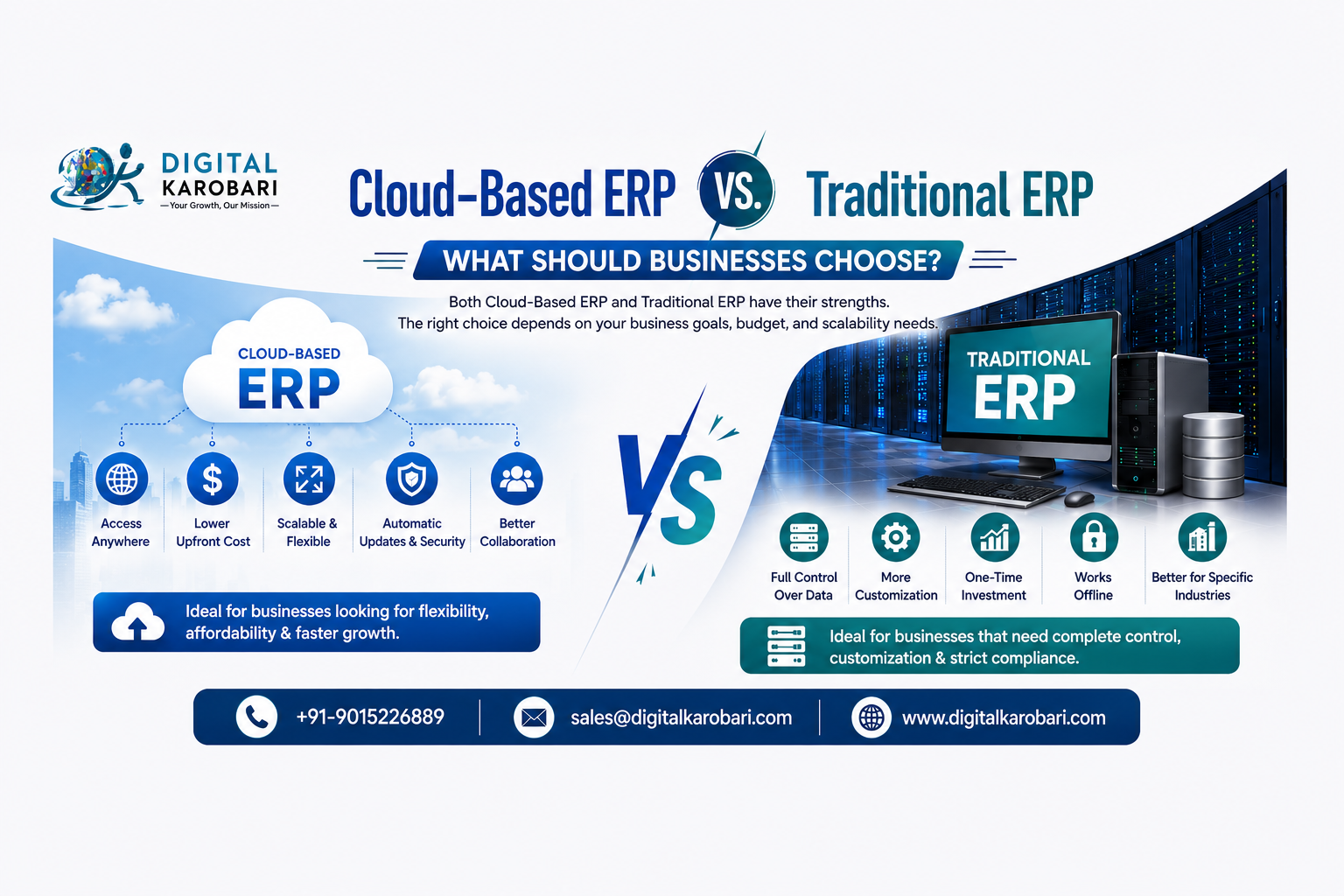
    Cloud-Based ERP vs. Traditional ERP

    Factor Cloud-Based ERP Traditional ERP
    Deployment Hosted in the cloud Installed on company infrastructure
    Initial Investment Generally lower Generally higher
    Accessibility Accessible through the internet Usually accessed through company network
    Maintenance Mostly managed by provider Managed by internal IT team
    Updates Usually handled by provider Organization manages upgrades
    Scalability Easier to scale May require additional hardware
    Infrastructure Minimal in-house infrastructure Requires servers and related hardware
    Remote Work Well suited for distributed teams Can require additional setup
    Customization Depends on the platform Often offers extensive customization
    IT Requirements Lower infrastructure burden Greater internal IT responsibility

    Benefits of Cloud-Based ERP

    1. Lower Infrastructure Requirements
      Cloud ERP reduces the need for businesses to purchase and maintain dedicated servers and other infrastructure. This can make ERP adoption more practical for small and medium-sized businesses.
    2. Access From Multiple Locations
      Authorized employees can access cloud ERP systems from different locations using an internet connection. This can support remote teams, branch offices, traveling employees, and businesses operating across multiple locations.
    3. Easier Scalability
      As a business grows, its ERP requirements can change. Cloud-based solutions can provide greater flexibility when adding users, locations, or capabilities.
    4. Simplified Maintenance
      Cloud ERP providers typically handle software maintenance, infrastructure management, and updates. This reduces the amount of technical work that needs to be handled internally.
    5. Faster Deployment
      Cloud ERP can often be deployed without the lengthy process of purchasing and configuring extensive physical infrastructure, helping businesses start using their system sooner.

    Benefits of Traditional ERP

    Traditional ERP still has advantages for certain organizations.
    Businesses that require extensive control over their infrastructure may prefer an on-premise solution. Organizations with specialized workflows, strict internal IT policies, or substantial technical resources may find this approach suitable.
    Traditional ERP can also offer significant customization possibilities, depending on the software and implementation partner. However, greater customization can also increase implementation complexity, maintenance requirements, and costs.

    Which ERP Is Better for Small and Medium Businesses?

    For many small and medium-sized businesses, cloud-based ERP can be an attractive option because it reduces infrastructure requirements and provides easier scalability.
    Instead of making a large upfront investment in servers and IT infrastructure, businesses can focus their resources on implementing the ERP system and improving business processes.
    However, the right choice depends on factors such as business size, industry requirements, budget, data policies, customization needs, and internal IT capabilities.

    Which ERP Should Large Enterprises Choose?

    Large organizations should evaluate both options carefully. A traditional ERP may be appropriate when an enterprise requires extensive control and highly customized infrastructure.
    On the other hand, cloud ERP can provide advantages for enterprises with multiple locations, distributed teams, rapidly changing requirements, or a need to scale resources efficiently.
    Rather than choosing an ERP solely based on company size, businesses should evaluate their processes, technical requirements, security policies, long-term goals, and total cost of ownership.

    How to Choose the Right ERP for Your Business

    Before selecting an ERP solution, businesses should consider:
    Current and future business requirements
    Number of employees and users
    Number of locations
    Budget and total cost of ownership
    Required integrations
    Customization requirements
    Data security and compliance needs
    Remote-access requirements
    Internal IT capabilities
    Scalability and future expansion
    It is also important to evaluate the ERP vendor, implementation support, training, data migration process, customer support, and integration capabilities.

    Conclusion

    The choice between cloud-based ERP and traditional ERP depends on what your business needs today and where it plans to go tomorrow.
    Cloud ERP can offer flexibility, accessibility, scalability, and reduced infrastructure responsibilities, while traditional ERP can provide greater control and extensive customization possibilities. Businesses should therefore compare both options based on their operational requirements rather than choosing one simply because it is newer or more popular.
    For businesses looking to modernize operations, the right ERP implementation can help connect departments, improve visibility, streamline processes, and support better decision-making.


    Ready to streamline your business operations with the right ERP solution?

    Explore how Digital Karobari can help your business adopt technology that improves efficiency, connects business processes, and supports sustainable growth. Contact Digital Karobari today to discuss your ERP and digital transformation requirements.
    Company Name: Digital Karobari
    🌐: https://digitalkarobari.
    📞: +91-9015226889

    FAQs

    1. What is the main difference between cloud ERP and traditional ERP?
      Cloud ERP is hosted on remote servers and accessed through the internet, while traditional ERP is installed and maintained on the company’s own infrastructure.
    2. Is cloud ERP cheaper than traditional ERP?
      Cloud ERP can require a lower initial infrastructure investment, but the overall cost depends on users, features, subscription terms, implementation, integrations, and other requirements.
    3. Is cloud ERP suitable for small businesses?
      Yes. Cloud ERP can be suitable for small businesses because it can reduce infrastructure requirements and provide scalable access to business management tools.
    4. Is traditional ERP more secure than cloud ERP?
      Neither model is automatically more secure. Security depends on factors such as system architecture, access controls, encryption, monitoring, backups, policies, and implementation practices.
    5. Can cloud ERP support remote employees?
      Yes. Cloud ERP can allow authorized employees to access business systems remotely, subject to the organization’s access and security policies.
    6. Which ERP is easier to scale?
      Cloud ERP is generally designed to make scaling users, resources, and capabilities easier, although the actual process depends on the ERP provider and pricing model.
    7. Can ERP software be customized?
      Yes. Both cloud and traditional ERP systems can offer customization or configuration options, but the level of customization varies by platform.
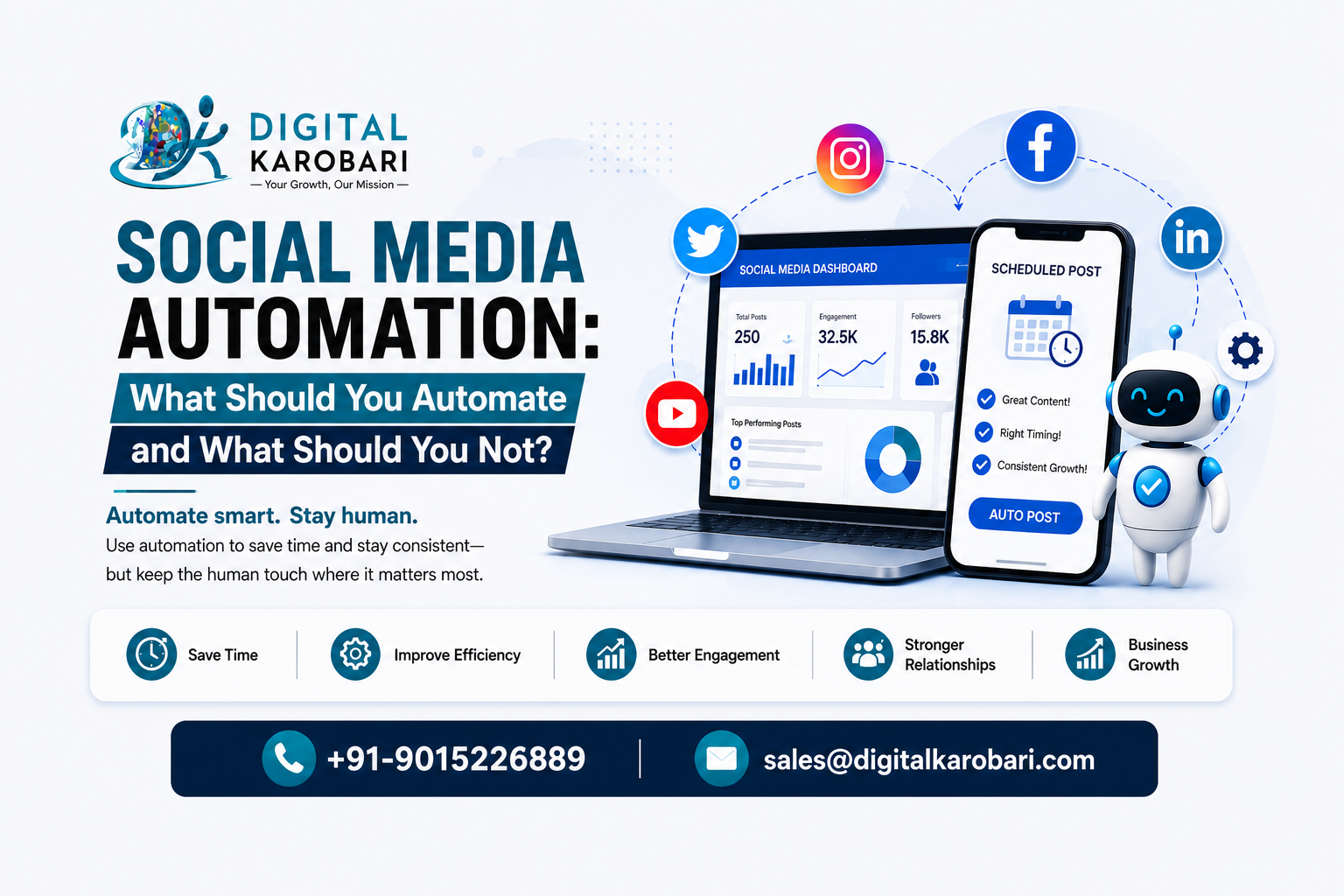
  • Social Media Automation: What Should You Automate and What Should You Not?

    Social Media Automation: What Should You Automate and What Should You Not?

    Social media has become an essential part of digital marketing, but managing multiple platforms consistently can be time-consuming. Businesses need to create content, schedule posts, respond to comments, monitor performance, engage with followers, and keep up with trends. This is where social media automation can make marketing more efficient.
    However, automation does not mean that every part of social media marketing should be handled by software. While automation can save time and improve consistency, excessive automation can make a brand feel impersonal and disconnected from its audience.
    The key is to understand what should be automated and what should remain human-driven.

    What Is Social Media Automation?

    Social media automation is the use of tools and software to perform repetitive social media marketing tasks automatically. These tools can help businesses schedule posts, publish content across platforms, generate reports, monitor mentions, and organize their social media workflow.
    For example, instead of manually publishing an Instagram, Facebook, or LinkedIn post every day, a business can prepare content in advance and schedule it to be published at selected times.
    Automation is particularly useful for businesses managing several social media channels because it reduces repetitive work and allows marketers to spend more time on strategy and creative activities.

    Why Should Businesses Use Social Media Automation?

    The biggest advantage of automation is time efficiency. Marketers can prepare several posts in advance rather than logging into different platforms every day.
    Automation can also improve consistency. Regular posting helps businesses maintain their online presence, and scheduling tools make it easier to follow a content calendar.
    Another benefit is better organization. Businesses can plan campaigns, schedule promotional content, coordinate posts across different platforms, and monitor performance from a centralized workflow.
    However, automation should be used as a supporting tool rather than a replacement for marketing strategy and genuine audience interaction.

    What Should You Automate?

    Schedule Regular Posts
    Post scheduling is one of the safest and most useful forms of social media automation. Businesses can prepare content ahead of time and schedule posts for specific dates and times.
    This is especially useful for evergreen content, educational posts, product updates, company announcements, and promotional campaigns.
    Scheduling also allows marketers to maintain a consistent publishing frequency without having to manually post every day.

    Content Calendar Management
    A social media content calendar can be partially automated using scheduling and workflow tools. Content can be organized according to campaigns, platforms, topics, and publishing dates.
    This helps marketing teams avoid last-minute posting and maintain a balanced content mix.

    Performance Reports
    Generating basic social media reports is another task that can be automated. Tools can collect information such as reach, impressions, engagement, clicks, follower growth, and other performance indicators.
    Automated reports save marketers from manually collecting data from every platform.
    However, automating reporting does not mean automating analysis. A person should still interpret the data and determine what is working and what needs improvement.

    Social Media Monitoring
    Businesses can automate monitoring for specific brand names, product names, keywords, or mentions. This helps marketers identify conversations related to their business.
    Monitoring automation can act as an early-warning system, allowing the marketing team to identify opportunities or potential problems quickly.

    Repetitive Internal Workflows
    Some behind-the-scenes marketing tasks can also be automated. For example, a team can create workflows for content approvals, assigning posts to team members, reminding employees about upcoming campaigns, or organizing published content.
    These processes can reduce administrative work and improve team productivity.

    What Should You NOT Automate?

    Genuine Customer Conversations
    Comments, questions, complaints, and direct messages often require context and empathy. Automatically responding to every interaction can make a business appear robotic.
    Customers want to feel that they are communicating with a real person. Businesses should therefore use automation to identify or organize conversations but keep important interactions human.

    Crisis Management
    Negative reviews, complaints, controversial posts, or public criticism should never be handled entirely through automated responses.
    A poorly timed automated post can make a difficult situation much worse. During a crisis, businesses should pause scheduled promotional content when appropriate and allow a responsible team member to assess the situation.

    Trend-Based Content
    Trending topics can change quickly. Automatically publishing content based on a predefined schedule without considering current events can create embarrassing or insensitive situations.
    Trend-based content requires human judgment because marketers need to understand the context before connecting a trend with their brand.

    Every Comment and Reply
    Automation can help identify comments that require attention, but businesses should avoid sending the same generic response to every person.
    A personalized reply can strengthen relationships and encourage further engagement. Simple interactions may sometimes be automated, but meaningful conversations should remain human.

    Brand Strategy and Creative Direction
    Automation tools can assist with content production and scheduling, but they should not determine the entire brand voice or marketing strategy.
    Human marketers should decide what the brand stands for, who it wants to reach, what type of content it should publish, and how it should communicate with its audience.

    Finding the Right Balance Between Automation and Human Interaction

    The best social media strategy combines automation with human creativity.
    Think of automation as a tool for handling repetitive work, while people remain responsible for strategy, creativity, relationships, and decision-making.
    For example, a business can automate post scheduling and reporting while keeping customer conversations, creative campaigns, crisis communication, and trend analysis under human control.
    This approach allows businesses to save time without sacrificing authenticity.

    Common Social Media Automation Mistakes

    One of the biggest mistakes is automating too much. Publishing the same content across every platform without adapting the message can make the brand feel generic.
    Another mistake is ignoring audience responses because scheduled content is already prepared. Social media is designed for interaction, so businesses need to actively monitor their communities.
    Using automation without reviewing analytics is another problem. Automation can make publishing easier, but marketers still need to evaluate engagement, conversions, audience behavior, and campaign performance.
    Businesses should also regularly review scheduled content. If circumstances change, previously scheduled posts may become irrelevant or inappropriate.

    How Digital Karobari Can Help

    Social media automation works best when it is integrated into a broader social media marketing strategy. Digital Karobari can help businesses plan content, develop social media strategies, manage campaigns, improve engagement, and use digital marketing tools more effectively.
    The objective should not simply be to publish more content. It should be to create a consistent, relevant, and engaging social media presence that supports business growth.

    Conclusion

    Social media automation can significantly reduce repetitive marketing work, improve consistency, and help businesses manage multiple platforms more efficiently. Scheduling posts, organizing content calendars, generating reports, monitoring mentions, and managing internal workflows are all suitable areas for automation.
    At the same time, businesses should avoid automating activities that require empathy, creativity, context, and human judgment. Customer conversations, crisis communication, trend-based content, and brand strategy should remain human-driven.
    The most effective approach is simple: automate repetitive tasks, but keep relationships and decisions human.

    Want to Make Social Media Marketing More Efficient?

    Let Digital Karobari help you build a smarter social media strategy that combines automation, creative content, audience engagement, and performance tracking. Get in touch with our team to create a social media approach designed around your business goals.
    Company Name: Digital Karobari
    🌐: https://digitalkarobari.
    📞: +91-9015226889

    FAQs

    1. What is social media automation?
      Social media automation involves using software and tools to schedule, publish, monitor, and manage repetitive social media marketing activities.
    2. What social media tasks should businesses automate?
      Businesses can automate post scheduling, content calendar workflows, basic reporting, social media monitoring, and repetitive internal marketing tasks.
    3. What should not be automated on social media?
      Customer conversations, crisis communication, creative strategy, sensitive responses, and trend-based content should generally be handled by humans.
    4. Is social media automation good for small businesses?
      Yes. Automation can help small businesses save time, maintain consistent posting, and manage multiple social media channels with fewer resources.
    5. Can social media automation reduce engagement?
      Over-automation can reduce engagement if audiences receive generic responses or irrelevant content. Automation should support human interaction rather than replace it.
    6. Should businesses automatically reply to comments?
      Not every comment should receive an automated response. Meaningful questions, complaints, and conversations should receive personalized human responses.
    7. Is social media automation the same as social media marketing?
      No. Automation is a tool within social media marketing. A complete social media strategy also includes content creation, audience research, engagement, branding, analytics, and campaign planning.
    8. How can a business use automation without losing authenticity?
      Automate repetitive publishing and administrative tasks while keeping creative decisions, customer conversations, community engagement, and sensitive communications human.
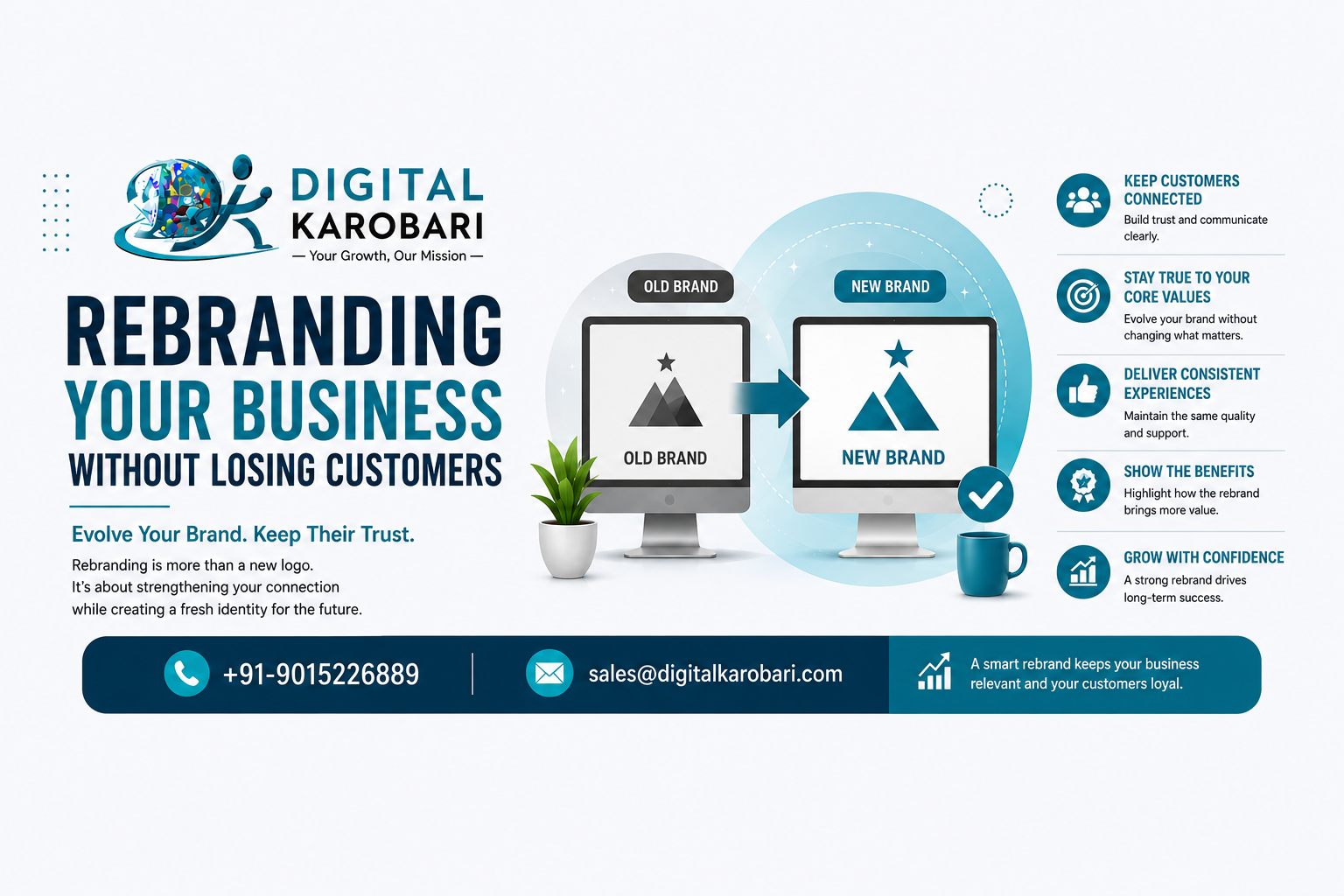
  • Rebranding Your Business Without Losing Customers

    Rebranding Your Business Without Losing Customers

    In today’s competitive business landscape, staying relevant is essential for long-term success. As customer preferences evolve and market trends change, businesses often need to refresh their image to remain competitive. This process, known as rebranding, can help attract new customers, strengthen your market position, and modernize your business. However, if handled poorly, rebranding can confuse loyal customers and negatively impact your reputation.
    The key to a successful rebrand is maintaining customer trust while introducing meaningful improvements. A thoughtful strategy ensures your existing audience continues to recognize and support your business while allowing you to expand your reach.

    What Is Business Rebranding?

    Business rebranding is the process of updating or completely changing your company’s visual identity, messaging, values, or positioning. It may involve:
    Designing a new logo
    Updating your website
    Refreshing your brand colors
    Creating a new brand voice
    Improving customer experience
    Changing marketing materials
    Introducing a new business vision
    Rebranding is much more than changing your logo—it’s about creating a stronger connection with your target audience.

    Why Businesses Rebrand

    Businesses choose to rebrand for several reasons, including:

    Keeping Up with Market Trends
    Consumer expectations and design preferences evolve. A modern brand helps your business remain relevant.

    Expanding Your Target Audience
    A refreshed identity can attract new customer segments while strengthening relationships with existing customers.

    Standing Out from Competitors
    A unique and memorable brand identity differentiates your business in crowded markets.

    Reflecting Business Growth
    If your products, services, or mission have evolved, your branding should reflect these changes.

    Building Greater Trust
    Professional branding enhances credibility and improves customer confidence.

    Common Rebranding Mistakes

    Avoid these common pitfalls:
    Changing everything at once without a strategy
    Ignoring customer feedback
    Losing your brand’s core identity
    Inconsistent messaging across platforms
    Poor communication with customers
    Neglecting SEO during website updates
    Forgetting to update social media profiles

    How to Rebrand Without Losing Customers

    Understand Why You’re Rebranding
    Before making changes, define clear objectives. Ask questions like:
    What problems are we solving?
    Who is our target audience?
    What business goals do we want to achieve?
    Having a clear purpose keeps your rebranding focused.

    Preserve Your Brand Values
    While visual elements may change, your company’s mission, values, and commitment to customers should remain consistent.
    Customers stay loyal because of trust—not just logos.

    Research Your Audience
    Understand what your customers appreciate about your brand.
    Gather insights through:
    Customer surveys
    Social media polls
    Online reviews
    Website analytics
    Sales feedback
    Use this information to make informed decisions.

    Refresh, Don’t Reinvent
    Unless absolutely necessary, avoid drastic changes.
    Instead:
    Modernize your logo
    Improve typography
    Update colors
    Enhance messaging
    Improve website usability
    Gradual improvements help customers adapt.

    Communicate the Changes Clearly
    Tell customers why you’re rebranding.
    Explain:
    What is changing
    Why it’s changing
    How it benefits them
    Transparency builds trust.

    Maintain Consistency
    Update your branding across every customer touchpoint:
    Website
    Social media
    Email marketing
    Business cards
    Brochures
    Advertisements
    Packaging
    Consistent branding reinforces recognition.

    Keep Your Website SEO-Friendly
    Website redesigns often affect search rankings.
    During rebranding:
    Maintain URL structures where possible
    Set up 301 redirects
    Update metadata
    Refresh content
    Optimize images
    Improve page speed
    This helps preserve organic traffic.

    Involve Your Existing Customers
    Invite loyal customers to participate in the process.
    Share:
    Sneak peeks
    Design concepts
    Polls
    Feedback forms
    Customers appreciate being included.

    Launch Strategically
    Plan your rollout carefully.
    A successful launch includes:
    Website announcement
    Email campaign
    Social media updates
    Press release
    Promotional offers
    Blog announcement
    Create excitement rather than confusion.

    Monitor Customer Feedback
    After launch, track:
    Website traffic
    Customer inquiries
    Social engagement
    Online reviews
    Sales performance
    Use customer feedback to make improvements.

    Signs It’s Time to Rebrand

    Every business reaches a point where its brand no longer reflects its vision, services, or the expectations of its target audience. If your logo, website, or marketing materials look outdated, it may be time for a refresh. Other signs include declining customer engagement, increased competition, expanding into new markets, or offering new products and services that your current brand doesn’t represent. Negative customer perceptions, inconsistent branding across platforms, and a drop in online visibility are also indicators that your business could benefit from rebranding. A well-planned rebrand helps your company stay relevant, strengthen its market position, and build stronger connections with both existing and potential customers.

    Benefits of Successful Rebranding

    A successful rebranding strategy can transform the way customers perceive your business while creating new opportunities for growth. It strengthens brand recognition, builds credibility, and enhances customer trust by presenting a more professional and modern image. Rebranding also helps businesses attract new audiences, differentiate themselves from competitors, and better communicate their unique value proposition. From an online marketing perspective, updating your website, improving user experience, and optimizing content can boost search engine rankings and increase organic traffic. Ultimately, a well-executed rebrand leads to improved customer loyalty, higher engagement, increased lead generation, and sustainable business growth.

    How Digital Karobari Helps Businesses Rebrand

    At Digital Karobari, we understand that rebranding is more than changing a logo—it’s about creating a stronger, more memorable identity that drives business success. Our team works closely with businesses to develop customized rebranding strategies that align with their goals, target audience, and market trends. We offer comprehensive branding solutions, including brand strategy, logo and visual identity design, website redesign and development, SEO optimization, content marketing, social media branding, and performance marketing. By combining creative design with data-driven digital marketing strategies, we ensure your rebrand not only looks modern but also improves online visibility, customer engagement, and lead generation. Whether you’re a startup looking to establish a strong identity or an established business seeking a fresh image, Digital Karobari helps you rebrand confidently while maintaining the trust and loyalty of your existing customers.

    Conclusion

    Rebranding is an opportunity to strengthen your business, not erase its identity. When guided by clear goals, customer insights, consistent messaging, and careful execution, a rebrand can refresh your business while preserving the trust and loyalty you’ve built over time.
    Whether you’re updating your logo, redesigning your website, or repositioning your brand, focus on communicating your purpose and delivering a consistent customer experience. A thoughtful rebranding strategy will help your business stay competitive, attract new audiences, and continue growing with confidence.

    Ready to Refresh Your Brand Without Losing Loyal Customers?

    A successful rebrand is more than a new logo—it’s about building stronger customer relationships and creating a brand that stands out in today’s competitive market.
    Digital Karobari helps businesses develop powerful brand identities, modern websites, SEO strategies, and performance marketing campaigns that drive measurable growth while keeping existing customers engaged.
    Contact Digital Karobari today to start your rebranding journey and build a stronger, more recognizable brand for the future.
    Company Name: Digital Karobari
    🌐: https://digitalkarobari.
    📞: +91-9015226889

    Frequently Asked Questions (FAQs)

    1. What is business rebranding?
      Business rebranding is the process of updating a company’s identity, messaging, visuals, or positioning to better reflect its goals and appeal to its target audience.
    2. Will rebranding affect my existing customers?
      Not if it’s done strategically. Clear communication, consistent messaging, and preserving your core values help maintain customer trust.
    3. How often should a business rebrand?
      Most businesses refresh their branding every 7–10 years, or sooner if there are significant changes in the market, services, or audience.
    4. Can rebranding improve SEO?
      Yes. When executed with proper SEO practices—such as maintaining URL structures, using 301 redirects, and optimizing content—rebranding can improve search visibility over time.
    5. What is the biggest mistake businesses make during rebranding?
      The most common mistake is making drastic changes without understanding customer expectations or communicating the reasons behind the changes.
    6. How long does a rebranding project take?
      Depending on the size of the business, a complete rebranding project can take anywhere from a few weeks to several months.
    7. Should I redesign my website during rebranding?
      Yes, if your website no longer reflects your brand or provides a poor user experience. Ensure SEO best practices are followed during the redesign.
    8. How can Digital Karobari help with rebranding?
      Digital Karobari offers end-to-end rebranding services, including brand strategy, logo design, website development, SEO, content marketing, social media branding, and performance marketing to help businesses grow without losing customer trust.
  • How AI Agents Are Replacing Traditional Marketing Workflows

    How AI Agents Are Replacing Traditional Marketing Workflows

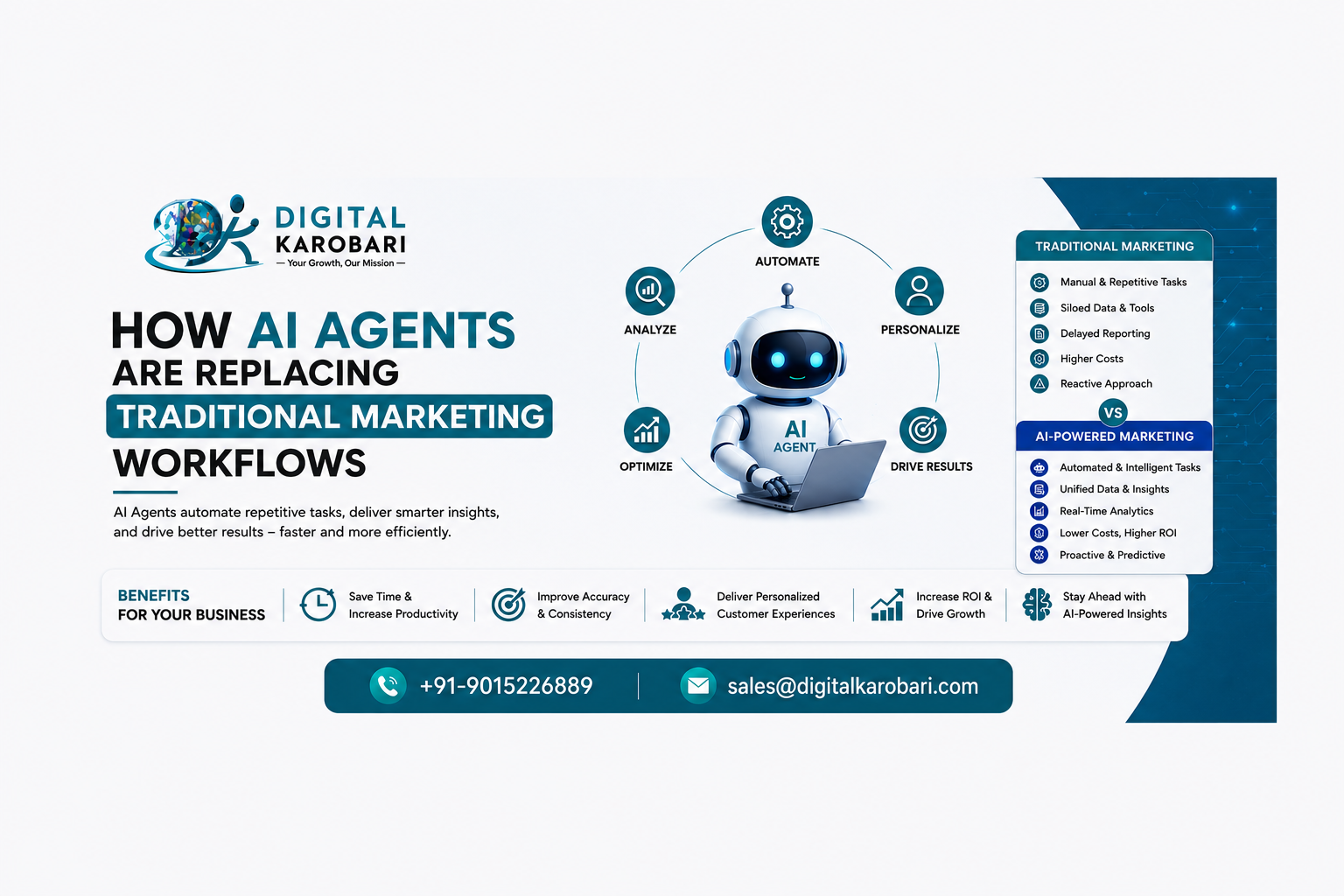
    The marketing industry has always evolved alongside technology. From print advertising to social media campaigns, every advancement has changed how businesses connect with customers. Today, the next major transformation is being driven by AI agents—intelligent software systems that can perform complex marketing tasks with minimal human intervention.
    Unlike traditional automation tools that follow fixed rules, AI agents can analyze data, learn from interactions, make decisions, and optimize campaigns in real time. They are helping businesses reduce manual effort, improve efficiency, and deliver more personalized customer experiences.
    Rather than replacing marketers, AI agents are taking over repetitive and time-consuming tasks, allowing marketing teams to focus on strategy, creativity, and business growth.

    What Are AI Agents?

    AI agents are advanced artificial intelligence systems capable of understanding goals, collecting information, making decisions, and executing tasks automatically. They use technologies such as machine learning, natural language processing (NLP), predictive analytics, and generative AI to complete marketing activities with greater speed and accuracy.
    For example, an AI agent can monitor campaign performance, identify underperforming ads, adjust budgets, generate reports, and recommend improvements—all without constant manual supervision.

    Traditional Marketing Workflows vs AI-Driven Workflows

    Traditional marketing often requires multiple team members handling separate responsibilities such as keyword research, content creation, campaign management, reporting, email marketing, and customer support. These processes can be time-consuming and prone to human error.
    AI-driven workflows automate many of these activities. AI agents work continuously, analyze large volumes of data instantly, and provide recommendations based on real-time insights. This enables businesses to launch campaigns faster, respond quickly to market changes, and improve overall productivity.

    Ways AI Agents Are Transforming Marketing

    Intelligent Content Creation
    Creating blogs, social media posts, email campaigns, ad copy, and product descriptions traditionally requires significant time and effort. AI agents assist marketers by generating content ideas, drafting copy, suggesting headlines, and optimizing content for search engines.
    Human creativity remains essential, but AI significantly accelerates the content production process.

    Smarter Customer Segmentation
    Understanding customer behavior is critical for successful marketing. AI agents analyze browsing habits, purchase history, demographics, and engagement patterns to create highly targeted customer segments.
    This enables businesses to deliver personalized campaigns that improve customer engagement and conversion rates.

    Campaign Optimization
    Instead of waiting for weekly or monthly reports, AI agents continuously monitor campaign performance. They can automatically adjust bidding strategies, optimize ad placements, identify high-performing keywords, and recommend budget reallocations.
    This leads to improved return on investment (ROI) and more efficient advertising campaigns.

    Automated Customer Support
    AI-powered chatbots and virtual assistants can answer frequently asked questions, qualify leads, recommend products, schedule appointments, and provide instant customer assistance around the clock.
    This improves customer satisfaction while reducing the workload on support teams.

    Predictive Marketing
    AI agents analyze historical and real-time data to forecast customer behavior, identify emerging trends, and predict future purchasing decisions.
    Businesses can use these insights to create proactive marketing strategies instead of reacting after trends have already changed.

    Email Marketing Automation
    AI personalizes email campaigns by determining the best send times, generating subject lines, segmenting audiences, and recommending relevant content based on customer preferences.
    The result is improved open rates, higher engagement, and increased conversions.

    Social Media Management
    AI agents assist with content scheduling, hashtag recommendations, audience engagement analysis, sentiment monitoring, and performance reporting. They help marketers maintain consistent social media activity while identifying opportunities to improve engagement.

    Marketing Analytics
    AI processes enormous volumes of marketing data within seconds. Instead of manually creating reports, marketers receive real-time dashboards with actionable insights that support better business decisions.

    Benefits of AI Agents

    Businesses adopting AI agents experience numerous advantages, including:
    Faster campaign execution
    Improved productivity
    Reduced operational costs
    Better customer personalization
    Real-time decision-making
    Higher lead generation
    Increased conversion rates
    Enhanced marketing ROI
    Continuous campaign optimization
    Scalable marketing operations

    Challenges Businesses Should Consider

    Although AI agents provide significant benefits, businesses should implement them thoughtfully. Human oversight remains essential to maintain brand consistency, ensure ethical AI usage, verify content accuracy, and protect customer data.
    Organizations should also invest in employee training so marketing teams can effectively collaborate with AI technologies rather than compete with them.

    The Future of AI Agents in Marketing

    AI agents will continue becoming more intelligent and autonomous. Future marketing systems may independently plan campaigns, allocate budgets, personalize customer journeys, generate creative assets, and optimize marketing strategies across multiple channels simultaneously.
    Businesses that embrace AI today will be better positioned to remain competitive in an increasingly digital marketplace.

    Why Choose Digital Karobari?

    At Digital Karobari, we help businesses leverage AI-powered marketing solutions to improve efficiency, increase online visibility, and generate quality leads. Our services include SEO, performance marketing, social media marketing, AI-driven content strategies, website optimization, branding, and digital transformation.
    By combining human expertise with advanced AI technologies, we create data-driven marketing strategies that help businesses achieve sustainable growth.

    Conclusion

    AI agents are reshaping traditional marketing workflows by automating repetitive tasks, improving decision-making, and enabling highly personalized customer experiences. While AI cannot replace human creativity and strategic thinking, it serves as a powerful partner that enhances marketing performance and business growth.
    Companies that successfully integrate AI into their marketing operations today will be well prepared for the future of digital marketing.

    Transform Your Marketing with AI-Powered Solutions from Digital Karobari

    The future of digital marketing is intelligent, automated, and data-driven. At Digital Karobari, we help businesses harness the power of AI agents to streamline marketing workflows, improve customer engagement, and maximize campaign performance. Whether you need SEO, performance marketing, social media management, AI-powered content strategies, or complete digital transformation services, our team is ready to help.
    Partner with Digital Karobari today to automate smarter, market faster, and grow your business with innovative AI-powered digital marketing solutions.
    Company Name: Digital Karobari
    🌐: https://digitalkarobari.
    📞: +91-9015226889

    Frequently Asked Questions (FAQs)

    1. What are AI agents in digital marketing?
      AI agents are intelligent software systems that automate marketing tasks such as campaign optimization, customer segmentation, content creation, reporting, and lead nurturing using artificial intelligence.
    2. Will AI replace digital marketers?
      No. AI is designed to automate repetitive work, while marketers continue to provide creativity, strategy, relationship-building, and business decision-making.
    3. How do AI agents improve marketing performance?
      They analyze data in real time, optimize campaigns, personalize customer experiences, automate workflows, and provide actionable insights that improve marketing ROI.
    4. Can small businesses use AI marketing tools?
      Yes. AI-powered marketing tools are increasingly affordable and help small businesses improve efficiency, reduce costs, and compete more effectively.
    5. Which marketing activities can AI automate?
      AI can assist with content creation, email marketing, SEO research, paid advertising, social media management, analytics, customer support, and lead qualification.
    6. Why choose Digital Karobari for AI-powered digital marketing?
      Digital Karobari combines AI-driven technologies with expert digital marketing strategies to help businesses improve online visibility, attract quality leads, optimize campaigns, and achieve measurable business growth.
  • Omnichannel Marketing Strategy Explained: A Complete Guide for Business Growth | Digital Karobari

    Omnichannel Marketing Strategy Explained: A Complete Guide for Business Growth | Digital Karobari

    Introduction

    Today’s customers interact with businesses through multiple channels before making a purchase. They may discover a brand on social media, visit its website, read online reviews, receive promotional emails, and finally make a purchase through an online store or physical location. This changing customer journey has made Omnichannel Marketing one of the most effective strategies for businesses looking to improve customer experience and increase sales.
    Unlike traditional marketing, where each platform operates independently, omnichannel marketing creates a seamless and consistent experience across every customer touchpoint. Whether customers engage with your business on mobile, desktop, social media, email, or in-store, they receive the same brand message and personalized experience.
    At Digital Karobari, we help businesses implement effective omnichannel marketing strategies that improve customer engagement, strengthen brand loyalty, and drive measurable business growth.

    What is Omnichannel Marketing?

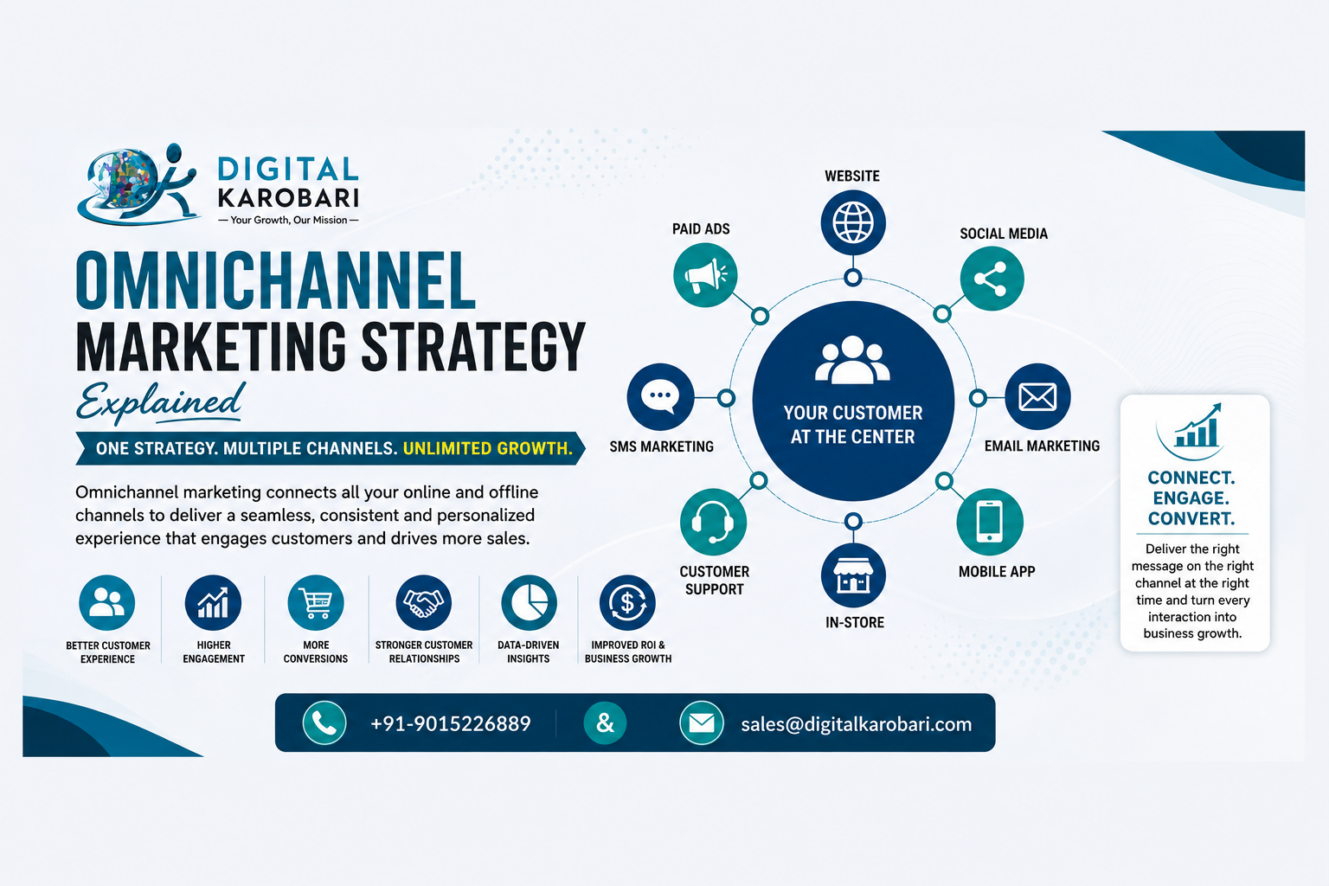
    Omnichannel marketing is a customer-centric marketing strategy that integrates multiple online and offline channels to deliver a consistent and personalized brand experience. Instead of treating each platform separately, all channels work together to create a unified customer journey.
    These channels may include:
    Business Website
    Social Media Platforms
    Email Marketing
    Google Search
    Google Ads
    Mobile Applications
    SMS Marketing
    WhatsApp Marketing
    Online Marketplaces
    Physical Stores
    Customer Support
    The primary goal is to ensure customers enjoy a smooth experience regardless of where or how they interact with your business.

    Why Omnichannel Marketing Matters

    Modern consumers expect businesses to recognize them across different platforms and provide a consistent experience. A customer may browse products on a smartphone, continue researching on a laptop, and complete the purchase later through an app or website. If the experience is disconnected, businesses risk losing potential customers.
    An effective omnichannel strategy improves customer satisfaction, strengthens trust, increases engagement, and creates more opportunities for conversions. It also allows businesses to better understand customer behavior by collecting data from multiple touchpoints.

    Benefits of Omnichannel Marketing

    Better Customer Experience
    Customers enjoy a seamless journey across multiple channels without interruptions. Consistent messaging and branding build trust and encourage long-term relationships.

    Increased Customer Engagement
    Businesses can interact with customers through their preferred communication channels, improving response rates and engagement.

    Higher Conversion Rates
    Providing relevant content and personalized recommendations across channels helps guide customers toward purchasing decisions, resulting in increased sales.

    Improved Customer Retention
    Consistent follow-ups, personalized offers, loyalty programs, and targeted communication encourage repeat purchases and strengthen customer loyalty.

    Better Data Insights
    Combining customer data from websites, social media, email campaigns, CRM systems, and mobile apps helps businesses better understand customer preferences and optimize future marketing campaigns.

    Key Components of an Omnichannel Marketing Strategy

    Understand Your Customer Journey
    Analyze how customers discover, research, compare, and purchase your products or services. Mapping the customer journey helps identify opportunities to improve the overall experience.

    Maintain Consistent Branding
    Your logo, messaging, visuals, tone of voice, and offers should remain consistent across all digital and offline channels to build brand recognition and trust.

    Personalize Customer Communication
    Use customer data to deliver personalized recommendations, product suggestions, email campaigns, and promotional offers based on user behavior and interests.

    Integrate Marketing Channels
    Connect your website, CRM, email marketing platform, social media accounts, Google Ads, WhatsApp, and analytics tools to ensure all channels work together efficiently.

    Use Marketing Automation
    Automated workflows can send welcome emails, abandoned cart reminders, product recommendations, appointment confirmations, and follow-up messages, improving customer engagement while saving time.

    Monitor Performance
    Track key metrics such as website traffic, conversion rate, customer lifetime value, engagement rate, email performance, social media interactions, and return on investment (ROI). Continuous optimization ensures better campaign performance.

    Best Practices for Omnichannel Marketing

    Businesses should focus on delivering value rather than simply promoting products. Ensure that every communication is relevant, timely, and personalized. Optimize websites for mobile devices, maintain active social media profiles, respond quickly to customer inquiries, and use analytics to improve decision-making. Regularly test campaigns, refine messaging, and update strategies based on customer feedback and performance data.

    Common Omnichannel Marketing Mistakes

    Many businesses fail to integrate their marketing channels, resulting in inconsistent messaging and disconnected customer experiences. Other common mistakes include ignoring customer data, sending generic emails, neglecting mobile optimization, failing to personalize content, and not measuring campaign performance. Without proper planning and coordination, businesses may miss valuable opportunities to engage customers effectively.

    Tools for Omnichannel Marketing

    Several tools help businesses manage omnichannel marketing efficiently. Popular platforms include HubSpot, Salesforce, Google Analytics 4, Meta Business Suite, Mailchimp, Klaviyo, Zoho CRM, WhatsApp Business API, Google Ads, and Canva for content creation. These tools enable businesses to automate campaigns, track customer interactions, and optimize marketing performance.

    Why Choose Digital Karobari for Omnichannel Marketing?

    At Digital Karobari, we create customized omnichannel marketing strategies that help businesses connect with customers across every digital touchpoint. Our experienced team combines SEO, Google Ads, Social Media Marketing, Email Marketing, WhatsApp Marketing, Content Marketing, and Analytics to deliver a seamless customer experience that drives engagement and sales. By using data-driven insights and the latest digital marketing tools, we help businesses improve brand visibility, generate qualified leads, and achieve long-term growth.

    Conclusion

    Omnichannel marketing is no longer optional for businesses that want to stay competitive in today’s digital landscape. Customers expect consistent experiences across websites, social media, email, mobile apps, and other platforms. Businesses that successfully integrate these channels can improve customer satisfaction, strengthen brand loyalty, and increase conversions. By implementing a well-planned omnichannel strategy and partnering with experts like Digital Karobari, businesses can create meaningful customer experiences that lead to sustainable growth and long-term success.

    Build a Seamless Customer Experience with Digital Karobari

    Want to engage customers across every digital touchpoint and increase your sales? Digital Karobari offers expert omnichannel marketing solutions that integrate SEO, Google Ads, Social Media Marketing, Email Marketing, WhatsApp Marketing, and Content Marketing into one powerful strategy. Our data-driven approach helps businesses deliver personalized customer experiences, generate quality leads, and maximize marketing ROI.
    Contact Digital Karobari today and create an omnichannel marketing strategy that drives measurable business growth.
    Company Name: Digital Karobari
    🌐: https://digitalkarobari.
    📞: +91-9015226889

    Frequently Asked Questions (FAQs)

    1. What is omnichannel marketing?
      Omnichannel marketing is a strategy that integrates multiple online and offline channels to provide customers with a seamless and consistent brand experience.
    2. How is omnichannel marketing different from multichannel marketing?
      Multichannel marketing uses multiple platforms independently, while omnichannel marketing connects all channels to create one unified customer journey.
    3. Why is omnichannel marketing important?
      It improves customer experience, increases engagement, boosts conversions, strengthens brand loyalty, and helps businesses deliver personalized interactions across all touchpoints.
    4. Which channels are included in an omnichannel marketing strategy?
      Common channels include websites, social media, email marketing, Google Ads, WhatsApp, SMS, mobile apps, CRM systems, online marketplaces, and physical stores.
    5. What tools are commonly used for omnichannel marketing?
      Businesses often use Google Analytics 4, HubSpot, Salesforce, Zoho CRM, Mailchimp, Meta Business Suite, WhatsApp Business API, Google Ads, and marketing automation platforms.
    6. How can Digital Karobari help with omnichannel marketing?
      Digital Karobari develops customized omnichannel marketing strategies by integrating SEO, Google Ads, Social Media Marketing, Email Marketing, Content Marketing, and Analytics to improve customer engagement and business growth.
  • SMO vs Social Media Marketing (SMM): What’s the Difference?

    SMO vs Social Media Marketing (SMM): What’s the Difference?

    In today’s digital world, social media has become one of the most effective ways for businesses to connect with customers, build brand awareness, and generate leads. However, many people confuse Social Media Optimization (SMO) with Social Media Marketing (SMM). While both are essential parts of a successful digital marketing strategy, they serve different purposes.
    Understanding the difference between SMO and SMM helps businesses invest in the right strategy and maximize their return on investment.

    What is Social Media Optimization (SMO)?

    Social Media Optimization (SMO) is the process of optimizing your social media profiles and content to increase organic visibility, engagement, and follower growth. The primary goal of SMO is to make your social media presence attractive, informative, and easy for users to interact with.
    SMO focuses on creating optimized profiles, posting valuable content consistently, using relevant hashtags, maintaining brand consistency, and encouraging audience engagement without relying heavily on paid advertising.
    Key Features of SMO
    Optimizing social media profiles
    Creating engaging organic content
    Consistent branding
    Strategic hashtag usage
    Improving audience engagement
    Increasing organic followers
    Driving free traffic to your website

    What is Social Media Marketing (SMM)?

    Social Media Marketing (SMM) involves promoting products or services through both organic and paid social media campaigns. Unlike SMO, SMM focuses on achieving specific business objectives such as lead generation, sales, website traffic, or app downloads.
    SMM includes paid advertisements, audience targeting, campaign management, remarketing, influencer collaborations, and performance tracking across platforms like Facebook, Instagram, LinkedIn, X (Twitter), and YouTube.
    Key Features of SMM
    Paid advertising campaigns
    Audience targeting
    Lead generation
    Brand awareness campaigns
    Conversion optimization
    Performance analytics
    Retargeting campaigns

    SMO vs SMM: Major Differences

    Feature Social Media Optimization (SMO) Social Media Marketing (SMM)
    Purpose Improve organic visibility Generate leads, sales, and conversions
    Cost Mostly organic Organic + Paid
    Focus Profile and content optimization Marketing campaigns
    Results Long-term brand growth Faster business results
    Audience Existing and new followers Highly targeted audiences
    Traffic Source Organic Organic + Paid Ads
    ROI Builds credibility over time Quick measurable ROI

    Why Your Business Needs Both SMO and SMM

    Many businesses think they should choose either SMO or SMM. In reality, the best results come when both strategies work together.
    SMO builds a strong social media foundation by creating an engaging profile, publishing quality content, and growing your community organically. SMM then amplifies your reach by promoting your content to highly targeted audiences through paid campaigns.
    When combined, they help businesses:
    Increase brand awareness
    Improve customer engagement
    Generate quality leads
    Build customer trust
    Increase website traffic
    Improve conversion rates
    Achieve sustainable business growth

    Benefits of Social Media Optimization

    A well-optimized social media profile helps businesses establish credibility and attract followers naturally. Regular posting, optimized visuals, informative captions, and active engagement create a positive brand image that encourages long-term customer relationships.
    Benefits include:
    Better organic reach
    Improved customer trust
    Higher engagement
    Strong brand identity
    Increased website visits
    Better search visibility

    Benefits of Social Media Marketing

    Social Media Marketing enables businesses to reach the right audience quickly. Paid advertising allows brands to target users based on demographics, interests, behaviors, and location, making campaigns highly effective.
    Benefits include:
    Faster lead generation
    Higher sales opportunities
    Better audience targeting
    Measurable campaign performance
    Increased website conversions
    Remarketing opportunities

    Which Strategy Should You Choose?

    If your goal is to build a strong online presence and grow your audience naturally, SMO is the ideal starting point. If you want faster results, increased leads, and higher sales, SMM is the better option.
    For most businesses, combining both SMO and SMM provides the best long-term results. SMO creates trust and engagement, while SMM accelerates growth through targeted promotions.

    Conclusion

    Social Media Optimization and Social Media Marketing are not competitors—they complement each other. SMO strengthens your brand’s organic presence, while SMM helps you achieve measurable business goals through strategic campaigns. Businesses that integrate both approaches enjoy greater visibility, stronger customer relationships, and higher conversions.
    Whether you’re a startup or an established business, investing in both SMO and SMM can significantly improve your digital marketing success.

    Grow Your Business with Digital Karobari

    Ready to maximize your social media presence? Digital Karobari offers expert Social Media Optimization (SMO) and Social Media Marketing (SMM) services to help businesses increase brand awareness, engage the right audience, generate quality leads, and boost sales. Whether you need organic growth or high-performing paid campaigns, our experts create customized strategies that deliver measurable results.
    Contact Digital Karobari today and take your social media marketing to the next level!
    Company Name: Digital Karobari
    🌐: https://digitalkarobari.
    📞: +91-9015226889

    Frequently Asked Questions (FAQs)

    1. What is the main difference between SMO and SMM?
      SMO focuses on improving your social media profiles and organic engagement, while SMM focuses on promoting your business through organic and paid marketing campaigns.
    2. Is SMO free?
      Most SMO activities are organic and require minimal investment, though professional management services may involve a fee.
    3. Does SMM include paid advertising?
      Yes. SMM includes paid campaigns on platforms such as Facebook, Instagram, LinkedIn, YouTube, and X to reach targeted audiences.
    4. Which is better for small businesses?
      Small businesses benefit most from combining SMO and SMM. SMO builds credibility, while SMM generates faster leads and sales.
    5. How long does SMO take to show results?
      SMO generally takes several weeks to months, depending on content quality, consistency, and audience engagement.
    6. Can SMM increase website traffic?
      Yes. Well-planned SMM campaigns can drive highly targeted visitors to your website, increasing conversions and sales.
    7. Why should businesses use both SMO and SMM?
      Using both creates a balanced strategy that builds long-term brand authority while delivering immediate marketing results.