Tag: digital marketing

  • Difference Between SEO, GEO, AEO, AIO & SXO: A Complete Guide for Modern Search

    Difference Between SEO, GEO, AEO, AIO & SXO: A Complete Guide for Modern Search

    Search is changing rapidly. People no longer rely only on traditional Google searches. They now use AI tools, voice assistants, featured snippets, AI-generated answers, and conversational search platforms to find information. As a result, digital marketers need to understand several search optimization approaches, including SEO, GEO, AEO, AIO, and SXO.
    Although these terms sound similar, each focuses on a different aspect of search visibility and user experience. Understanding their differences can help businesses create a stronger digital marketing strategy and reach potential customers across traditional and AI-powered search platforms.

    What Is SEO?

    SEO (Search Engine Optimization) is the process of improving a website so that its pages can rank higher in traditional search engine results.
    SEO focuses on factors such as keyword targeting, high-quality content, technical website performance, backlinks, internal linking, search intent, and website authority.
    For example, if someone searches for “best digital marketing agency in Mumbai,” an SEO strategy aims to help a relevant webpage appear prominently in Google’s organic search results.
    Key SEO activities include:
    Keyword research
    On-page optimization
    Technical SEO
    Content creation
    Internal linking
    Link building
    Local SEO
    Website performance optimization
    Main goal: Increase organic visibility and website traffic from search engines.

    What Is GEO?

    GEO (Generative Engine Optimization) focuses on improving a brand’s visibility in AI-generated search results.
    Instead of simply trying to rank a webpage among traditional blue links, GEO aims to make a brand or website more likely to be mentioned, cited, or represented accurately in AI-generated answers.
    AI-powered search experiences can summarize information from multiple sources before presenting an answer to users. Therefore, businesses need authoritative, trustworthy, well-structured and contextually relevant content.
    GEO strategies can include:
    Creating authoritative content
    Providing clear and factual answers
    Building brand authority
    Using structured information
    Demonstrating expertise and credibility
    Covering topics comprehensively
    Creating content that AI systems can easily interpret
    Main goal: Increase visibility within generative and AI-powered search experiences.

    What Is AEO?

    AEO (Answer Engine Optimization) focuses on optimizing content to provide direct answers to users’ questions.
    Search engines increasingly display answers through featured snippets, People Also Ask sections, voice assistants, and other answer-focused search features.
    For example, if a user searches “What is performance marketing?”, a concise and well-structured explanation may be selected as an answer.
    AEO content often uses:
    Frequently asked questions
    Question-based headings
    Concise answers
    Structured content
    Lists and tables
    Clear definitions
    Natural-language queries
    Main goal: Make your content suitable for direct answers in search results.

    What Is AIO?

    AIO (AI Optimization) is a broader approach focused on making digital content, websites, and brand information easier for AI systems to understand, process, retrieve, and use.
    While GEO specifically emphasizes visibility in generative search experiences, AIO can be considered a broader AI-focused optimization approach. Depending on the context, the term AIO may also be used differently by marketers, so businesses should define what they mean when using it.
    AIO can involve:
    Structuring information clearly
    Creating authoritative content
    Improving entity and brand understanding
    Using structured data
    Maintaining consistent business information
    Producing machine-readable and human-friendly content
    Optimizing content for AI-driven discovery
    Main goal: Make your digital presence easier for AI systems to understand and surface.

    What Is SXO?

    SXO (Search Experience Optimization) combines SEO with user experience (UX).
    Getting visitors to your website is only the first step. Once users arrive, they should be able to quickly find what they need, understand your offering, and take the desired action.
    SXO therefore considers both search visibility and the experience users receive after clicking a search result.
    Important SXO factors include:
    Page speed
    Mobile usability
    Website navigation
    Content readability
    Search intent
    Clear calls-to-action
    Page layout
    Conversion experience
    Overall user satisfaction
    Main goal: Attract the right visitors and provide an experience that encourages engagement and conversion.

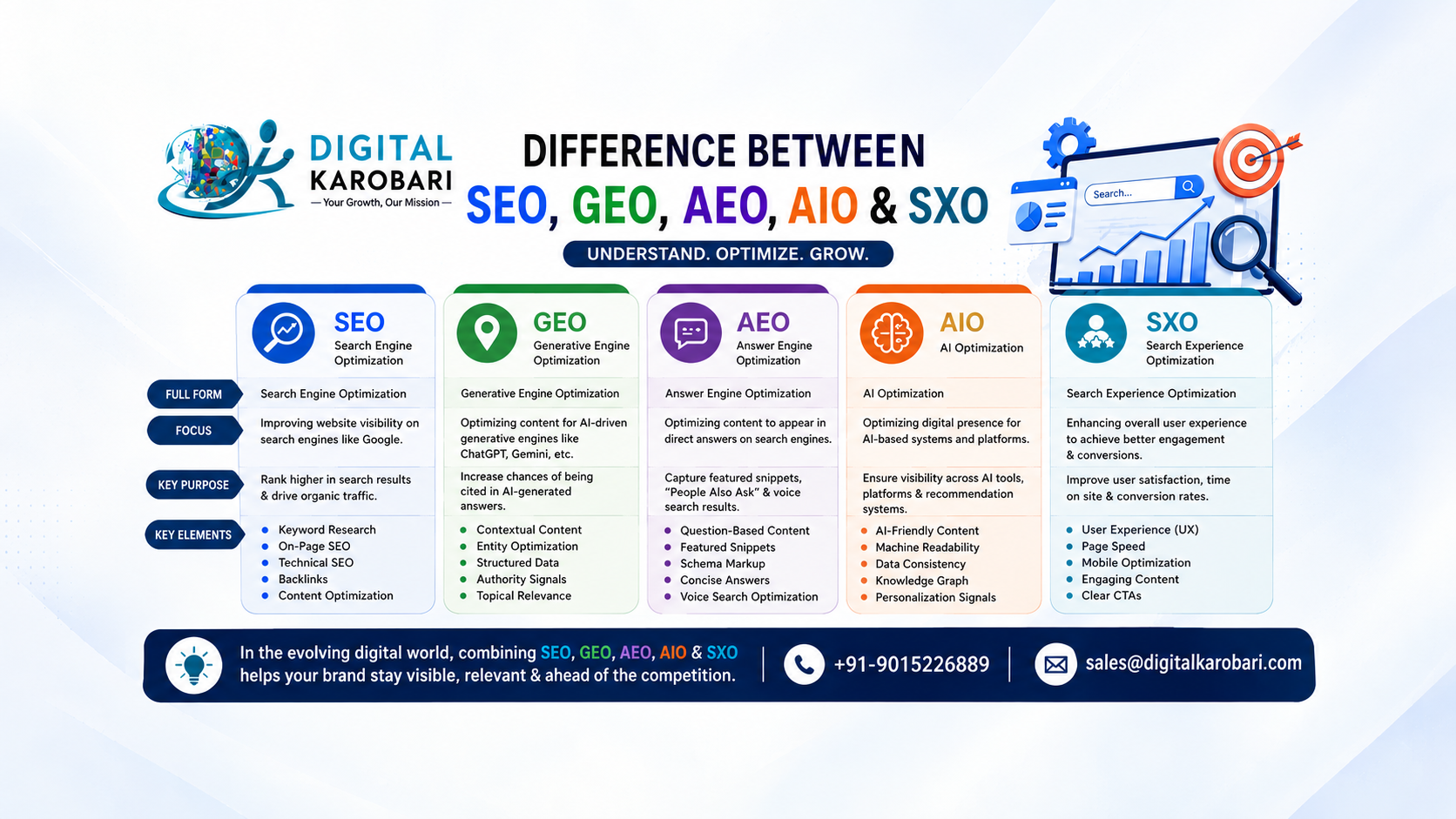
    SEO vs GEO vs AEO vs AIO vs SXO

    Approach Full Form Primary Focus Main Goal
    SEO Search Engine Optimization Traditional search engines Improve organic rankings
    GEO Generative Engine Optimization AI-generated search Increase AI visibility and mentions
    AEO Answer Engine Optimization Direct answers Become a useful answer source
    AIO AI Optimization AI understanding and discovery Make content easier for AI systems to interpret
    SXO Search Experience Optimization Search + user experience Improve engagement and conversions

    How Are These Strategies Connected?

    These approaches should not necessarily be treated as competitors. They can work together as part of a modern search strategy.
    A business might use SEO to improve traditional organic visibility, AEO to target question-based searches, GEO/AIO to strengthen visibility in AI-powered experiences, and SXO to ensure visitors have a strong experience after reaching the website.
    For example, a digital marketing agency could create a comprehensive article about SEO services. SEO helps the article target relevant search terms. AEO can structure sections around common questions. GEO and AIO can help make the information more understandable and useful in AI-powered search environments. SXO ensures that visitors can easily navigate the page and contact the agency.

    Which One Should Your Business Focus On?

    The best approach is not to choose only one.
    Instead, businesses should build a comprehensive search strategy around quality content, technical accessibility, authority, search intent, structured information, and excellent user experience.
    SEO remains an important foundation, while AEO, GEO, AIO and SXO address newer ways people discover and interact with information.
    A modern strategy could look like this:
    SEO → Get discovered in search
    AEO → Answer user questions
    GEO → Improve visibility in generative search
    AIO → Make information AI-friendly
    SXO → Deliver a better experience and convert visitors

    Conclusion

    The search landscape is evolving beyond traditional rankings. Businesses now need to think about where users search, how search engines answer questions, how AI systems interpret information, and what happens after users visit a website.
    SEO, GEO, AEO, AIO and SXO each address a different part of this ecosystem. Rather than treating them as separate marketing techniques, businesses can combine them to build a comprehensive and future-ready digital presence.
    For Digital Karobari, this means helping businesses move beyond simply “ranking on Google” toward becoming visible, useful, trustworthy and easy to interact with across modern search experiences.

    Ready to Make Your Business Visible Across Modern Search?

    Don’t optimize only for rankings. Build a digital presence that users, search engines and AI-powered platforms can understand and trust.
    Talk to Digital Karobari today and discover how our SEO, SMO, content and digital marketing strategies can help your business improve online visibility and generate better opportunities.
    Company Name: Digital Karobari
    🌐: https://digitalkarobari.
    📞: +91-9015226889

    Frequently Asked Questions

    1. What is the difference between SEO and GEO?
      SEO focuses primarily on improving visibility in traditional search engine results, while GEO focuses on improving a brand’s visibility and representation in generative AI search experiences.
    2. Is AEO replacing SEO?
      No. AEO complements SEO by focusing on direct answers and question-based search experiences. A strong SEO foundation can support an effective AEO strategy.
    3. What is the difference between GEO and AIO?
      GEO generally focuses on visibility within generative search experiences, whereas AIO is a broader term for optimizing information and digital assets for AI systems.
    4. What does SXO mean in digital marketing?
      SXO stands for Search Experience Optimization. It combines search optimization with user experience to improve both website visibility and what users experience after clicking a search result.
    5. Which is more important: SEO or GEO?
      Both can be valuable. SEO remains essential for traditional search visibility, while GEO is increasingly relevant as users adopt AI-powered search and answer experiences.
    6. How can businesses prepare for AI search?
      Businesses should publish authoritative content, answer customer questions clearly, maintain accurate brand information, improve technical website quality, demonstrate expertise, and create useful content that satisfies user intent.
    7. Can SEO, GEO, AEO, AIO and SXO be used together?
      Yes. Combining these approaches can create a broader search strategy that addresses traditional search, direct answers, AI-powered discovery and website user experience.
  • Social Media Platforms: How Brands Win Attention, Traffic, and Sales in the Paid Media Era

    Social Media Platforms: How Brands Win Attention, Traffic, and Sales in the Paid Media Era

    Introduction

    Social media platforms have evolved into powerful marketing ecosystems where brands compete for attention, engagement, and conversions. Today, businesses rely heavily on social media marketing and paid social media advertising to connect with their audience and drive measurable results.

    From discovering new products on Instagram to watching product reviews on YouTube, consumers spend several hours each day on social platforms. This makes social media one of the most effective digital marketing channels for businesses.

    At Digital Karobari, we help businesses transform social media platforms into growth engines through data-driven advertising strategies, creative campaigns, and performance marketing optimization.

    This guide explains how social media platforms work in marketing, why paid social media is essential today, and how businesses can use these platforms to generate leads, traffic, and sales.


    Understanding Social Media Platforms in Digital Marketing

    Social media platforms are online environments where users interact with content, communities, and brands. For businesses, these platforms provide advanced marketing tools that allow brands to reach highly targeted audiences.

    Modern social media advertising platforms allow businesses to target audiences based on:

    • Interests and behaviour
    • Demographics
    • Location
    • Job titles
    • Purchase intent
    • Previous website visits

    This level of targeting makes social media marketing far more efficient than traditional advertising methods.

    Businesses working with a social media marketing agency in Mumbai can leverage these platforms to reach the right audience and achieve better marketing ROI.


    Why Social Media Platforms Are Important for Business Growth

    Massive Audience Reach

    Social media platforms host billions of active users worldwide.

    Popular platforms like Facebook, Instagram, LinkedIn, and YouTube attract audiences from every demographic group. This allows businesses to reach potential customers at scale.

    For local businesses in Mumbai, Vasai, Malad West, and across Maharashtra, social media marketing helps build strong online visibility and customer engagement.


    Discovery-Based Marketing

    Unlike search engines where users actively look for solutions, social media enables discovery marketing.

    Users discover products, services, and brands while browsing content.

    This allows businesses to:

    • create demand
    • build brand awareness
    • influence buying decisions early

    Advanced Targeting Capabilities

    One of the biggest advantages of social media advertising is precise audience targeting.

    Businesses can target users based on:

    • interests
    • online behaviour
    • purchase history
    • profession
    • location

    For example, a digital marketing agency in Mumbai can target entrepreneurs, business owners, and startup founders in specific geographic areas.


    Real-Time Performance Tracking

    Social media advertising platforms provide detailed analytics including:

    • impressions
    • clicks
    • engagement
    • leads generated
    • cost per conversion

    This allows marketers to measure campaign success and optimize strategies continuously.


    Key Social Media Platforms for Advertising

    Different social media platforms serve different marketing objectives.

    Understanding the strengths of each platform helps businesses create effective campaigns.


    Facebook Advertising

    Facebook remains one of the most powerful advertising platforms for businesses.

    It offers advanced audience targeting and supports various campaign objectives including:

    • lead generation
    • e-commerce sales
    • website traffic
    • retargeting campaigns

    Facebook advertising works particularly well for:

    • local businesses
    • e-commerce brands
    • service providers

    Instagram Advertising

    Instagram is a visual-first platform ideal for storytelling and brand engagement.

    Brands can use formats such as:

    • reels
    • stories
    • carousel ads
    • influencer collaborations

    This platform works best for:

    • lifestyle brands
    • fashion and beauty products
    • D2C businesses
    • online stores

    LinkedIn Advertising

    LinkedIn is the most effective platform for B2B marketing and professional networking.

    Businesses can target users based on:

    • job titles
    • industries
    • company size
    • professional experience

    LinkedIn ads are highly effective for:

    • SaaS companies
    • B2B service providers
    • recruitment campaigns

    YouTube Advertising

    YouTube combines video content with strong user intent.

    Businesses use YouTube advertising for:

    • product demonstrations
    • brand storytelling
    • tutorials and educational content
    • remarketing campaigns

    Video marketing also improves brand trust and engagement.


    Paid Social vs Organic Social Media

    Organic social media focuses on building a community through regular content posting.

    However, organic reach has declined significantly over time.

    Paid social media advertising provides:

    • faster reach
    • better targeting
    • measurable results
    • scalable campaigns

    Successful brands combine both organic content and paid social media strategies.


    How Paid Social Media Advertising Works

    Effective social media advertising follows a structured marketing funnel.

    Awareness Stage

    Ads introduce the brand to new audiences through engaging content.

    Consideration Stage

    Users interact with educational content, testimonials, and product demonstrations.

    Conversion Stage

    Targeted ads encourage users to take action such as signing up or purchasing.

    Retargeting Stage

    Users who interacted with the brand but didn’t convert are targeted again with reminder ads.

    This funnel-based strategy improves conversions and customer acquisition.


    Common Social Media Marketing Mistakes

    Many businesses fail to get results from social media because they:

    • run ads without a clear strategy
    • target overly broad audiences
    • ignore performance data
    • fail to test ad creatives
    • focus only on vanity metrics

    Successful campaigns require continuous testing, data analysis, and optimization.


    How Digital Karobari Helps Businesses Grow on Social Media

    Digital Karobari helps brands leverage social media platforms through strategic marketing and performance advertising.

    Our offices operate in:

    • Malad West, Mumbai
    • Vasai, Mumbai
    • Maharashtra, India

    Our Social Media Marketing Approach

    Audience Research

    We identify high-intent audiences using data analysis.

    Creative Strategy

    We design high-performing creatives optimized for each platform.

    Campaign Optimization

    Continuous A/B testing and performance improvements.

    Conversion Tracking

    Detailed analytics to track leads, sales, and ROI.


    Conclusion

    Social media platforms have transformed digital marketing. Businesses that understand how to use these platforms strategically can build brand awareness, generate qualified leads, and increase revenue.

    By combining creative storytelling with data-driven advertising strategies, brands can turn social media into powerful growth engines.

    Working with an experienced social media marketing agency in Mumbai like Digital Karobari ensures that campaigns are optimized for performance, targeting, and long-term success.

    FAQ SECTION

    What are social media platforms in digital marketing?

    Social media platforms are online channels where businesses promote products, engage with audiences, and run targeted advertising campaigns.

    Which social media platform is best for advertising?

    Facebook, Instagram, LinkedIn, and YouTube are the most effective platforms depending on your target audience and marketing goals.

    Why is paid social media advertising important?

    Paid social media advertising increases reach, enables precise audience targeting, and delivers measurable marketing results.

    How much does social media marketing cost in India?

    Costs vary depending on ad budgets, platforms, and campaign goals. Businesses often start with small budgets and scale campaigns based on performance.

    What does a social media marketing agency do?

    A social media marketing agency manages strategy, ad campaigns, creative content, targeting, and performance optimization.

    Grow Your Business with Digital Karobari

    If you want to generate leads, increase website traffic, and grow your brand through social media marketing, our experts are here to help.

    Company Name: Digital Karobari

    Website:
    https://www.digitalkarobari.com

    Phone Number:
    +91-7558663792 / +91-9015226889

    Contact us today to build a powerful social media marketing strategy for your business.

    Instagram Advertising

    Instagram focuses heavily on visual storytelling. Reels, Stories, and Feed ads allow brands to engage users in a highly immersive way.

    Best suited for:

    • Lifestyle brands
    • Fashion and beauty
    • D2C e-commerce
    • Influencer-led campaigns

    LinkedIn Advertising

    LinkedIn is the go-to platform for B2B marketing. It allows precise targeting based on job titles, industries, company size, and seniority.

    Best suited for:

    • B2B lead generation
    • SaaS companies
    • Recruitment marketing
    • High-value services

    YouTube Advertising

    YouTube combines video content with intent-based targeting. Ads can appear before, during, or alongside video content.

    Best suited for:

    • Brand storytelling
    • Product education
    • High-consideration purchases

    Twitter (X) Advertising

    Twitter is fast-paced and conversation-driven. Brands use it for topical campaigns, thought leadership, and real-time engagement.

    Best suited for:

    • Tech brands
    • Media and entertainment
    • Event-driven promotions

    Paid Social vs Organic Social: Understanding the Difference

    Organic reach on social media has declined significantly. While organic content helps build credibility and community, paid media is what drives scale and consistent results.

    AspectOrganic SocialPaid Social
    ReachLimitedScalable
    SpeedSlowImmediate
    TargetingBroadHighly precise
    ResultsLong-term brandingMeasurable ROI
    ControlLowHigh

    A successful social strategy combines both — but paid social is essential for growth.

    How Social Media Advertising Works

    Paid social campaigns follow a structured funnel approach.

    Awareness Stage

    Ads introduce your brand to new audiences using videos, reels, and visuals.

    Consideration Stage

    Users engage with educational content, testimonials, and problem-solution messaging.

    Conversion Stage

    Highly targeted ads push users to take action — sign up, enquire, or purchase.

    Retargeting Stage

    Users who interacted but didn’t convert are brought back through reminder ads and offers.

    This funnel-driven approach is where most businesses see consistent performance improvements.

    Common Mistakes Businesses Make on Social Media Platforms

    • Running ads without a clear objective
    • Using the same creatives across all platforms
    • Ignoring audience segmentation
    • Not tracking conversions properly
    • Focusing on vanity metrics instead of ROI

    Social media platforms reward brands that test, analyze, and optimize continuously.

    How Digital Karobari Helps Brands Win on Social Media Platforms

    At Digital Karobari, we don’t treat social media ads as isolated campaigns. We treat them as part of a broader growth strategy.

    Our Paid Social Media Approach

    Audience Research and Funnel Planning
    We identify high-intent audience segments and map them to the right platform and funnel stage.

    Creative Strategy and Ad Design
    Scroll-stopping creatives designed for each platform’s behavior patterns.

    Performance Optimization
    Continuous A/B testing, budget optimization, and audience refinement.

    Conversion Tracking and Analytics
    Clear measurement of leads, sales, and ROI — not just clicks.

    Platform-Specific Expertise
    Each platform is handled differently based on user intent and ad formats.

    When Should Your Business Invest in Social Media Advertising?

    Social media advertising is ideal if:

    • You want faster visibility and growth
    • Organic reach is no longer delivering results
    • You want to scale leads or sales predictably
    • You need better targeting than traditional advertising
    • You want measurable performance and ROI

    If any of these apply, paid social media platforms should be part of your marketing strategy.

    Conclusion: Social Media Platforms Are Growth Engines, Not Just Channels

    Social media platforms have evolved into powerful business tools. When used strategically, they help brands build awareness, drive traffic, and generate consistent revenue.

    The brands that succeed are not those who post the most — but those who understand platforms, audiences, and performance metrics.

    At Digital Karobari, we help businesses turn social media platforms into predictable growth engines through strategic advertising, creative excellence, and continuous optimization.

    If you’re ready to get serious about social media advertising, now is the time to act.

    Connect with Digital Karobari today and build a paid social strategy that delivers real business results.