Tag: digital marketing agency

  • Can AI-Generated Content Rank on Google? What Businesses Should Know

    Can AI-Generated Content Rank on Google? What Businesses Should Know

    AI has changed the way businesses create content. From blog posts and product descriptions to social media copy and website pages, artificial intelligence can help brands produce content faster and at scale. But one question continues to concern businesses and marketers: Can AI-generated content rank on Google?
    The short answer is yes, AI-generated content can rank on Google. However, simply using AI to produce large volumes of content does not guarantee rankings. Google’s focus is on whether content is useful, reliable, original and created to satisfy the needs of users.
    For businesses, the real opportunity lies in using AI as a content-support tool rather than treating it as a replacement for strategy, expertise and human judgment.

    Does Google Penalise AI-Generated Content?

    Google does not automatically penalise content simply because AI was used to create it. What matters is the quality and purpose of the content.
    Google’s search systems are designed to prioritise helpful content that provides value to users. Content created primarily to manipulate search rankings, whether written by humans or AI, can perform poorly.
    This means businesses should avoid publishing AI-generated articles without reviewing, editing and improving them. Content should be fact-checked, relevant to the target audience and aligned with the search intent behind the topic.

    What Makes AI Content Rank on Google?

    AI-generated content can perform well when it follows the same principles expected from high-quality human-written content.

    1. Focus on Search Intent
      Before creating content, understand what the user is actually looking for.
      For example, someone searching for “digital marketing agency for small business” may want to compare agencies, understand services or find a suitable provider. A generic article about digital marketing may not satisfy that intent.
      AI can help generate a first draft, but businesses need human input to make sure the content directly answers the user’s questions.
    2. Add Original Insights
      One of the biggest weaknesses of generic AI content is that it can repeat information already available online.
      Businesses should add something unique, such as:
      ⦁ Industry experience
      ⦁ Original examples
      ⦁ Case studies
      ⦁ Expert opinions
      ⦁ Data and research
      ⦁ Practical recommendations
      ⦁ Customer experiences
      ⦁ First-hand observations
      Original insights can make content more valuable and differentiated.
    3. Demonstrate Expertise and Trust
      Content becomes stronger when it reflects genuine knowledge of the subject.
      For example, a healthcare company should provide medically responsible and professionally reviewed information. An engineering company should demonstrate technical expertise. A digital marketing agency should support recommendations with practical experience and measurable results.
      AI can assist with writing, but subject-matter expertise gives the content credibility.
    4. Avoid Keyword Stuffing
      Using AI to insert the same keyword repeatedly can make content unnatural and difficult to read.
      Instead, businesses should focus on covering the topic comprehensively and naturally using related terms, questions and concepts.
      The goal should be to help the reader first and optimise for search engines second.
    5. Fact-Check AI-Generated Content
      AI tools can sometimes produce inaccurate, outdated or misleading information.
      Before publishing an AI-assisted article, businesses should verify:
      ⦁ Statistics
      ⦁ Dates
      ⦁ Names
      ⦁ Industry claims
      ⦁ Product specifications
      ⦁ Regulations
      ⦁ Research references
      ⦁ Links and sources
      Human review is particularly important for technical, financial, legal, healthcare and other sensitive topics.

    AI Content vs Human Content: What Should Businesses Choose?

    The choice does not have to be AI versus humans.
    A better approach is AI + human expertise.
    AI can help businesses with research, content outlines, brainstorming, first drafts, headline ideas, content repurposing and editing. Human writers and subject-matter experts can then add experience, context, accuracy, originality and brand voice.
    This combination can make the content creation process more efficient without sacrificing quality.

    Can AI-Generated Blog Posts Rank?

    Yes. An AI-assisted blog can rank if it provides genuine value and satisfies the user’s search intent.
    However, publishing hundreds of generic AI articles simply because they can be produced quickly is unlikely to be an effective long-term SEO strategy.
    A better process is:
    Research → Search Intent → Content Strategy → AI Assistance → Human Expertise → Fact Checking → SEO Optimisation → Publishing → Performance Analysis
    This approach allows businesses to benefit from AI while maintaining the quality expected from a professional website.

    How Businesses Can Use AI Without Hurting SEO

    Businesses can use AI responsibly throughout their content workflow.

    Use AI for Research and Ideas
    AI can help identify potential topics, questions and content angles. These ideas should then be validated through keyword research and actual audience needs.

    Create Detailed Content Briefs
    Instead of asking AI to “write a 2,000-word SEO article,” provide a detailed brief covering the target audience, search intent, key questions, tone, keywords, internal links and important points to address.

    Add Human Experience
    After generating a draft, add examples from your business, customer questions, project experience and industry knowledge.

    Optimise for Readers
    Use clear headings, short paragraphs, useful examples, bullet points and logical content structure. Good SEO content should be easy to understand and navigate.

    Keep Content Updated
    Industries, products, regulations and search trends change. Businesses should periodically review important content and update outdated information.

    What Businesses Should Avoid When Using AI Content

    AI can become a problem when it is used purely for mass content production.
    Avoid:
    ⦁ Publishing unedited AI-generated articles
    ⦁ Creating content solely to target keywords
    ⦁ Producing large volumes of repetitive pages
    ⦁ Making unsupported claims
    ⦁ Copying competitors’ content
    ⦁ Adding keywords unnaturally
    ⦁ Publishing inaccurate information
    ⦁ Using AI without understanding the target audience
    ⦁ Creating content that provides little value beyond what already exists online
    The objective should not be to publish more content. It should be to publish better content.

    The Future of AI and SEO

    AI is likely to remain an important part of digital marketing and SEO. As AI tools become more advanced, businesses will be able to produce and personalise content more efficiently.
    At the same time, originality, expertise, trust and usefulness will remain important differentiators.
    Businesses that combine AI technology with strong SEO strategy, human expertise and genuine audience understanding will be better positioned to build sustainable organic visibility.

    Final Thoughts

    So, can AI-generated content rank on Google? Yes, it can.
    But ranking should not be the result of simply generating content with AI and publishing it. Businesses need to focus on search intent, originality, accuracy, expertise, user experience and genuine value.
    AI should be viewed as a powerful assistant—not a shortcut around good SEO.
    For businesses, the winning approach is simple: use AI to improve the content creation process, but use human expertise to make the content worth reading.

    Want to turn AI into a smarter part of your SEO strategy?

    At Digital Karobari, we help businesses build SEO and digital marketing strategies designed around visibility, relevant traffic and long-term growth. From content strategy and SEO to performance-focused digital marketing, our team can help you use AI effectively without compromising quality.
    Get in touch with Digital Karobari today and build a smarter content strategy for your business.
    Company Name: Digital Karobari
    🌐: https://digitalkarobari.
    📞: +91-9015226889

    Frequently Asked Questions

    1. Can Google rank AI-generated content?
      Yes. Google can rank AI-generated content when it is useful, relevant, accurate and created to satisfy users’ needs. The use of AI itself does not automatically prevent content from ranking.
    2. Does Google penalise websites for using AI content?
      Google does not automatically penalise content simply because AI was used. However, content created primarily to manipulate search rankings or provide little value can perform poorly regardless of whether it was written by AI or a human.
    3. Is AI-generated content good for SEO?
      AI-generated content can support SEO when it is properly researched, reviewed, fact-checked and enhanced with original insights. Businesses should avoid relying on unedited, generic AI content.
    4. Should businesses disclose that content was created using AI?
      The need for disclosure can depend on the context, industry and applicable requirements. Businesses should prioritise transparency and accuracy, particularly when content could significantly affect users’ decisions.
    5. Can AI-written blogs rank on the first page of Google?
      Yes, AI-assisted blogs can reach the first page when they provide strong value, satisfy search intent, demonstrate expertise and compete effectively with existing search results. There is no guaranteed ranking simply because AI was used.
    6. How can businesses improve AI-generated content?
      Businesses can improve AI-generated content by adding original insights, expert opinions, real examples, accurate data, appropriate internal links, relevant keywords and a strong brand voice. Human editing and fact-checking are also essential.
    7. Is human-written content better than AI content?
      Not necessarily. Quality depends more on usefulness, accuracy, originality and relevance than on whether AI or a human produced the initial draft. A combination of AI assistance and human expertise can be highly effective.
  • Why Your Brand Needs a Search Strategy, Not Just an SEO Strategy

    Why Your Brand Needs a Search Strategy, Not Just an SEO Strategy

    Search has changed. Earlier, businesses mainly focused on ranking their website on Google for important keywords. Today, customers discover brands through traditional search engines, AI-powered search, social platforms, YouTube, reviews, business listings, communities, and other digital touchpoints.
    That means ranking on Google is still important, but it is no longer the entire search journey.
    A modern brand needs a broader search strategy that connects SEO, content, brand authority, user intent, local visibility, digital PR, social discovery and AI search. Recent industry discussions similarly point toward a shift from rankings alone toward broader visibility and how consistently a brand is understood across search and AI-driven discovery.
    For businesses working with an agency such as Digital Karobari, this shift creates an opportunity to move from simply chasing keywords to building long-term digital visibility.

    What Is a Search Strategy?

    A search strategy is a broader plan for making your brand discoverable whenever potential customers are researching a problem, product, service or solution online.
    Traditional SEO often asks:
    “How can we rank this page for this keyword?”
    A search strategy asks:
    “Where is our customer searching, what are they looking for, and how can our brand become the most useful and trustworthy answer?”
    This can include:
    Traditional SEO
    Local SEO
    Content marketing
    Technical SEO
    Brand searches
    AI search optimization
    Answer Engine Optimization (AEO)
    Generative Engine Optimization (GEO)

    Social search
    YouTube optimization
    Digital PR
    Reviews and reputation
    Industry publications
    Conversion optimization
    The objective isn’t simply to generate impressions. It is to build search visibility that supports awareness, trust, leads and revenue.

    SEO Is Still Important — But It Is Only One Part

    This doesn’t mean SEO is becoming irrelevant.
    Google search remains an important discovery channel, and strong technical foundations, useful content, internal linking, structured information and authority still matter.
    The difference is that customers increasingly move between multiple discovery environments before making a decision.
    For example, a potential customer might:
    Search Google for a problem.
    Read an article.
    Watch a YouTube video.
    Search the brand name.
    Check reviews.
    Compare competitors.
    Ask an AI tool for recommendations.
    Visit the company’s website.
    Contact the business.
    If your strategy only focuses on step one, you may miss many of the other opportunities.
    Modern search therefore requires a connected visibility strategy rather than isolated SEO activities.

    Search Behaviour Is No Longer Limited to Google

    People don’t always begin their research on a traditional search engine.
    Depending on the product or service, users may discover information through:
    Google
    YouTube
    Instagram
    LinkedIn
    Reddit and online communities
    Google Maps
    Marketplace platforms
    AI assistants
    Industry websites
    Reviews
    Brand websites
    For example, someone looking for a digital marketing agency might search:
    “best digital marketing agency in Mumbai”
    But they could also search:
    “how to improve website leads”
    or ask an AI assistant:
    “Which digital marketing agencies can help a small business generate leads?”
    These are different search experiences, but they can lead to the same buying decision.
    Your brand needs to be prepared for all of them.

    Search Strategy Starts With Search Intent

    Keywords are useful, but keywords alone don’t explain what a customer wants.
    Consider the search:
    “SEO agency Mumbai”
    This has a strong commercial intent.
    Now compare it with:
    “how does SEO work?”
    This is primarily informational.
    Another search:
    “SEO agency pricing”
    is closer to the consideration stage.
    A strong search strategy maps content and landing pages to different stages of the customer journey.
    Informational Intent
    Users want to learn.
    Examples:
    What is SEO?
    How does PPC work?
    How does digital marketing generate leads?
    Commercial Investigation
    Users are comparing options.
    Examples:
    Best SEO agency for small businesses
    SEO vs PPC
    Digital marketing agency vs freelancer
    Transactional Intent
    Users are ready to take action.
    Examples:
    Hire SEO agency
    Digital marketing services Mumbai
    PPC management company
    Your content strategy should address all three.

    Build a Strong Brand Entity

    Search engines and AI systems need to understand who your brand is, what you offer and why you are relevant.
    Your brand information should be consistent across:
    Website
    About page
    Service pages
    Author profiles
    Social media
    Business listings
    Industry directories
    Reviews
    PR mentions
    Third-party publications
    For example, if one website describes your company as a digital marketing agency, another calls it a web development company, and another describes completely different services, the overall brand signal becomes less consistent.
    Clear positioning helps both users and machines understand your business.
    Industry research increasingly emphasizes entity clarity, semantic relationships and consistent brand information as important components of modern search visibility.

    Create Content Around Topics, Not Just Keywords

    Publishing one article for every keyword isn’t a sustainable content strategy.
    Instead, brands should build topic clusters.
    For example, a digital marketing agency could create a central topic around:
    Digital Marketing
    Then build supporting content around:
    SEO
    Local SEO
    PPC
    Social media marketing
    Content marketing
    Performance marketing
    Conversion optimization
    AI marketing
    Marketing analytics
    These pages can be connected through internal links.
    This creates a clearer relationship between your services and supporting educational content.
    A strategic content structure can also help establish topical authority rather than producing disconnected articles simply to target individual keywords.

    Optimize for AI Search

    One of the biggest reasons brands need a broader search strategy is the growth of AI-powered discovery.
    Users can now ask AI systems questions such as:
    “What are the best digital marketing strategies for a small business?”
    Instead of receiving a traditional list of ten blue links, the user may receive a summarized answer.
    That changes the visibility objective.
    The goal becomes not only:
    “Can my website rank?”
    but also:
    “Does reliable information about my brand exist across the web that AI systems can understand and potentially reference?”
    AI search optimization involves areas such as:
    Clear and useful content
    Strong topical relevance
    Structured information
    Consistent brand descriptions
    Author expertise
    First-hand experience
    Third-party mentions
    Digital PR
    Reviews
    Internal linking
    Structured data
    Strong website architecture
    AI search is increasingly being treated as a broader discovery environment rather than simply another variation of traditional rankings.

    Your Website Should Answer Real Customer Questions

    A search strategy should connect your content directly to customer problems.
    Instead of creating an article simply because a keyword has search volume, ask:
    What does the customer need to know before contacting us?
    For a digital marketing company, that might include:
    Why isn’t my website generating leads?
    SEO or PPC — which should I choose?
    How much should I spend on digital marketing?
    How long does SEO take?
    How can I reduce my cost per lead?
    How can I improve my website conversion rate?
    How can AI improve my marketing?
    These questions can become:
    Blog posts
    FAQs
    Guides
    Comparison pages
    Case studies
    Videos
    Social posts
    Landing pages
    One useful piece of information can therefore support multiple search channels.

    Don’t Ignore Branded Search

    One of the strongest signals that people know and trust your company is branded search.
    Compare:
    “SEO agency Mumbai”
    with:
    “Digital Karobari SEO services”
    The second query shows that the user already knows the brand.
    Building branded search demand requires more than SEO. It can involve:
    Content marketing
    Social media
    PR
    Thought leadership
    Video marketing
    Customer reviews
    Partnerships
    Case studies
    Consistent brand messaging
    The long-term goal is to move customers from discovering a generic category to actively searching for your brand.

    Build Authority Beyond Your Website

    Your website isn’t the only place where your brand reputation is built.
    Third-party sources can influence how customers perceive your business and can contribute to broader search visibility.
    Consider building a presence through:
    Industry publications
    Business directories
    Guest contributions
    PR coverage
    Interviews
    Podcasts
    Reviews
    Professional communities
    Social platforms
    Relevant business listings
    This is particularly important in an AI-driven search environment, where systems may synthesize information from multiple sources rather than relying exclusively on a single website.

    Connect Search Visibility With Conversion

    Getting discovered is only the first step.
    Imagine your website ranks well but has:
    Weak messaging
    Slow pages
    Confusing navigation
    Poor CTAs
    No trust signals
    Difficult contact forms
    Traffic may increase without meaningful business growth.
    That’s why a search strategy should connect SEO with CRO — Conversion Rate Optimization.
    A successful journey looks more like:
    Search → Click → Understand → Trust → Engage → Convert
    Rather than:
    Keyword → Ranking → Traffic
    This is why search performance should ultimately be evaluated against business outcomes, not rankings alone.

    Measure More Than Keyword Rankings

    Keyword rankings remain useful, but they shouldn’t be the only measurement.
    A broader search strategy can track:
    Visibility
    Organic impressions
    Keyword visibility
    Branded searches
    Local visibility
    AI search mentions/citations where measurable
    Engagement
    Organic traffic
    Engaged sessions
    Content engagement
    Returning visitors
    Business Performance
    Qualified leads
    Conversion rate
    Cost per acquisition
    Revenue
    Customer acquisition cost
    Brand Growth
    Brand searches
    Reviews
    Mentions
    Referrals
    Third-party coverage
    The more your measurement connects search activity to business results, the easier it becomes to identify which strategies actually deserve more investment.

    SEO Strategy vs Search Strategy

    SEO Strategy Search Strategy
    Primarily focuses on search engines Focuses on the complete discovery journey
    Keyword rankings are central Visibility and business outcomes are central
    Website-focused Website + AI + social + third-party platforms
    Mostly organic search Organic, AI, local, social and other discovery channels
    Focuses heavily on rankings Focuses on visibility, trust and conversions
    Content targets keywords Content targets customer questions and intent
    Backlinks are important Authority, mentions, reputation and citations all matter
    Traffic is a major KPI Qualified leads and revenue become important KPIs
    The takeaway: SEO should be a component of your search strategy—not the entire strategy.

    How Digital Karobari Can Help Build a Modern Search Strategy

    A modern search strategy requires multiple digital marketing disciplines working together.
    Digital Karobari can help businesses build a connected strategy around:
    SEO
    Content marketing
    Performance marketing
    Social media marketing
    Website optimization
    Conversion optimization
    Brand visibility
    AI-focused search strategies
    Instead of treating each channel as a separate activity, businesses can connect these channels around a common objective: being discovered, trusted and chosen by the right customers.

    Conclusion

    The future of search isn’t simply about ranking number one for a keyword.
    It’s about being visible wherever your customers are researching, being clearly understood when they discover you, and providing enough value and credibility to become part of their final decision.
    Traditional SEO remains an important foundation. But as discovery expands across AI platforms, social networks, video, reviews, local search and other digital environments, brands need a much broader approach.
    The winning question is no longer:
    “How do we rank for this keyword?”
    It is:
    “How do we become the brand customers discover and trust throughout their entire search journey?”
    That is the difference between an SEO strategy and a modern search strategy.

    Ready to Move Beyond Traditional SEO?

    Don’t let your brand compete only for keyword rankings. Build a search strategy designed for Google, AI search, social discovery and the complete customer journey.
    Partner with Digital Karobari to build a stronger, more connected digital visibility strategy.
    Get in touch with Digital Karobari today and turn search visibility into meaningful business growth.
    Company Name: Digital Karobari
    🌐: https://digitalkarobari.
    📞: +91-9015226889

    Frequently Asked Questions

    1. What is a search strategy?
      A search strategy is a comprehensive approach to making a brand discoverable across search engines, AI platforms, social media, local search, content platforms and other places where customers research products and services.
    2. Is SEO still important in 2026?
      Yes. SEO remains an important foundation for organic visibility. However, brands can benefit from combining SEO with content, brand building, local visibility, AI search optimization, digital PR and conversion optimization.
    3. What is the difference between SEO and search strategy?
      SEO primarily focuses on improving visibility in search engines. A search strategy takes a broader approach by considering multiple discovery channels, customer intent, brand visibility, AI search, content and conversions.
    4. Does AI search replace SEO?
      No. AI search changes the discovery environment but does not eliminate the need for strong SEO foundations. Technical accessibility, useful content, authority and clear information remain important.
    5. What is GEO?
      GEO, or Generative Engine Optimization, refers to strategies designed to improve a brand’s visibility and representation within AI-generated search experiences.
    6. Why is branded search important?
      Branded searches indicate that users are actively looking for your company rather than simply searching for a generic product or service. Growing branded demand can strengthen awareness and help create a more durable brand presence.
    7. How can businesses prepare for AI search?
      Businesses should create clear, authoritative content, maintain consistent brand information, demonstrate expertise, improve technical accessibility, build relevant third-party authority and structure content so that important information is easy to understand.
    8. How long does it take to build search visibility?
      There is no fixed timeline. Results depend on competition, website authority, content quality, technical health, industry, existing brand awareness and the scope of the strategy. SEO and brand visibility are generally long-term investments.
    9. Should a business focus on SEO or PPC?
      It doesn’t have to be either/or. SEO can support long-term organic visibility, while PPC can provide targeted visibility and data more quickly. The right mix depends on business goals, competition, budget and customer journey.
    10. Can a digital marketing agency help with a search strategy?
      Yes. A digital marketing agency can combine SEO, content, paid advertising, social media, website optimization, brand visibility and other channels into a coordinated search strategy.
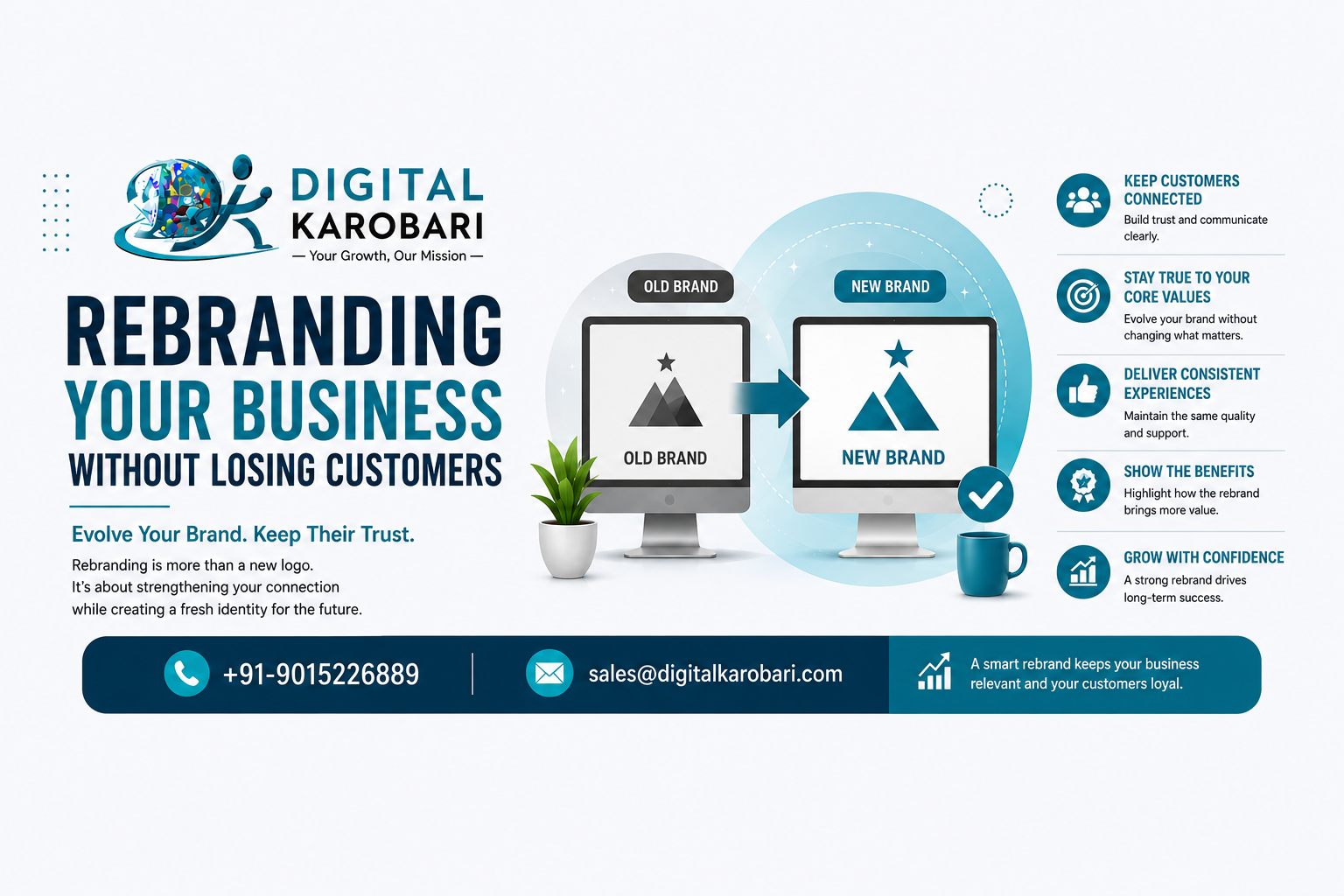
  • Rebranding Your Business Without Losing Customers

    Rebranding Your Business Without Losing Customers

    In today’s competitive business landscape, staying relevant is essential for long-term success. As customer preferences evolve and market trends change, businesses often need to refresh their image to remain competitive. This process, known as rebranding, can help attract new customers, strengthen your market position, and modernize your business. However, if handled poorly, rebranding can confuse loyal customers and negatively impact your reputation.
    The key to a successful rebrand is maintaining customer trust while introducing meaningful improvements. A thoughtful strategy ensures your existing audience continues to recognize and support your business while allowing you to expand your reach.

    What Is Business Rebranding?

    Business rebranding is the process of updating or completely changing your company’s visual identity, messaging, values, or positioning. It may involve:
    Designing a new logo
    Updating your website
    Refreshing your brand colors
    Creating a new brand voice
    Improving customer experience
    Changing marketing materials
    Introducing a new business vision
    Rebranding is much more than changing your logo—it’s about creating a stronger connection with your target audience.

    Why Businesses Rebrand

    Businesses choose to rebrand for several reasons, including:

    Keeping Up with Market Trends
    Consumer expectations and design preferences evolve. A modern brand helps your business remain relevant.

    Expanding Your Target Audience
    A refreshed identity can attract new customer segments while strengthening relationships with existing customers.

    Standing Out from Competitors
    A unique and memorable brand identity differentiates your business in crowded markets.

    Reflecting Business Growth
    If your products, services, or mission have evolved, your branding should reflect these changes.

    Building Greater Trust
    Professional branding enhances credibility and improves customer confidence.

    Common Rebranding Mistakes

    Avoid these common pitfalls:
    Changing everything at once without a strategy
    Ignoring customer feedback
    Losing your brand’s core identity
    Inconsistent messaging across platforms
    Poor communication with customers
    Neglecting SEO during website updates
    Forgetting to update social media profiles

    How to Rebrand Without Losing Customers

    Understand Why You’re Rebranding
    Before making changes, define clear objectives. Ask questions like:
    What problems are we solving?
    Who is our target audience?
    What business goals do we want to achieve?
    Having a clear purpose keeps your rebranding focused.

    Preserve Your Brand Values
    While visual elements may change, your company’s mission, values, and commitment to customers should remain consistent.
    Customers stay loyal because of trust—not just logos.

    Research Your Audience
    Understand what your customers appreciate about your brand.
    Gather insights through:
    Customer surveys
    Social media polls
    Online reviews
    Website analytics
    Sales feedback
    Use this information to make informed decisions.

    Refresh, Don’t Reinvent
    Unless absolutely necessary, avoid drastic changes.
    Instead:
    Modernize your logo
    Improve typography
    Update colors
    Enhance messaging
    Improve website usability
    Gradual improvements help customers adapt.

    Communicate the Changes Clearly
    Tell customers why you’re rebranding.
    Explain:
    What is changing
    Why it’s changing
    How it benefits them
    Transparency builds trust.

    Maintain Consistency
    Update your branding across every customer touchpoint:
    Website
    Social media
    Email marketing
    Business cards
    Brochures
    Advertisements
    Packaging
    Consistent branding reinforces recognition.

    Keep Your Website SEO-Friendly
    Website redesigns often affect search rankings.
    During rebranding:
    Maintain URL structures where possible
    Set up 301 redirects
    Update metadata
    Refresh content
    Optimize images
    Improve page speed
    This helps preserve organic traffic.

    Involve Your Existing Customers
    Invite loyal customers to participate in the process.
    Share:
    Sneak peeks
    Design concepts
    Polls
    Feedback forms
    Customers appreciate being included.

    Launch Strategically
    Plan your rollout carefully.
    A successful launch includes:
    Website announcement
    Email campaign
    Social media updates
    Press release
    Promotional offers
    Blog announcement
    Create excitement rather than confusion.

    Monitor Customer Feedback
    After launch, track:
    Website traffic
    Customer inquiries
    Social engagement
    Online reviews
    Sales performance
    Use customer feedback to make improvements.

    Signs It’s Time to Rebrand

    Every business reaches a point where its brand no longer reflects its vision, services, or the expectations of its target audience. If your logo, website, or marketing materials look outdated, it may be time for a refresh. Other signs include declining customer engagement, increased competition, expanding into new markets, or offering new products and services that your current brand doesn’t represent. Negative customer perceptions, inconsistent branding across platforms, and a drop in online visibility are also indicators that your business could benefit from rebranding. A well-planned rebrand helps your company stay relevant, strengthen its market position, and build stronger connections with both existing and potential customers.

    Benefits of Successful Rebranding

    A successful rebranding strategy can transform the way customers perceive your business while creating new opportunities for growth. It strengthens brand recognition, builds credibility, and enhances customer trust by presenting a more professional and modern image. Rebranding also helps businesses attract new audiences, differentiate themselves from competitors, and better communicate their unique value proposition. From an online marketing perspective, updating your website, improving user experience, and optimizing content can boost search engine rankings and increase organic traffic. Ultimately, a well-executed rebrand leads to improved customer loyalty, higher engagement, increased lead generation, and sustainable business growth.

    How Digital Karobari Helps Businesses Rebrand

    At Digital Karobari, we understand that rebranding is more than changing a logo—it’s about creating a stronger, more memorable identity that drives business success. Our team works closely with businesses to develop customized rebranding strategies that align with their goals, target audience, and market trends. We offer comprehensive branding solutions, including brand strategy, logo and visual identity design, website redesign and development, SEO optimization, content marketing, social media branding, and performance marketing. By combining creative design with data-driven digital marketing strategies, we ensure your rebrand not only looks modern but also improves online visibility, customer engagement, and lead generation. Whether you’re a startup looking to establish a strong identity or an established business seeking a fresh image, Digital Karobari helps you rebrand confidently while maintaining the trust and loyalty of your existing customers.

    Conclusion

    Rebranding is an opportunity to strengthen your business, not erase its identity. When guided by clear goals, customer insights, consistent messaging, and careful execution, a rebrand can refresh your business while preserving the trust and loyalty you’ve built over time.
    Whether you’re updating your logo, redesigning your website, or repositioning your brand, focus on communicating your purpose and delivering a consistent customer experience. A thoughtful rebranding strategy will help your business stay competitive, attract new audiences, and continue growing with confidence.

    Ready to Refresh Your Brand Without Losing Loyal Customers?

    A successful rebrand is more than a new logo—it’s about building stronger customer relationships and creating a brand that stands out in today’s competitive market.
    Digital Karobari helps businesses develop powerful brand identities, modern websites, SEO strategies, and performance marketing campaigns that drive measurable growth while keeping existing customers engaged.
    Contact Digital Karobari today to start your rebranding journey and build a stronger, more recognizable brand for the future.
    Company Name: Digital Karobari
    🌐: https://digitalkarobari.
    📞: +91-9015226889

    Frequently Asked Questions (FAQs)

    1. What is business rebranding?
      Business rebranding is the process of updating a company’s identity, messaging, visuals, or positioning to better reflect its goals and appeal to its target audience.
    2. Will rebranding affect my existing customers?
      Not if it’s done strategically. Clear communication, consistent messaging, and preserving your core values help maintain customer trust.
    3. How often should a business rebrand?
      Most businesses refresh their branding every 7–10 years, or sooner if there are significant changes in the market, services, or audience.
    4. Can rebranding improve SEO?
      Yes. When executed with proper SEO practices—such as maintaining URL structures, using 301 redirects, and optimizing content—rebranding can improve search visibility over time.
    5. What is the biggest mistake businesses make during rebranding?
      The most common mistake is making drastic changes without understanding customer expectations or communicating the reasons behind the changes.
    6. How long does a rebranding project take?
      Depending on the size of the business, a complete rebranding project can take anywhere from a few weeks to several months.
    7. Should I redesign my website during rebranding?
      Yes, if your website no longer reflects your brand or provides a poor user experience. Ensure SEO best practices are followed during the redesign.
    8. How can Digital Karobari help with rebranding?
      Digital Karobari offers end-to-end rebranding services, including brand strategy, logo design, website development, SEO, content marketing, social media branding, and performance marketing to help businesses grow without losing customer trust.
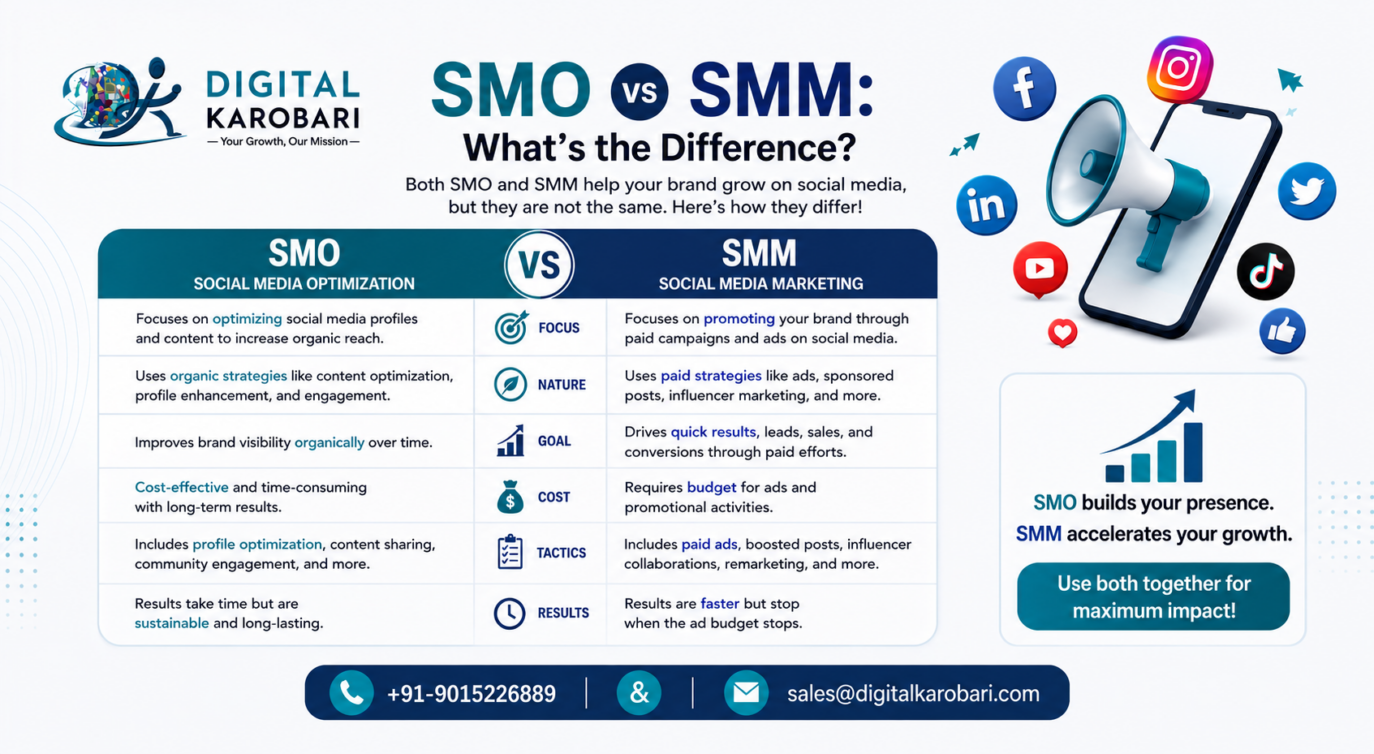
  • SMO vs Social Media Marketing (SMM): What’s the Difference?

    SMO vs Social Media Marketing (SMM): What’s the Difference?

    In today’s digital world, social media has become one of the most effective ways for businesses to connect with customers, build brand awareness, and generate leads. However, many people confuse Social Media Optimization (SMO) with Social Media Marketing (SMM). While both are essential parts of a successful digital marketing strategy, they serve different purposes.
    Understanding the difference between SMO and SMM helps businesses invest in the right strategy and maximize their return on investment.

    What is Social Media Optimization (SMO)?

    Social Media Optimization (SMO) is the process of optimizing your social media profiles and content to increase organic visibility, engagement, and follower growth. The primary goal of SMO is to make your social media presence attractive, informative, and easy for users to interact with.
    SMO focuses on creating optimized profiles, posting valuable content consistently, using relevant hashtags, maintaining brand consistency, and encouraging audience engagement without relying heavily on paid advertising.
    Key Features of SMO
    Optimizing social media profiles
    Creating engaging organic content
    Consistent branding
    Strategic hashtag usage
    Improving audience engagement
    Increasing organic followers
    Driving free traffic to your website

    What is Social Media Marketing (SMM)?

    Social Media Marketing (SMM) involves promoting products or services through both organic and paid social media campaigns. Unlike SMO, SMM focuses on achieving specific business objectives such as lead generation, sales, website traffic, or app downloads.
    SMM includes paid advertisements, audience targeting, campaign management, remarketing, influencer collaborations, and performance tracking across platforms like Facebook, Instagram, LinkedIn, X (Twitter), and YouTube.
    Key Features of SMM
    Paid advertising campaigns
    Audience targeting
    Lead generation
    Brand awareness campaigns
    Conversion optimization
    Performance analytics
    Retargeting campaigns

    SMO vs SMM: Major Differences

    Feature Social Media Optimization (SMO) Social Media Marketing (SMM)
    Purpose Improve organic visibility Generate leads, sales, and conversions
    Cost Mostly organic Organic + Paid
    Focus Profile and content optimization Marketing campaigns
    Results Long-term brand growth Faster business results
    Audience Existing and new followers Highly targeted audiences
    Traffic Source Organic Organic + Paid Ads
    ROI Builds credibility over time Quick measurable ROI

    Why Your Business Needs Both SMO and SMM

    Many businesses think they should choose either SMO or SMM. In reality, the best results come when both strategies work together.
    SMO builds a strong social media foundation by creating an engaging profile, publishing quality content, and growing your community organically. SMM then amplifies your reach by promoting your content to highly targeted audiences through paid campaigns.
    When combined, they help businesses:
    Increase brand awareness
    Improve customer engagement
    Generate quality leads
    Build customer trust
    Increase website traffic
    Improve conversion rates
    Achieve sustainable business growth

    Benefits of Social Media Optimization

    A well-optimized social media profile helps businesses establish credibility and attract followers naturally. Regular posting, optimized visuals, informative captions, and active engagement create a positive brand image that encourages long-term customer relationships.
    Benefits include:
    Better organic reach
    Improved customer trust
    Higher engagement
    Strong brand identity
    Increased website visits
    Better search visibility

    Benefits of Social Media Marketing

    Social Media Marketing enables businesses to reach the right audience quickly. Paid advertising allows brands to target users based on demographics, interests, behaviors, and location, making campaigns highly effective.
    Benefits include:
    Faster lead generation
    Higher sales opportunities
    Better audience targeting
    Measurable campaign performance
    Increased website conversions
    Remarketing opportunities

    Which Strategy Should You Choose?

    If your goal is to build a strong online presence and grow your audience naturally, SMO is the ideal starting point. If you want faster results, increased leads, and higher sales, SMM is the better option.
    For most businesses, combining both SMO and SMM provides the best long-term results. SMO creates trust and engagement, while SMM accelerates growth through targeted promotions.

    Conclusion

    Social Media Optimization and Social Media Marketing are not competitors—they complement each other. SMO strengthens your brand’s organic presence, while SMM helps you achieve measurable business goals through strategic campaigns. Businesses that integrate both approaches enjoy greater visibility, stronger customer relationships, and higher conversions.
    Whether you’re a startup or an established business, investing in both SMO and SMM can significantly improve your digital marketing success.

    Grow Your Business with Digital Karobari

    Ready to maximize your social media presence? Digital Karobari offers expert Social Media Optimization (SMO) and Social Media Marketing (SMM) services to help businesses increase brand awareness, engage the right audience, generate quality leads, and boost sales. Whether you need organic growth or high-performing paid campaigns, our experts create customized strategies that deliver measurable results.
    Contact Digital Karobari today and take your social media marketing to the next level!
    Company Name: Digital Karobari
    🌐: https://digitalkarobari.
    📞: +91-9015226889

    Frequently Asked Questions (FAQs)

    1. What is the main difference between SMO and SMM?
      SMO focuses on improving your social media profiles and organic engagement, while SMM focuses on promoting your business through organic and paid marketing campaigns.
    2. Is SMO free?
      Most SMO activities are organic and require minimal investment, though professional management services may involve a fee.
    3. Does SMM include paid advertising?
      Yes. SMM includes paid campaigns on platforms such as Facebook, Instagram, LinkedIn, YouTube, and X to reach targeted audiences.
    4. Which is better for small businesses?
      Small businesses benefit most from combining SMO and SMM. SMO builds credibility, while SMM generates faster leads and sales.
    5. How long does SMO take to show results?
      SMO generally takes several weeks to months, depending on content quality, consistency, and audience engagement.
    6. Can SMM increase website traffic?
      Yes. Well-planned SMM campaigns can drive highly targeted visitors to your website, increasing conversions and sales.
    7. Why should businesses use both SMO and SMM?
      Using both creates a balanced strategy that builds long-term brand authority while delivering immediate marketing results.
  • The Role of Content Marketing in SEO Success

    The Role of Content Marketing in SEO Success

    Introduction

    Search Engine Optimization (SEO) and content marketing are two of the most powerful digital marketing strategies. While SEO helps websites rank higher on search engines, content marketing provides the valuable information users are searching for. Together, they create a strong online presence that attracts visitors, builds trust, and converts prospects into customers.
    Google’s algorithms prioritize websites that consistently publish high-quality, relevant, and user-focused content. Businesses that invest in content marketing not only improve their search rankings but also establish themselves as industry leaders.
    This blog explains how content marketing contributes to SEO success and why every business should make it a key part of its digital marketing strategy.

    What is Content Marketing?

    Content marketing is the process of creating and sharing valuable, informative, and engaging content to attract and retain a target audience. Instead of directly promoting products or services, content marketing focuses on solving customer problems and answering their questions.
    Examples include:
    Blog posts
    Articles
    Infographics
    Videos
    Case studies
    Whitepapers
    E-books
    Social media content
    Email newsletters
    High-quality content helps build credibility while supporting SEO goals.

    Why Content Marketing Matters for SEO

    Search engines aim to deliver the best possible results for users. Fresh, informative, and authoritative content helps search engines understand your website and rank it for relevant searches.
    Content marketing supports SEO by:
    Increasing keyword visibility
    Improving user engagement
    Generating backlinks
    Reducing bounce rates
    Increasing dwell time
    Building topical authority
    Supporting internal linking
    Encouraging social sharing

    How Content Marketing Improves SEO

    Targets Relevant Keywords
    Every piece of content provides an opportunity to rank for valuable search terms.
    Instead of focusing on a single keyword, businesses can target:
    Primary keywords
    Secondary keywords
    Long-tail keywords
    Local SEO keywords
    Question-based searches
    Well-optimized content naturally includes keywords without stuffing.

    Increases Organic Traffic
    Publishing helpful content consistently gives search engines more pages to index.
    The more quality pages your website has, the greater the opportunity to appear in search results and attract visitors.

    Builds Website Authority
    Expert articles demonstrate knowledge and experience.
    When your content consistently answers user questions better than competitors, search engines view your website as a trusted source.
    This improves domain authority over time.

    Generates High-Quality Backlinks
    Useful content naturally attracts backlinks from:
    Industry blogs
    News websites
    Business directories
    Educational websites
    Resource pages
    Backlinks remain one of Google’s strongest ranking factors.

    Improves User Experience
    Good content keeps users engaged.
    Visitors stay longer when they find valuable information, which improves metrics such as:
    Average session duration
    Pages per session
    Bounce rate
    These engagement signals positively influence SEO performance.

    Supports Internal Linking
    Blogs allow businesses to connect related pages across their website.
    Internal links help:
    Search engines crawl pages
    Pass SEO value
    Improve website structure
    Guide users toward services and products

    Helps Rank for Voice Search
    Voice searches are becoming increasingly common.
    Creating conversational content that answers questions directly improves visibility for voice search queries like:
    What is content marketing?
    How does SEO work?
    Why is blogging important?

    Keeps Your Website Fresh
    Google prefers websites that update regularly.
    Publishing fresh blogs keeps your website active and signals that your business continues to provide current information.

    Types of Content That Improve SEO

    Blog Articles
    Regular blogs target industry keywords and educate users.
    How-to Guides
    Step-by-step tutorials attract long-tail keyword traffic.
    Case Studies
    Show real business results while building credibility.
    Videos
    Video content improves engagement and increases time spent on your website.
    Infographics
    Visual content earns shares and backlinks.
    FAQs
    Frequently Asked Questions target conversational search queries and improve user experience.

    Content Marketing Best Practices for SEO

    Understand Your Audience
    Create content that solves customer problems.
    Perform Keyword Research
    Use relevant keywords naturally throughout your content.
    Publish Regularly
    Maintain a consistent publishing schedule.
    Focus on Quality
    Provide accurate, original, and valuable information.
    Optimize Headlines
    Use engaging titles that include target keywords.
    Add Internal Links
    Link related blogs and service pages.
    Include Visual Content
    Use images, charts, and videos to improve readability.
    Update Older Content
    Refresh outdated articles to maintain rankings.

    Common Content Marketing Mistakes

    Avoid these mistakes:
    Keyword stuffing
    Thin or duplicate content
    Ignoring search intent
    Poor formatting
    No internal linking
    Publishing without a strategy
    Copying competitor content
    Not updating old blogs

    Measuring Content Marketing Success

    Track these SEO metrics:
    Organic traffic
    Keyword rankings
    Click-through rate (CTR)
    Bounce rate
    Time on page
    Conversion rate
    Backlinks
    Leads generated
    Indexed pages
    Returning visitors
    Use tools like Google Analytics and Google Search Console to monitor performance.

    Why Businesses Should Invest in Content Marketing

    Content marketing offers long-term benefits:
    Higher search rankings
    Better brand awareness
    More qualified leads
    Increased website traffic
    Improved customer trust
    Higher conversion rates
    Lower long-term marketing costs
    Sustainable organic growth
    Unlike paid advertising, quality content continues attracting visitors long after publication.

    Conclusion

    Content marketing is the foundation of successful SEO. By creating informative, relevant, and optimized content, businesses can improve search rankings, attract more visitors, and establish long-term authority in their industry. A consistent content strategy not only enhances visibility but also builds trust and drives meaningful customer engagement. Businesses that invest in content marketing today will be better positioned for sustainable online growth in the future.

    Grow Your Business with SEO-Driven Content Marketing

    High-quality content is the key to better search rankings, increased organic traffic, and stronger customer engagement. At Digital Karobari, we create SEO-optimized content strategies that help businesses improve online visibility, generate qualified leads, and achieve sustainable growth.
    Our Content Marketing Services Include:
    SEO Blog Writing
    Keyword Research
    Website Content Creation
    Landing Page Content
    Technical SEO Content
    Content Strategy & Planning
    Local SEO Content
    Content Optimization & Updates
    Partner with Digital Karobari today and turn your content into a powerful engine for SEO success and business growth.
    Company Name: Digital Karobari
    🌐: https://digitalkarobari.
    📞: +91-9015226889

    Frequently Asked Questions (FAQs)

    1. What is content marketing in SEO?
      Content marketing involves creating valuable and relevant content that helps improve search engine rankings and attract organic traffic.
    2. Why is content important for SEO?
      Content helps search engines understand your website, target keywords, answer user queries, and improve rankings.
    3. How often should businesses publish content?
      Publishing one to four high-quality blog posts each month is a good starting point, depending on your industry and goals.
    4. Does blogging improve SEO?
      Yes. Regular blogging increases indexed pages, targets new keywords, improves authority, and drives organic traffic.
    5. What type of content performs best for SEO?
      How-to guides, detailed blogs, case studies, FAQs, videos, and evergreen content typically perform well.
    6. How long does content marketing take to improve SEO?
      Results usually begin appearing within 3–6 months, depending on competition, content quality, and website authority.
    7. Can old blog posts be updated for better rankings?
      Yes. Updating existing content with fresh information, keywords, and internal links can improve search rankings.
    8. Is content marketing suitable for small businesses?
      Absolutely. It helps small businesses build visibility, attract local customers, and compete with larger brands through organic search.
  • How to Rank in Google AI Overviews with AEO (Answer Engine Optimization)

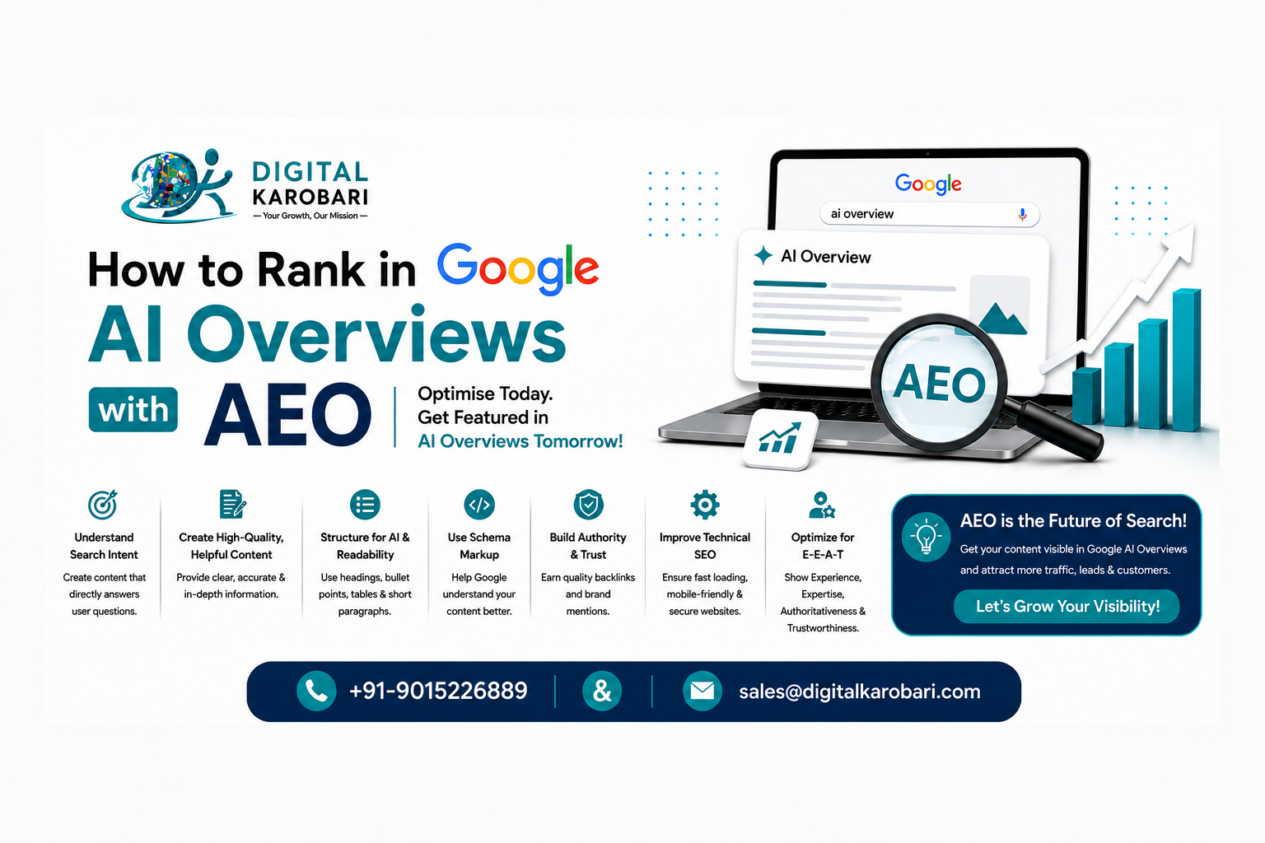
    How to Rank in Google AI Overviews with AEO (Answer Engine Optimization)

    Google Search is evolving rapidly with the introduction of AI Overviews, a feature that uses artificial intelligence to generate summarized answers directly in search results. This shift means businesses and websites need to optimize their content not only for traditional SEO but also for Answer Engine Optimization (AEO). AEO focuses on creating content that AI systems can easily understand, extract, and present as direct answers to users.
    If your business wants to maintain visibility and attract more organic traffic, ranking in Google AI Overviews should be a key part of your digital marketing strategy. In this blog, we’ll explain what AEO is, why it matters, and how you can optimize your content to increase your chances of appearing in AI-generated search results.

    What Are Google AI Overviews?

    Google AI Overviews are AI-generated summaries that appear at the top of search engine results pages (SERPs). Instead of showing only a list of websites, Google provides users with concise answers gathered from multiple trusted sources.
    AI Overviews aim to:
    Answer questions quickly.
    Provide reliable and relevant information.
    Improve the user search experience.
    Reduce the need for multiple searches.
    For businesses, appearing in AI Overviews can significantly increase visibility, credibility, and website traffic.

    What Is Answer Engine Optimization (AEO)?

    Answer Engine Optimization (AEO) is the process of structuring and optimizing content so that search engines and AI-powered search assistants can easily understand and use it to answer user queries.
    Unlike traditional SEO, which primarily focuses on ranking web pages, AEO emphasizes:
    Answering user questions clearly.
    Structuring content logically.
    Using conversational language.
    Providing trustworthy information.
    Optimizing for voice and AI search.

    Why AI Overviews Matter for Businesses

    AI-powered search is changing how users discover information. Businesses that optimize for AI Overviews can benefit from:
    Increased online visibility.
    Higher brand authority.
    More qualified website traffic.
    Better user engagement.
    Greater trust from potential customers.
    As AI-generated search experiences become more common, AEO will play an increasingly important role in digital marketing.

    How to Rank in Google AI Overviews

    Focus on User Intent
    Understand what users are searching for and create content that directly answers their questions.
    Examples include:
    What is AEO?
    How does AI Overview work?
    Why is Answer Engine Optimization important?
    Answer these questions clearly within the first few paragraphs.

    Write Clear and Concise Answers
    AI systems prefer content that provides direct, accurate, and easy-to-understand answers.
    Best practices:
    Keep explanations simple.
    Avoid unnecessary jargon.
    Use short paragraphs.
    Include bullet points where appropriate.

    Use Question-Based Headings
    Structure your content around common user queries.
    Examples:
    What is AEO?
    How does Google AI Overview work?
    How can businesses optimize for AI search?
    Question-based headings make it easier for AI systems to identify relevant answers.

    Create High-Quality, Original Content
    Google prioritizes valuable and original content.
    Ensure your content:
    Solves real user problems.
    Includes practical insights.
    Demonstrates expertise.
    Is regularly updated.
    Avoid duplicate or low-quality content.

    Optimize for Featured Snippets
    Many AI Overviews use content similar to featured snippets.
    Improve your chances by:
    Writing definitions.
    Using numbered lists.
    Including comparison tables.
    Adding step-by-step guides.

    Implement Structured Data
    Schema markup helps search engines understand your content better.
    Useful schema types include:
    FAQ Schema
    Article Schema
    Organization Schema
    Local Business Schema
    Breadcrumb Schema
    Structured data increases the likelihood of AI understanding your content accurately.

    Build Topical Authority
    Instead of publishing isolated articles, create comprehensive content clusters around your niche.
    For example, if your business focuses on digital marketing, publish content about:
    SEO
    AEO
    GEO

    Content Marketing
    AI Marketing
    Voice Search
    Local SEO
    This demonstrates expertise and improves topical relevance.

    Improve Website Experience
    AI-powered search also considers user experience.
    Optimize:
    Mobile responsiveness
    Page speed
    Secure HTTPS connection
    Easy navigation
    Readable design
    A fast and user-friendly website encourages better engagement.

    Strengthen E-E-A-T Signals
    Google values content that demonstrates:
    Experience
    Expertise
    Authoritativeness
    Trustworthiness
    Include:
    Author information
    Business details
    Customer testimonials
    Accurate references where appropriate
    Updated content
    Strong E-E-A-T signals improve overall credibility.

    Optimize for Conversational Search
    Many users now search using natural language.
    Instead of targeting only keywords like:
    “Digital Marketing Agency”
    Optimize for conversational queries such as:
    Which digital marketing agency is best for my business?
    How can AEO improve my website rankings?
    What is the difference between SEO and AEO?
    This aligns with how AI interprets search intent.

    Common Mistakes to Avoid

    Many businesses make the mistake of treating AEO the same as traditional SEO by focusing only on keywords rather than providing direct, valuable answers to user queries. Publishing thin, duplicate, or outdated content can reduce your chances of appearing in Google AI Overviews. Another common mistake is ignoring user intent and creating content that doesn’t fully address what people are searching for. Poor website performance, slow loading speeds, lack of mobile optimization, and missing structured data can also negatively impact visibility. Businesses should also avoid keyword stuffing, weak internal linking, and neglecting to update existing content. To succeed with AEO, focus on creating high-quality, trustworthy, and well-structured content that delivers real value while maintaining a fast, secure, and user-friendly website.

    Benefits of AEO for Businesses

    Answer Engine Optimization (AEO) helps businesses improve their visibility in AI-powered search results by making their content easier for search engines to understand and display. Appearing in Google AI Overviews can increase brand awareness, establish authority, and attract highly relevant organic traffic. AEO also enhances user experience by providing clear and concise answers that match search intent, leading to better engagement and higher conversion rates. As voice search and AI-driven search continue to grow, businesses that invest in AEO gain a competitive advantage by staying ahead of changing search trends. Combined with traditional SEO, AEO creates a stronger digital presence, improves long-term search performance, and helps businesses connect with customers at every stage of their online journey.

    Why Choose Digital Karobari for AEO Services?

    Digital Karobari specializes in helping businesses adapt to the future of search through advanced Answer Engine Optimization (AEO) strategies. Our experienced team creates high-quality, AI-friendly content that aligns with user intent and follows Google’s latest search guidelines. We combine AEO with SEO, Generative Engine Optimization (GEO), technical SEO, content marketing, and website optimization to maximize your online visibility. From implementing structured data and improving website performance to building topical authority and optimizing for AI Overviews, we provide end-to-end solutions tailored to your business goals. Whether you’re a startup, local business, or enterprise, Digital Karobari delivers data-driven strategies that help increase search rankings, drive qualified traffic, generate more leads, and ensure your business remains competitive in the evolving AI-powered search landscape.

    Conclusion

    Google AI Overviews are reshaping the future of online search. Businesses that embrace Answer Engine Optimization today will be better positioned to gain visibility, build authority, and attract qualified traffic in the years ahead. By creating helpful, structured, and trustworthy content, optimizing for user intent, and improving website performance, your business can increase its chances of being featured in AI-generated search results. Partner with Digital Karobari to implement future-ready AEO strategies and stay ahead in the evolving digital landscape.

    Future-Proof Your Search Strategy with Digital Karobari

    As AI-powered search transforms the way people find information, your business needs an optimization strategy that goes beyond traditional SEO. Digital Karobari specializes in Answer Engine Optimization (AEO), SEO, and Generative Engine Optimization (GEO) to help your website rank in Google AI Overviews and attract high-quality organic traffic. Contact our team today to build AI-ready content, improve search visibility, and grow your business with future-focused digital marketing solutions.
    Company Name: Digital Karobari
    🌐: https://digitalkarobari.
    📞: +91-9015226889

    Frequently Asked Questions (FAQs)

    1. What is Answer Engine Optimization (AEO)?
      AEO is the process of optimizing content so AI-powered search engines and assistants can easily understand and present it as direct answers to user queries.
    2. What are Google AI Overviews?
      Google AI Overviews are AI-generated summaries that provide users with quick, informative answers at the top of search results by combining information from multiple trusted sources.
    3. How is AEO different from traditional SEO?
      SEO focuses on improving webpage rankings, while AEO emphasizes creating structured, high-quality answers that AI systems can use in search results.
    4. How can I improve my chances of appearing in AI Overviews?
      Create original content, answer user questions clearly, use structured data, improve website performance, build topical authority, and demonstrate strong E-E-A-T signals.
    5. Does AEO replace SEO?
      No. AEO complements SEO. Businesses should combine both strategies to maximize visibility in traditional search results and AI-powered search experiences.
    6. Can Digital Karobari help with AEO?
      Yes. Digital Karobari offers AEO, SEO, GEO, content marketing, technical SEO, and website optimization services to help businesses improve online visibility.
  • How Can I Tell If a Digital Marketing Agency Has Expertise in My Industry?

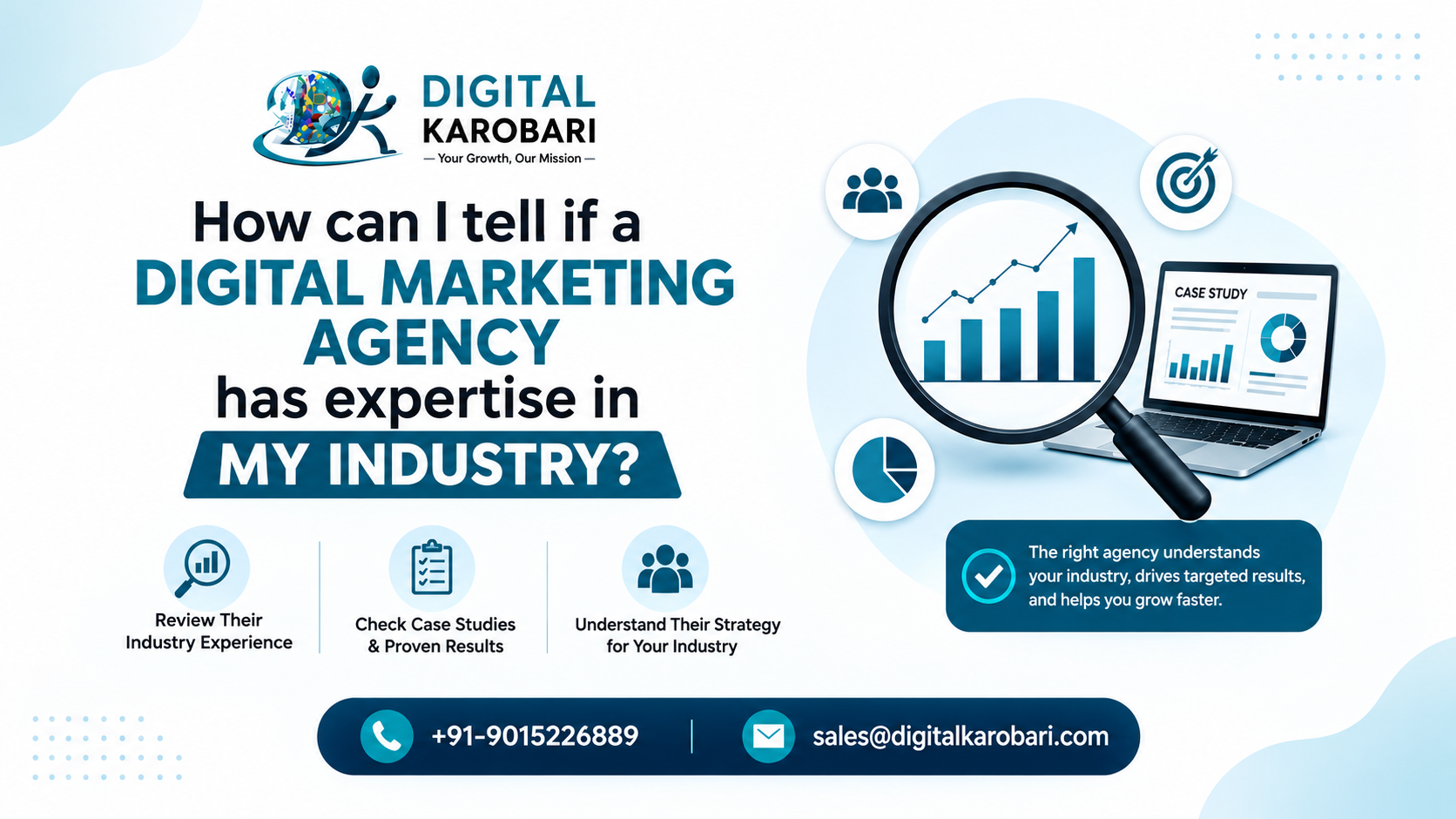
    How Can I Tell If a Digital Marketing Agency Has Expertise in My Industry?

    Choosing the right digital marketing agency is one of the most important decisions for your business. While many agencies promise impressive results, not all of them understand the unique challenges, customer behavior, and competition within your industry.
    An agency with industry-specific expertise can create strategies that generate qualified leads, improve conversions, and deliver measurable business growth. But how do you identify whether an agency truly understands your market?
    In this guide, we’ll explain the key signs that indicate a digital marketing agency has genuine expertise in your industry.

    Why Industry Experience Matters

    Every industry has different audiences, buying cycles, regulations, and competition. Marketing strategies that work for an eCommerce brand may not be effective for a manufacturing company, healthcare provider, educational institution, or legal firm.
    An experienced agency understands:
    Industry trends
    Customer pain points
    Competitor landscape
    Buyer journey
    Search behavior
    Lead generation strategies
    Compliance requirements (where applicable)
    This allows them to create campaigns that deliver better ROI.

    Review Their Portfolio

    A strong agency should showcase previous projects and successful campaigns.
    Look for:
    Businesses similar to yours
    Industry-specific websites
    SEO case studies
    PPC campaigns
    Social media campaigns
    Content marketing examples
    If they have worked with businesses like yours, they already understand your audience and challenges.

    Check Their Case Studies

    Case studies provide deeper insights than a portfolio.
    Look for measurable outcomes such as:
    Increased organic traffic
    Higher conversion rates
    More qualified leads
    Better search rankings
    Lower cost per acquisition
    Improved ROI
    A results-driven agency focuses on data rather than vague promises.

    Read Client Testimonials

    Testimonials reveal what clients actually experienced.
    Look for comments about:
    Communication
    Industry knowledge
    Strategy
    Transparency
    Reporting
    Business growth
    Also check Google Reviews, Clutch, and other trusted review platforms.

    Evaluate Their Website Content

    An agency that understands your industry often publishes valuable content about it.
    Check whether they have blogs on:
    Industry trends
    Customer challenges
    Marketing strategies
    SEO updates
    Paid advertising
    AI marketing
    Analytics
    Helpful content demonstrates expertise.

    Ask About Their Industry Experience

    Don’t hesitate to ask questions such as:
    Have you worked with businesses in our industry?
    What challenges do companies like ours face?
    What strategies have worked?
    What KPIs do you track?
    How long before we see results?
    Experienced agencies answer confidently with real examples.

    Assess Their SEO Knowledge

    Industry-specific SEO requires understanding:
    Buyer intent
    Keyword research
    Competitor analysis
    Technical SEO
    Local SEO
    Content strategy
    Ask how they would improve your visibility on search engines.

    Evaluate Their Paid Advertising Experience

    Running successful Google Ads and social media campaigns requires industry expertise.
    A skilled agency should understand:
    Audience targeting
    Budget optimization
    Conversion tracking
    Remarketing
    Ad creatives
    Landing page optimization
    Their recommendations should align with your business goals.

    Check Their Reporting Process

    Professional agencies provide regular performance reports.
    Reports should include:
    Website traffic
    Keyword rankings
    Lead generation
    Conversion rates
    Ad performance
    Return on ad spend (ROAS)
    ROI
    Transparent reporting builds trust.

    Understand Their Strategy Process

    Avoid agencies offering identical packages for every client.
    Instead, they should first understand:
    Your business goals
    Target audience
    Competitors
    Marketing budget
    Current performance
    Sales process
    A customized strategy generally delivers better long-term results.

    Evaluate Their Communication

    Good communication is essential for successful marketing partnerships.
    Ask yourself:
    Are they responsive?
    Do they explain technical concepts clearly?
    Do they understand your business objectives?
    Are they proactive with suggestions?
    An agency that listens carefully usually develops stronger campaigns.

    Ask About the Tools They Use

    Experienced agencies use professional marketing tools such as:
    Google Analytics
    Google Search Console
    Google Ads
    Meta Ads Manager
    SEO research tools
    Heatmap software
    CRM integrations
    Marketing automation platforms
    The right tools improve decision-making.

    Look for Long-Term Clients

    Long-term client relationships indicate consistent performance.
    If businesses continue working with the agency for years, it’s a positive sign that they deliver value.

    Red Flags to Watch Out For

    Not every digital marketing agency that promises impressive results has the expertise to deliver them. One of the biggest red flags is guaranteeing instant success or claiming they can secure the #1 ranking on Google within a short period, as no agency can control search engine algorithms. Be cautious of agencies that rely on generic, one-size-fits-all marketing packages without first understanding your business, industry, and goals. A lack of case studies, client testimonials, or measurable success stories may also indicate limited experience or inconsistent performance. Transparency is another key factor—if an agency is unwilling to explain its strategies, provide regular performance reports, or clearly outline how your marketing budget will be used, it may not be the right partner. Additionally, agencies that focus only on vanity metrics such as likes, impressions, or website visits without discussing leads, conversions, and return on investment (ROI) should be approached with caution. Poor communication, unrealistic promises, hidden fees, and outdated marketing practices are also warning signs. A trustworthy digital marketing agency will set realistic expectations, use ethical marketing techniques, maintain open communication, and focus on long-term, sustainable growth rather than quick but short-lived results.

    Questions to Ask Before Hiring

    Hiring a digital marketing agency is a long-term investment, so it’s important to ask the right questions before making your decision. Start by asking whether the agency has experience working with businesses in your industry and request examples of similar projects or case studies. Understand how they plan to achieve your marketing goals and which key performance indicators (KPIs) they use to measure success. Ask about their approach to SEO, paid advertising, social media marketing, and content creation, as well as how often they will provide performance reports and campaign updates. It’s also important to know who will manage your account, how they communicate with clients, and how they handle underperforming campaigns. A reliable agency will answer these questions transparently, provide realistic expectations, and explain how their strategies are tailored to your business rather than offering one-size-fits-all solutions.

    Why Businesses Choose Digital Karobari

    Businesses choose Digital Karobari because we believe every company deserves a customized digital marketing strategy that aligns with its unique goals, target audience, and industry requirements. Our team combines expertise in SEO, performance marketing, Google Ads, social media marketing, website development, content marketing, and local SEO to create data-driven campaigns that deliver measurable results. We focus on increasing online visibility, generating high-quality leads, improving conversion rates, and maximizing return on investment through continuous optimization and transparent reporting. By staying updated with the latest digital marketing trends, AI-powered strategies, and search engine algorithm changes, we help businesses remain competitive in an ever-evolving digital landscape. At Digital Karobari, we don’t just execute marketing campaigns—we build long-term partnerships focused on sustainable business growth, ensuring our clients receive dedicated support, strategic insights, and consistent performance improvements.


    Conclusion

    Choosing the right digital marketing agency goes beyond comparing prices. Look for industry experience, proven results, transparent communication, and a customized approach. Agencies that understand your market can develop strategies that attract the right customers and generate sustainable business growth.
    Take the time to evaluate portfolios, case studies, reviews, and reporting methods before making your decision. A knowledgeable agency becomes more than a service provider—it becomes a long-term growth partner.

    Ready to Work with a Digital Marketing Agency That Understands Your Industry?

    Your business deserves marketing strategies tailored to your industry—not generic solutions.
    Digital Karobari helps businesses increase visibility, generate quality leads, improve conversions, and achieve sustainable growth with customized digital marketing solutions.
    Contact Digital Karobari today for a free consultation and discover how industry-focused digital marketing can accelerate your business success.
    Company Name: Digital Karobari
    🌐: https://digitalkarobari.
    📞: +91-9015226889

    FAQs

    1. Why is industry experience important when choosing a digital marketing agency?
      Industry experience helps agencies understand customer behavior, competitors, and effective marketing strategies specific to your business.
    2. How can I verify an agency’s expertise?
      Review their portfolio, case studies, client testimonials, certifications, and previous work in your industry.
    3. Should I choose an agency that specializes in my niche?
      Yes. Industry-specific knowledge often leads to better targeting, stronger messaging, and improved campaign performance.
    4. What questions should I ask before hiring an agency?
      Ask about their experience, reporting process, communication style, campaign strategy, KPIs, and previous client success stories.
    5. Can a digital marketing agency help improve lead quality?
      Yes. Experienced agencies optimize campaigns to attract qualified leads that are more likely to convert.
    6. How long does it take to see digital marketing results?
      SEO usually takes 3–6 months, while PPC and paid social campaigns can generate results much faster with proper optimization.
    7. What industries does Digital Karobari serve?
      Digital Karobari works with businesses across manufacturing, healthcare, education, real estate, eCommerce, technology, professional services, and more.
    8. What makes Digital Karobari different?
      We combine industry research, data-driven strategies, transparent reporting, and continuous optimization to deliver measurable business growth.
  • How E-E-A-T Helps Websites Rank Higher

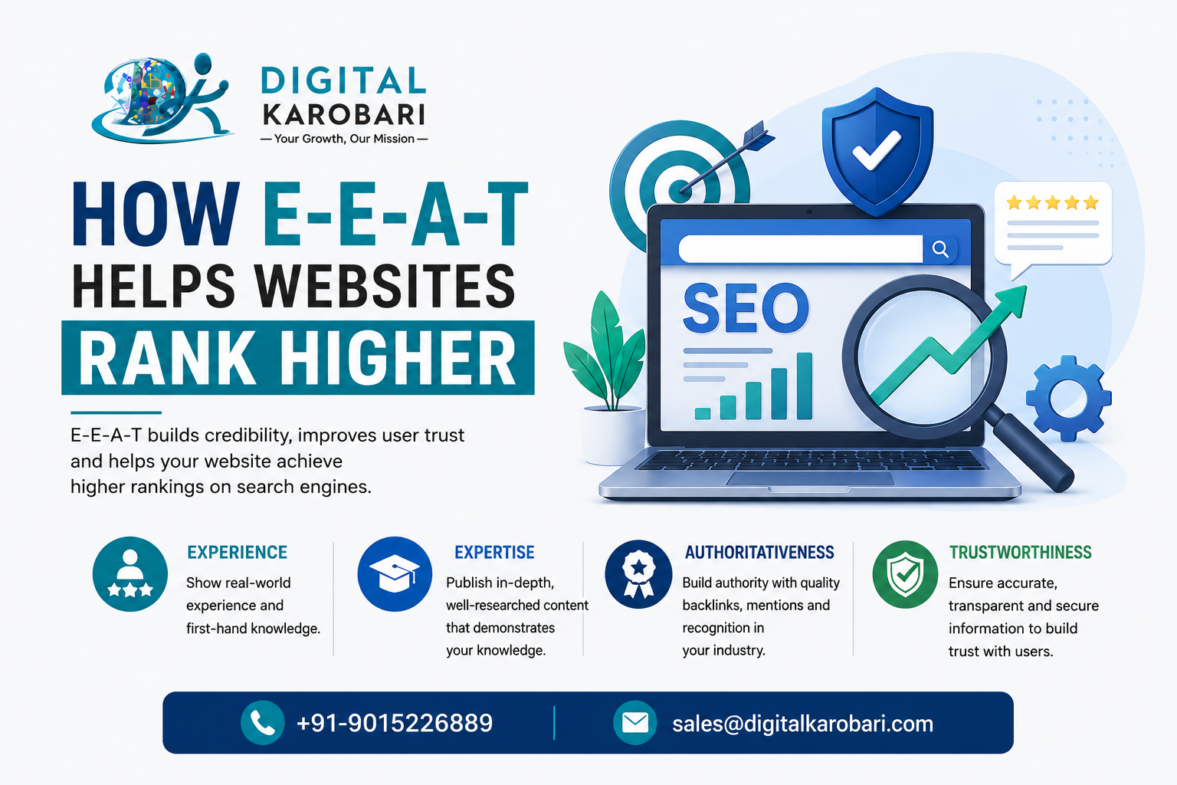
    How E-E-A-T Helps Websites Rank Higher

    Introduction

    Search engine optimization (SEO) is constantly evolving, and Google’s focus has shifted beyond keywords and backlinks to prioritize content quality and user trust. One of the most important concepts influencing modern SEO is E-E-A-T, which stands for Experience, Expertise, Authoritativeness, and Trustworthiness.
    Google wants to deliver accurate, reliable, and helpful information to users. Websites that demonstrate genuine experience, industry expertise, authority, and trust are more likely to perform well in search results, especially in competitive industries.
    At Digital Karobari, we help businesses create SEO strategies that align with Google’s latest guidelines, improving visibility, credibility, and long-term organic growth.

    What is E-E-A-T?

    E-E-A-T is a framework used by Google’s Search Quality Evaluators to assess the quality and credibility of web content. While it is not a direct ranking factor, it strongly influences how Google evaluates content quality and user value.
    The four components include:
    Experience – Demonstrating first-hand knowledge or practical involvement in the topic.
    Expertise – Showing professional knowledge or specialized skills.
    Authoritativeness – Being recognized as a trusted source within your industry.
    Trustworthiness – Providing accurate, transparent, and secure information.
    Together, these elements help build confidence with both search engines and users.

    Why E-E-A-T Matters for SEO

    Google’s primary goal is to provide users with the most relevant and trustworthy information. Websites with strong E-E-A-T signals are more likely to:
    Rank higher for competitive keywords
    Build user confidence
    Increase organic traffic
    Improve engagement metrics
    Generate more qualified leads
    Strengthen brand reputation
    For industries such as healthcare, finance, legal services, and education, E-E-A-T is especially important because users rely on accurate information to make important decisions.

    Understanding the Four Pillars of E-E-A-T

    Experience
    Google values content written by people who have practical, real-world experience.
    Examples include:
    Product reviews based on actual usage
    Case studies
    Customer success stories
    Personal insights
    Project portfolios
    Adding authentic experiences makes your content more valuable and trustworthy.

    Expertise
    Expertise refers to your knowledge and qualifications within a specific field.
    Ways to demonstrate expertise include:
    Publishing in-depth articles
    Sharing industry insights
    Providing accurate information
    Showcasing certifications
    Displaying professional credentials
    Well-researched content establishes your website as a reliable source.

    Authoritativeness
    Authority is built when others recognize your business as an industry leader.
    You can improve authority by:
    Earning quality backlinks
    Receiving positive reviews
    Publishing original research
    Being featured on reputable websites
    Maintaining a consistent content strategy
    Authority grows over time through credibility and recognition.

    Trustworthiness
    Trust is considered the most important aspect of E-E-A-T.
    Build trust by:
    Using HTTPS security
    Displaying contact information
    Publishing accurate content
    Providing transparent business details
    Showing customer testimonials
    Including clear privacy and refund policies
    A trustworthy website encourages both users and search engines to engage with your content.

    How to Improve Your Website’s E-E-A-T

    Publish High-Quality Content
    Create original, informative, and well-structured content that solves user problems.
    Add Author Information
    Include author bios with qualifications, experience, and expertise.
    Update Content Regularly
    Keep articles current with the latest trends, statistics, and industry developments.
    Build Quality Backlinks
    Earn links from trusted websites through valuable content and digital PR.
    Showcase Customer Reviews
    Positive reviews help establish trust and credibility.
    Improve Website Security
    Use SSL certificates, secure payment gateways, and transparent privacy policies.
    Include Case Studies
    Real-world examples demonstrate practical experience and successful outcomes.
    Strengthen Your About Page
    Clearly explain your company’s mission, experience, team, and achievements.

    Common Mistakes That Hurt E-E-A-T

    Many websites struggle to achieve strong search rankings because they overlook the principles of E-E-A-T. Publishing thin, duplicate, or AI-generated content without human review can reduce credibility and fail to provide real value to users. Using misleading headlines, sharing outdated or inaccurate information, and failing to cite reliable sources can weaken trust. Websites that lack author profiles, company details, customer reviews, or clear contact information often appear less credible to both users and search engines. Poor website security, broken links, excessive advertisements, and slow loading speeds can also negatively impact user experience and trustworthiness. Additionally, relying on low-quality backlinks or engaging in manipulative SEO practices can harm your website’s authority and long-term search performance.

    E-E-A-T and AI Content

    AI tools can help generate content efficiently, but human expertise remains essential. Google values content that demonstrates real experience, originality, and usefulness.
    To ensure AI-assisted content supports E-E-A-T:
    Fact-check every article
    Add expert insights
    Include real examples and case studies
    Update content regularly
    Maintain originality and authenticity
    Human review is key to producing content that earns trust and performs well in search results.

    Benefits of Strong E-E-A-T

    Building strong E-E-A-T offers significant long-term advantages for any business looking to grow its online presence. When your website consistently demonstrates real experience, expert knowledge, industry authority, and trustworthiness, it becomes more valuable to both users and search engines. This often leads to higher rankings on Google, increased organic traffic, longer user engagement, and improved conversion rates. A trustworthy website also encourages repeat visitors, strengthens brand reputation, and builds customer confidence. Over time, businesses with strong E-E-A-T are more likely to earn high-quality backlinks, positive reviews, and greater recognition within their industry, creating a sustainable foundation for long-term SEO success.

    How Digital Karobari Helps Improve E-E-A-T

    At Digital Karobari, we help businesses strengthen every aspect of E-E-A-T through strategic SEO and content marketing solutions. Our team creates high-quality, user-focused content backed by thorough research, industry insights, and SEO best practices to establish expertise and credibility. We optimize website structure, improve technical SEO, enhance page speed, implement secure HTTPS protocols, and ensure a seamless user experience that builds trust with both visitors and search engines. Our services also include authority-building strategies such as ethical link building, digital PR, reputation management, and local SEO to increase your brand’s online visibility. By continuously monitoring performance, updating content, and aligning with Google’s latest search guidelines, Digital Karobari helps businesses build lasting authority, improve search rankings, and achieve sustainable organic growth.

    Conclusion

    E-E-A-T has become an essential part of successful SEO. By focusing on real experience, expert knowledge, industry authority, and user trust, businesses can improve search rankings while building meaningful relationships with their audience.
    Instead of chasing short-term SEO tactics, invest in creating valuable content, maintaining transparency, and demonstrating genuine expertise. These efforts will help your website achieve sustainable growth and long-term success.
    Partner with Digital Karobari to develop an SEO strategy that aligns with Google’s best practices and positions your business as a trusted leader in your industry.

    Build Trust. Improve Rankings. Grow Your Business.

    Your website deserves more than just traffic—it deserves credibility that converts visitors into customers.
    Digital Karobari helps businesses strengthen their E-E-A-T with data-driven SEO strategies, high-quality content, technical optimization, and authority-building campaigns that align with Google’s latest search guidelines.
    Our SEO Services Include:
    Comprehensive SEO Audits
    On-Page & Technical SEO
    Content Marketing & Blogging
    Local SEO Optimization
    High-Quality Link Building
    Digital PR & Brand Authority
    Website Performance Optimization
    Monthly SEO Reporting
    Ready to improve your Google rankings? Contact Digital Karobari today and let our SEO experts help your website earn trust, authority, and long-term organic growth.
    Company Name: Digital Karobari
    🌐: https://digitalkarobari.
    📞: +91-9015226889

    Frequently Asked Questions (FAQs)

    1. What does E-E-A-T stand for?
      E-E-A-T stands for Experience, Expertise, Authoritativeness, and Trustworthiness, a framework Google uses to evaluate content quality.
    2. Is E-E-A-T a Google ranking factor?
      E-E-A-T is not a direct ranking factor, but it significantly influences how Google assesses the quality and credibility of content.
    3. Why is E-E-A-T important for SEO?
      Strong E-E-A-T helps improve user trust, content quality, search visibility, and long-term organic rankings.
    4. How can I improve my website’s E-E-A-T?
      Create high-quality content, showcase author expertise, earn quality backlinks, maintain website security, publish case studies, and update content regularly.
    5. Does E-E-A-T apply to all websites?
      Yes. Every website benefits from demonstrating experience, expertise, authority, and trust, especially businesses in competitive industries.
    6. Can AI-generated content meet E-E-A-T standards?
      Yes, if it is reviewed by experts, fact-checked, enriched with original insights, and provides genuine value to readers.
    7. How long does it take to improve E-E-A-T?
      Building strong E-E-A-T is an ongoing process that typically takes several months of consistent content creation, optimization, and reputation building.
    8. How can Digital Karobari help improve my website’s E-E-A-T?
      Digital Karobari provides SEO, content marketing, technical optimization, digital PR, and reputation management services to strengthen your website’s credibility and improve search performance.
  • AEO Strategies for Local Business: How to Get Found in AI-Powered Search

    AEO Strategies for Local Business: How to Get Found in AI-Powered Search

    Introduction

    The way people search online is changing rapidly. Instead of scrolling through pages of search results, users are increasingly relying on AI-powered search engines, voice assistants, and generative AI platforms to get direct answers. This shift has given rise to Answer Engine Optimization (AEO), a digital marketing strategy focused on helping businesses appear in AI-generated responses and featured answers.
    For local businesses, AEO presents a significant opportunity to increase visibility, attract qualified leads, and stay ahead of competitors. At Digital Karobari, we help businesses optimize their online presence for both traditional search engines and emerging AI-driven search experiences.

    What is Answer Engine Optimization (AEO)?

    Answer Engine Optimization (AEO) is the process of optimizing your website and online content to provide direct, accurate, and structured answers to user queries. Unlike traditional SEO, which focuses on rankings, AEO focuses on becoming the answer that search engines, AI assistants, and voice search platforms recommend.
    Popular platforms influenced by AEO include:
    Google AI Overviews
    ChatGPT
    Microsoft Copilot
    Gemini
    Siri
    Alexa
    Voice Search Assistants

    Why AEO Matters for Local Businesses

    Local consumers often search for:
    “Best digital marketing agency near me”
    “Web development company in Mumbai”
    “SEO services near me”
    “Top restaurant in my area”
    AI-powered search tools aim to provide direct recommendations rather than a list of links. Businesses optimized for AEO have a better chance of being featured in these responses.
    Benefits of AEO for Local Businesses
    Increased online visibility
    More qualified local leads
    Higher trust and authority
    Better voice search performance
    Improved customer engagement
    Enhanced local brand recognition

    Effective AEO Strategies for Local Businesses

    Create Question-and-Answer Content
    Develop content that directly answers common customer questions.
    Examples:
    What services do you offer?
    How much does SEO cost?
    Why choose a local marketing agency?
    Use clear and concise answers that AI platforms can easily understand.

    Optimize Your Google Business Profile
    A fully optimized Google Business Profile improves local visibility.
    Include:
    Accurate business information
    Business categories
    Service descriptions
    Photos and videos
    Customer reviews
    Updated contact details

    Build Comprehensive FAQ Sections
    FAQ pages are highly valuable for AEO because they provide direct answers to user queries.
    Include FAQs related to:
    Services
    Pricing
    Locations
    Business processes
    Industry-specific concerns

    Use Structured Data Markup
    Schema markup helps search engines understand your content better.
    Important schema types include:
    Local Business Schema
    FAQ Schema
    Review Schema
    Service Schema
    Organization Schema

    Focus on Local Search Intent
    Create content targeting location-based keywords such as:
    SEO Company in Mumbai
    Digital Marketing Services in Mumbai
    Website Development Company Near Me
    This improves relevance for local AI-generated recommendations.

    Encourage Customer Reviews
    Positive reviews strengthen trust signals and improve your chances of appearing in local AI-powered recommendations.
    Ask satisfied customers to leave reviews on:
    Google
    Facebook
    Industry directories

    Publish High-Quality Educational Content
    Create blogs, guides, and resources that answer common customer questions.
    Examples:
    How SEO Helps Small Businesses
    Benefits of Website Development
    Social Media Marketing Tips
    Educational content increases authority and visibility.

    Optimize for Voice Search
    Voice searches are usually conversational.
    Instead of targeting:
    “SEO agency Mumbai”
    Target:
    “Which is the best SEO agency in Mumbai?”
    Use natural language throughout your content.

    Maintain Consistent Business Information
    Ensure your business name, address, phone number, and website details are consistent across all online platforms.
    Consistency helps search engines verify your business information.

    Improve Website Performance
    Fast-loading websites provide better user experiences and support higher visibility in both search engines and AI-generated results.
    Focus on:
    Mobile responsiveness
    Page speed
    Secure HTTPS connections
    Easy navigation

    Common AEO Mistakes to Avoid

    Ignoring local search intent
    Using incomplete Google Business Profiles
    Not updating business information
    Publishing thin or low-quality content
    Failing to answer customer questions clearly
    Neglecting structured data implementation

    How Digital Karobari Helps Businesses with AEO

    At Digital Karobari, we help local businesses adapt to the future of search through advanced AEO and SEO strategies.
    Our services include:
    AEO Strategy Development
    Local SEO Optimization
    Content Marketing
    FAQ & Schema Implementation
    Google Business Profile Optimization
    Voice Search Optimization
    Technical SEO
    GEO (Generative Engine Optimization)
    Our goal is to position your business where customers are searching—whether on Google, AI assistants, or emerging answer engines.

    Conclusion

    Answer Engine Optimization is becoming essential for local businesses looking to increase visibility in AI-powered search environments. By creating helpful content, optimizing local listings, implementing structured data, and focusing on customer questions, businesses can improve their chances of appearing in direct answers and AI-generated recommendations.
    Partner with Digital Karobari to future-proof your digital presence and stay ahead in the evolving search landscape.

    Ready to Make Your Business Visible in AI-Powered Search?

    Digital Karobari helps local businesses optimize for Answer Engine Optimization (AEO), Local SEO, and Generative Engine Optimization (GEO) to attract more customers and improve online visibility.
    Contact Digital Karobari today for a free consultation and discover how AEO can help your business become the answer customers find first.Company Name: Digital Karobari
    🌐: https://digitalkarobari.
    📞: +91-9015226889

    FAQs

    1. What is AEO?
      Answer Engine Optimization (AEO) is the practice of optimizing content so AI-powered search engines and voice assistants can provide your business as a direct answer to user queries.
    2. How is AEO different from SEO?
      SEO focuses on improving search rankings, while AEO focuses on becoming the direct answer provided by AI search tools and voice assistants.
    3. Why is AEO important for local businesses?
      AEO helps local businesses gain visibility in AI-generated search results, voice searches, and featured answers, leading to more qualified leads.
    4. Does Google Business Profile help with AEO?
      Yes. A complete and optimized Google Business Profile improves local search visibility and supports AEO efforts.
    5. What role do FAQs play in AEO?
      FAQs provide clear, direct answers to customer questions, making them highly valuable for AI-powered search engines.
    6. How does schema markup support AEO?
      Schema markup helps search engines understand your content and increases the chances of appearing in rich results and AI-generated answers.
    7. Is voice search optimization part of AEO?
      Yes. Voice search relies heavily on direct answers, making voice optimization an important component of AEO.
    8. Can Digital Karobari help with AEO implementation?
      Yes. Digital Karobari offers AEO, SEO, local SEO, content optimization, and GEO services to improve online visibility and AI search performance.