Tag: SEO Content Strategy

  • Can AI-Generated Content Rank on Google? What Businesses Should Know

    Can AI-Generated Content Rank on Google? What Businesses Should Know

    AI has changed the way businesses create content. From blog posts and product descriptions to social media copy and website pages, artificial intelligence can help brands produce content faster and at scale. But one question continues to concern businesses and marketers: Can AI-generated content rank on Google?
    The short answer is yes, AI-generated content can rank on Google. However, simply using AI to produce large volumes of content does not guarantee rankings. Google’s focus is on whether content is useful, reliable, original and created to satisfy the needs of users.
    For businesses, the real opportunity lies in using AI as a content-support tool rather than treating it as a replacement for strategy, expertise and human judgment.

    Does Google Penalise AI-Generated Content?

    Google does not automatically penalise content simply because AI was used to create it. What matters is the quality and purpose of the content.
    Google’s search systems are designed to prioritise helpful content that provides value to users. Content created primarily to manipulate search rankings, whether written by humans or AI, can perform poorly.
    This means businesses should avoid publishing AI-generated articles without reviewing, editing and improving them. Content should be fact-checked, relevant to the target audience and aligned with the search intent behind the topic.

    What Makes AI Content Rank on Google?

    AI-generated content can perform well when it follows the same principles expected from high-quality human-written content.

    1. Focus on Search Intent
      Before creating content, understand what the user is actually looking for.
      For example, someone searching for “digital marketing agency for small business” may want to compare agencies, understand services or find a suitable provider. A generic article about digital marketing may not satisfy that intent.
      AI can help generate a first draft, but businesses need human input to make sure the content directly answers the user’s questions.
    2. Add Original Insights
      One of the biggest weaknesses of generic AI content is that it can repeat information already available online.
      Businesses should add something unique, such as:
      ⦁ Industry experience
      ⦁ Original examples
      ⦁ Case studies
      ⦁ Expert opinions
      ⦁ Data and research
      ⦁ Practical recommendations
      ⦁ Customer experiences
      ⦁ First-hand observations
      Original insights can make content more valuable and differentiated.
    3. Demonstrate Expertise and Trust
      Content becomes stronger when it reflects genuine knowledge of the subject.
      For example, a healthcare company should provide medically responsible and professionally reviewed information. An engineering company should demonstrate technical expertise. A digital marketing agency should support recommendations with practical experience and measurable results.
      AI can assist with writing, but subject-matter expertise gives the content credibility.
    4. Avoid Keyword Stuffing
      Using AI to insert the same keyword repeatedly can make content unnatural and difficult to read.
      Instead, businesses should focus on covering the topic comprehensively and naturally using related terms, questions and concepts.
      The goal should be to help the reader first and optimise for search engines second.
    5. Fact-Check AI-Generated Content
      AI tools can sometimes produce inaccurate, outdated or misleading information.
      Before publishing an AI-assisted article, businesses should verify:
      ⦁ Statistics
      ⦁ Dates
      ⦁ Names
      ⦁ Industry claims
      ⦁ Product specifications
      ⦁ Regulations
      ⦁ Research references
      ⦁ Links and sources
      Human review is particularly important for technical, financial, legal, healthcare and other sensitive topics.

    AI Content vs Human Content: What Should Businesses Choose?

    The choice does not have to be AI versus humans.
    A better approach is AI + human expertise.
    AI can help businesses with research, content outlines, brainstorming, first drafts, headline ideas, content repurposing and editing. Human writers and subject-matter experts can then add experience, context, accuracy, originality and brand voice.
    This combination can make the content creation process more efficient without sacrificing quality.

    Can AI-Generated Blog Posts Rank?

    Yes. An AI-assisted blog can rank if it provides genuine value and satisfies the user’s search intent.
    However, publishing hundreds of generic AI articles simply because they can be produced quickly is unlikely to be an effective long-term SEO strategy.
    A better process is:
    Research → Search Intent → Content Strategy → AI Assistance → Human Expertise → Fact Checking → SEO Optimisation → Publishing → Performance Analysis
    This approach allows businesses to benefit from AI while maintaining the quality expected from a professional website.

    How Businesses Can Use AI Without Hurting SEO

    Businesses can use AI responsibly throughout their content workflow.

    Use AI for Research and Ideas
    AI can help identify potential topics, questions and content angles. These ideas should then be validated through keyword research and actual audience needs.

    Create Detailed Content Briefs
    Instead of asking AI to “write a 2,000-word SEO article,” provide a detailed brief covering the target audience, search intent, key questions, tone, keywords, internal links and important points to address.

    Add Human Experience
    After generating a draft, add examples from your business, customer questions, project experience and industry knowledge.

    Optimise for Readers
    Use clear headings, short paragraphs, useful examples, bullet points and logical content structure. Good SEO content should be easy to understand and navigate.

    Keep Content Updated
    Industries, products, regulations and search trends change. Businesses should periodically review important content and update outdated information.

    What Businesses Should Avoid When Using AI Content

    AI can become a problem when it is used purely for mass content production.
    Avoid:
    ⦁ Publishing unedited AI-generated articles
    ⦁ Creating content solely to target keywords
    ⦁ Producing large volumes of repetitive pages
    ⦁ Making unsupported claims
    ⦁ Copying competitors’ content
    ⦁ Adding keywords unnaturally
    ⦁ Publishing inaccurate information
    ⦁ Using AI without understanding the target audience
    ⦁ Creating content that provides little value beyond what already exists online
    The objective should not be to publish more content. It should be to publish better content.

    The Future of AI and SEO

    AI is likely to remain an important part of digital marketing and SEO. As AI tools become more advanced, businesses will be able to produce and personalise content more efficiently.
    At the same time, originality, expertise, trust and usefulness will remain important differentiators.
    Businesses that combine AI technology with strong SEO strategy, human expertise and genuine audience understanding will be better positioned to build sustainable organic visibility.

    Final Thoughts

    So, can AI-generated content rank on Google? Yes, it can.
    But ranking should not be the result of simply generating content with AI and publishing it. Businesses need to focus on search intent, originality, accuracy, expertise, user experience and genuine value.
    AI should be viewed as a powerful assistant—not a shortcut around good SEO.
    For businesses, the winning approach is simple: use AI to improve the content creation process, but use human expertise to make the content worth reading.

    Want to turn AI into a smarter part of your SEO strategy?

    At Digital Karobari, we help businesses build SEO and digital marketing strategies designed around visibility, relevant traffic and long-term growth. From content strategy and SEO to performance-focused digital marketing, our team can help you use AI effectively without compromising quality.
    Get in touch with Digital Karobari today and build a smarter content strategy for your business.
    Company Name: Digital Karobari
    🌐: https://digitalkarobari.
    📞: +91-9015226889

    Frequently Asked Questions

    1. Can Google rank AI-generated content?
      Yes. Google can rank AI-generated content when it is useful, relevant, accurate and created to satisfy users’ needs. The use of AI itself does not automatically prevent content from ranking.
    2. Does Google penalise websites for using AI content?
      Google does not automatically penalise content simply because AI was used. However, content created primarily to manipulate search rankings or provide little value can perform poorly regardless of whether it was written by AI or a human.
    3. Is AI-generated content good for SEO?
      AI-generated content can support SEO when it is properly researched, reviewed, fact-checked and enhanced with original insights. Businesses should avoid relying on unedited, generic AI content.
    4. Should businesses disclose that content was created using AI?
      The need for disclosure can depend on the context, industry and applicable requirements. Businesses should prioritise transparency and accuracy, particularly when content could significantly affect users’ decisions.
    5. Can AI-written blogs rank on the first page of Google?
      Yes, AI-assisted blogs can reach the first page when they provide strong value, satisfy search intent, demonstrate expertise and compete effectively with existing search results. There is no guaranteed ranking simply because AI was used.
    6. How can businesses improve AI-generated content?
      Businesses can improve AI-generated content by adding original insights, expert opinions, real examples, accurate data, appropriate internal links, relevant keywords and a strong brand voice. Human editing and fact-checking are also essential.
    7. Is human-written content better than AI content?
      Not necessarily. Quality depends more on usefulness, accuracy, originality and relevance than on whether AI or a human produced the initial draft. A combination of AI assistance and human expertise can be highly effective.
  • How Competitor Analysis Can Improve Your SEO Strategy

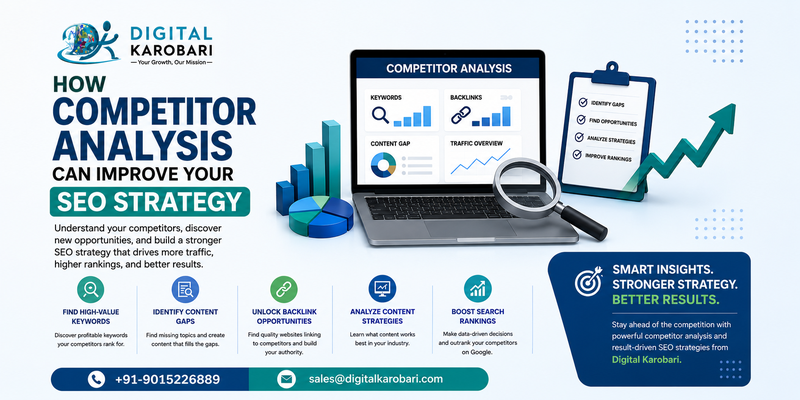
    How Competitor Analysis Can Improve Your SEO Strategy

    SEO is not only about optimizing your own website. To build a stronger search strategy, businesses also need to understand what competitors are doing, which keywords they target, what type of content they publish, and where they are earning visibility.
    Competitor analysis provides valuable insights that can help businesses identify opportunities, avoid common mistakes, and develop a more focused SEO strategy. Instead of copying competitors, the goal is to understand the search landscape and find ways to create something better and more useful.
    For businesses working with Digital Karobari, competitor analysis can be an important part of developing a data-driven SEO and digital marketing strategy.

    What Is SEO Competitor Analysis?

    SEO competitor analysis is the process of researching websites that compete with your business in search engine results.
    These competitors may not always be your direct business competitors. A website could compete with you for specific keywords even if it offers a slightly different product or service.
    An SEO competitor analysis typically examines:
    Target keywords
    Search rankings
    Content strategy
    Website structure
    Backlink profiles
    Search intent
    Featured search results
    Internal linking
    On-page optimization
    Local SEO presence
    The information gathered can then be used to identify gaps and opportunities for your own website.

    Why Is Competitor Analysis Important for SEO?

    Search results are competitive. If several businesses are targeting the same audience, simply publishing content may not be enough to achieve strong rankings.
    Competitor analysis can help answer important questions:
    Which keywords are competitors ranking for?
    What topics are generating visibility for them?
    What type of content does Google appear to prefer?
    Where are competitors weak?
    Which topics have not been covered well?
    What backlinks or online mentions are helping competitors?
    These insights can make SEO planning more strategic.

    1. Discover Valuable Keyword Opportunities
      One of the biggest benefits of competitor analysis is discovering keywords you may have overlooked.
      For example, your competitors may rank for long-tail searches related to your products or services that are not currently included in your SEO strategy.
      Instead of targeting only highly competitive keywords, you can identify opportunities across different stages of the customer journey.
      These may include:
      Informational keywords
      Commercial keywords
      Transactional keywords
      Local search terms
      Long-tail keywords
      Problem-based searches
      The goal is not to copy a competitor’s keyword list but to identify relevant opportunities that align with your own business.
    2. Identify Content Gaps
      A content gap occurs when your website does not adequately address a topic that potential customers are searching for.
      Suppose three competitors have detailed guides covering a particular customer problem, while your website has no useful resource addressing it. That represents an opportunity.
      A competitor content analysis can help you discover:
      Missing blog topics
      Questions customers are asking
      Underdeveloped service pages
      Missing comparison content
      Frequently discussed industry problems
      Topics that deserve more detailed coverage
      Once these gaps are identified, businesses can create original content that provides greater value.
    3. Understand Search Intent
      Ranking for a keyword is not simply about using that keyword repeatedly.
      Search intent describes what a user is actually trying to accomplish when they perform a search.
      Competitor analysis can help you understand whether search results for a particular keyword mainly contain:
      Blog articles
      Product pages
      Service pages
      Comparison guides
      Tutorials
      Videos
      Category pages
      For example, if most top-ranking pages for a keyword are detailed educational guides, creating a short promotional page may not satisfy the user’s intent.
      Understanding the current search landscape helps businesses create content that better matches what users expect.
    4. Improve Your Content Strategy
      Competitors can provide useful information about the topics and formats receiving search visibility.
      You can examine:
      Content length
      Headings
      Topics covered
      FAQs
      Images and videos
      Internal links
      Examples
      Original research
      Calls to action
      However, the goal should not be to create a longer version of every competitor article.
      Instead, ask:
      What information is missing?
      Can we explain the topic more clearly?
      Can we provide original examples?
      Can we make the content easier to understand?
      Can we provide more practical value?
      This approach helps transform competitor research into a better content strategy.
    5. Find Backlink Opportunities
      Backlinks can still play an important role in SEO. Competitor backlink analysis can reveal websites that have already linked to similar businesses or industry content.
      These websites may include:
      Industry publications
      Business directories
      Professional organizations
      Resource pages
      Partner websites
      Relevant blogs
      Local business websites
      Instead of trying to replicate every competitor backlink, businesses should focus on earning relevant, credible, and natural links.
    6. Analyze Competitor On-Page SEO
      Competitor analysis can also reveal how successful websites structure their pages.
      You can compare factors such as:
      Page titles
      Meta descriptions
      Heading structure
      URL structure
      Content organization
      Internal links
      Image optimization
      Calls to action
      Service page structure
      This can help identify areas where your website may need improvement.
    7. Discover Local SEO Opportunities
      For businesses serving specific locations, competitor analysis can be especially useful for local SEO.
      You can examine competitors’:
      Google Business Profile presence
      Reviews
      Local landing pages
      Location-specific content
      Business citations
      Local backlinks
      Service-area targeting
      For example, if several competitors are ranking for searches related to a specific city or neighborhood, it may indicate an opportunity to create useful location-focused content or improve your local SEO signals.
    8. Identify Competitor Strengths and Weaknesses
      No competitor is perfect.
      A competitor may have strong backlinks but outdated content. Another may have excellent content but a poor user experience. Someone else may rank well nationally but have weak local visibility.
      A simple SWOT-style analysis can help:
      Area Questions to Ask
      Content What topics do they cover well?
      Keywords Which searches generate visibility?
      Backlinks Where are their links coming from?
      UX Is their website easy to navigate?
      Local SEO How strong is their local presence?
      Technical SEO Are there noticeable performance issues?
      Conversion How effectively do pages encourage action?
      These observations can help you prioritize your own SEO improvements.
    9. Create a Better SEO Roadmap
      Competitor research becomes more valuable when it leads to action.
      Instead of maintaining a list of competitor keywords without a plan, organize opportunities according to their potential business value.
      For example:
      Priority 1: High-intent keywords related directly to your services.
      Priority 2: Content gaps that can attract relevant organic traffic.
      Priority 3: Supporting informational content.
      Priority 4: Authority-building and backlink opportunities.
      This creates a more structured SEO roadmap.

    How to Perform an SEO Competitor Analysis

    A practical competitor analysis can follow these steps:
    Step 1: Identify Your Search Competitors
    Search for your important products, services, and topics. Note the websites consistently appearing in the results.
    Step 2: Analyze Their Keywords
    Identify relevant keywords where competitors have strong visibility and determine whether those searches are relevant to your business.
    Step 3: Review Their Content
    Look at their most visible pages and identify what topics, formats, and questions they address.
    Step 4: Compare Your Website
    Find areas where your content, page structure, internal linking, or user experience can be improved.
    Step 5: Analyze Backlinks
    Research where competitors are earning relevant backlinks and determine which opportunities may be appropriate for your business.
    Step 6: Identify Gaps
    Create a list of keywords, topics, services, locations, and customer questions that your website does not adequately cover.
    Step 7: Build an Action Plan
    Prioritize opportunities based on search intent, business relevance, competition, and potential value rather than simply trying to outperform competitors on every keyword.
    Competitor Analysis Does Not Mean Copying
    One of the most important principles of competitor research is don’t copy—learn.
    Copying another website’s content, structure, branding, or messaging will not create a sustainable SEO advantage.
    Instead, competitor research should help you understand the market and discover opportunities to provide something more useful.
    Your content should offer your own expertise, examples, insights, experience, and solutions.

    Common Competitor Analysis Mistakes

    Businesses often make mistakes such as:
    Focusing only on competitor rankings
    Copying competitor content
    Targeting every keyword competitors rank for
    Ignoring search intent
    Looking only at backlinks
    Choosing competitors based only on business type
    Ignoring local competitors
    Failing to prioritize opportunities
    Not connecting SEO research with business goals
    Competitor analysis should be a continuous learning process rather than a one-time activity.

    How Digital Karobari Can Help

    A successful SEO strategy requires more than keyword research. It involves understanding competitors, customers, search intent, content opportunities, technical performance, and business objectives.
    Digital Karobari helps businesses develop digital marketing strategies that can strengthen their online presence and connect them with relevant audiences.
    By combining competitor research with SEO, content marketing, social media, and other digital strategies, businesses can build a more comprehensive approach to online growth.

    Conclusion

    Competitor analysis can provide valuable insights for improving an SEO strategy. From finding new keywords and content gaps to understanding search intent, backlinks, local SEO, and on-page optimization, competitor research helps businesses make more informed decisions.
    The objective is not to become a copy of your competitors. It is to understand what works, identify what is missing, and create a stronger experience for your target audience.
    When competitor insights are combined with quality content, technical SEO, relevant keywords, and a clear business strategy, they can become a powerful part of long-term organic growth.

    Want to Outperform Your Competitors in Search Results?

    Understanding what your competitors are doing is only the first step. Digital Karobari can help you turn competitor insights into a focused SEO strategy designed around your business goals, target audience, and search opportunities.
    📈 Discover new opportunities. Build better content. Strengthen your online visibility.
    👉 Connect with Digital Karobari today and take the next step toward a stronger SEO strategy.
    Company Name: Digital Karobari
    🌐: https://digitalkarobari.
    📞: +91-9015226889

    FAQs

    1. What is competitor analysis in SEO?
      SEO competitor analysis is the process of researching competing websites to understand their keywords, content, backlinks, rankings, technical structure, and other SEO strategies.
    2. How does competitor analysis improve SEO?
      It can help businesses discover keyword opportunities, identify content gaps, understand search intent, find backlink opportunities, and uncover areas where their website can be improved.
    3. Should I target all the keywords my competitors rank for?
      No. Competitor keywords should be evaluated based on relevance, search intent, competition, and potential business value before being added to your SEO strategy.
    4. How often should businesses perform competitor analysis?
      A detailed analysis can be performed periodically, while important competitor changes can be monitored more regularly. The frequency depends on how competitive and fast-changing the industry is.
    5. Can competitor analysis help with content marketing?
      Yes. It can reveal topics, questions, formats, and content gaps that can inform a more useful and relevant content strategy.
    6. Can competitor analysis improve local SEO?
      Yes. Reviewing local competitors can reveal opportunities involving location pages, reviews, local content, citations, local backlinks, and Google Business Profile optimization.
    7. Is competitor backlink analysis important?
      It can be useful for discovering relevant websites and potential link-building opportunities. However, businesses should focus on earning quality, relevant links rather than copying every competitor backlink.
    8. Does competitor analysis guarantee higher Google rankings?
      No. Competitor analysis provides insights, but rankings depend on many factors, including content quality, relevance, technical SEO, authority, user experience, competition, and search engine algorithms.
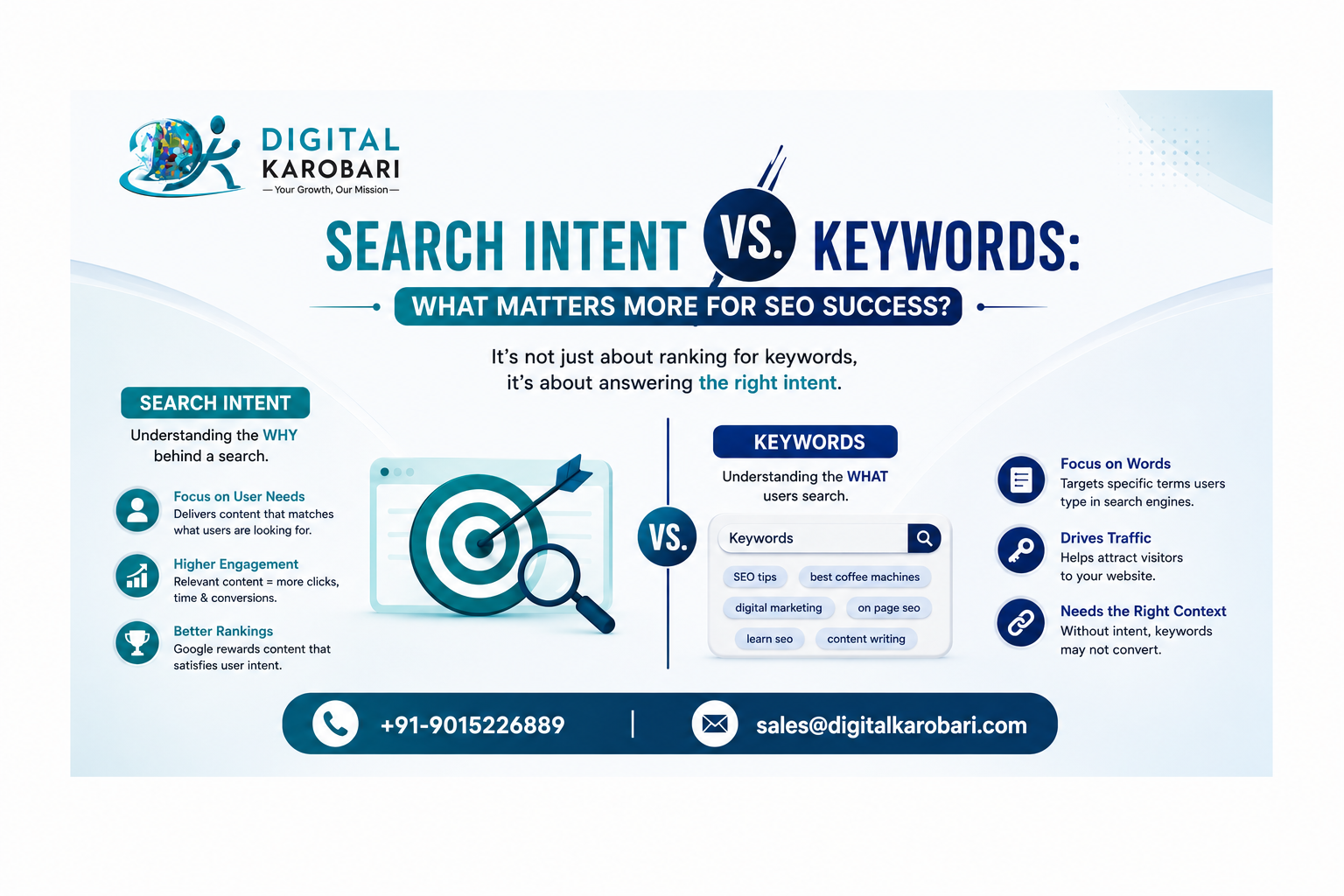
  • Search Intent vs. Keywords: What Matters More for SEO Success?

    Search Intent vs. Keywords: What Matters More for SEO Success?

    Introduction

    SEO has changed significantly over the years. Earlier, ranking on Google was largely associated with finding the right keywords and using them strategically across a webpage. While keywords are still important, modern search engines have become much better at understanding what users actually want when they search.
    This is where search intent becomes important.
    A website may target high-volume keywords, but if its content does not satisfy the reason behind the search, it may struggle to rank or convert visitors into customers. On the other hand, content built around the right search intent can attract highly relevant users, even when the keyword itself has lower search volume.
    So, what matters more for SEO—search intent or keywords? The answer is that both work together, but search intent should guide your keyword strategy and content creation.

    What Is Search Intent?

    Search intent refers to the reason behind a user’s search query. In simple terms, it answers the question:
    “What is the user trying to accomplish with this search?”
    For example, someone searching for:
    “what is SEO” is probably looking for information.
    “best SEO tools” is comparing different options.
    “buy SEO software” has a strong purchasing intent.
    “Digital Karobari SEO services” is likely looking for a specific brand or service.
    Understanding this purpose helps marketers create content that directly matches what users expect to find.

    What Are Keywords in SEO?

    Keywords are the words or phrases people enter into search engines to find information, products or services.
    Examples include:
    SEO services
    digital marketing agency
    social media marketing
    SEO tips for beginners
    Google Ads agency
    content marketing strategy
    Keywords help search engines understand the topic of a webpage. They also help businesses identify what potential customers are searching for.
    However, simply inserting a keyword repeatedly into an article does not guarantee better rankings.
    The goal isn’t to use a keyword as many times as possible. The goal is to create the most useful content for the person searching that keyword.

    Search Intent vs. Keywords: What’s the Difference?

    Keywords tell you what people search for, while search intent helps you understand why they search for it.
    For example, consider the keyword:
    “SEO agency”
    Someone searching this phrase could be:
    Looking for an SEO agency
    Comparing different agencies
    Researching SEO services
    Trying to understand what an SEO agency does
    Preparing to hire an agency
    The keyword alone doesn’t provide the complete picture.
    Understanding intent allows marketers to determine what type of content would best satisfy the searcher.

    The Four Main Types of Search Intent

    Informational Intent
    Users with informational intent want to learn something.
    Examples:
    What is SEO?
    How does Google Ads work?
    How to improve website rankings
    Benefits of social media marketing
    Blog posts, guides, tutorials and educational resources are usually effective for these searches.

    Navigational Intent
    Users already have a specific website, company or destination in mind.
    Examples:
    Digital Karobari
    Facebook login
    Google Search Console
    Digital Karobari SEO services
    For these searches, users generally want to reach a particular website or page.

    Commercial Investigation Intent
    Users are researching before making a purchase decision.
    Examples:
    Best SEO agency in Mumbai
    SEO vs Google Ads
    Best digital marketing services
    SEO agency pricing
    Comparison articles, service pages, reviews and detailed guides can work well for this intent.

    Transactional Intent
    Users are ready to take action.
    Examples:
    Hire SEO agency
    Buy SEO software
    Digital marketing services
    Google Ads management services
    Service pages, product pages and landing pages are generally more appropriate for transactional searches.

    Why Search Intent Matters More Than Keyword Density

    Keyword density used to receive considerable attention in SEO. Today, focusing excessively on how many times a keyword appears can lead to unnatural and low-quality content.
    Instead, marketers should focus on:
    Understanding the user’s question
    Providing complete information
    Covering relevant subtopics
    Answering related questions
    Using natural language
    Creating an easy-to-navigate page
    Providing a clear next step
    For example, if someone searches “how to do SEO for a small business,” they probably don’t want to read a page that repeatedly uses the phrase “small business SEO.”
    They want practical information about keyword research, local SEO, technical SEO, content creation, link building and performance tracking.
    That is why intent-focused content is generally more valuable than keyword-focused content.

    How Keywords and Search Intent Work Together

    This doesn’t mean keywords are no longer important.
    Keywords remain useful for discovering:
    What your audience searches for
    Topics worth creating content around
    Customer problems
    Search demand
    Relevant terminology
    Content opportunities
    The difference is in how you use them.
    Instead of starting with:
    “How many times should I use this keyword?”
    Start with:
    “What does someone searching this keyword actually want?”
    Then create content that satisfies that need.

    Example: Keyword vs. Search Intent

    Suppose your target keyword is:
    “social media marketing strategy”
    A keyword-focused article might simply repeat the phrase throughout the content.
    An intent-focused article would recognize that the searcher probably wants to learn how to create and implement a social media strategy.
    The article could therefore cover:
    Identifying the target audience
    Selecting social media platforms
    Creating content pillars
    Building a posting schedule
    Using paid and organic strategies
    Tracking engagement
    Measuring conversions
    Improving the strategy based on analytics
    This provides significantly more value than simply repeating the target keyword.

    How to Identify Search Intent Before Writing Content

    Before creating an SEO article, follow these steps.

    Study the Search Results
    Search your target keyword on Google and examine the pages that appear.
    Look at:
    Content type
    Page format
    Search-result titles
    Common topics
    Frequently answered questions
    Whether results are mostly blogs, product pages, service pages or category pages
    The existing search results can provide useful clues about what users expect.

    Look at Related Searches
    Related searches and question-based searches can reveal additional information users want.
    For example, a search around SEO may lead to questions about:
    SEO cost
    SEO techniques
    SEO tools
    SEO benefits
    SEO strategy
    These can help you expand your content naturally.

    Match Content Type With Intent


    The format of your page should match the user’s goal.

    Search Intent Suitable Content
    Informational Blog, guide, tutorial
    Navigational Brand or specific page
    Commercial Comparison, review, service guide
    Transactional Service/product/landing page

    How to Build an Intent-Focused Keyword Strategy

    A strong SEO strategy combines keyword research with intent analysis.
    Step 1: Find Relevant Keywords
    Use keyword research to identify phrases related to your products, services and customer problems.
    Step 2: Group Keywords by Intent
    Don’t organize keywords only by search volume. Group them according to whether they are informational, navigational, commercial or transactional.
    Step 3: Create the Right Content
    Match every keyword group with an appropriate content format.
    Step 4: Cover the Topic Completely
    Include relevant questions, supporting topics and useful examples rather than forcing exact-match keywords into every paragraph.
    Step 5: Add Internal Links
    Connect informational content with relevant service pages and other useful resources. This can help users move naturally through the customer journey.
    Step 6: Measure Performance
    Track more than rankings. Look at:
    Organic traffic
    Engagement
    Leads
    Conversions
    Click-through rate
    Relevant keyword visibility
    Landing-page performance

    Common Mistakes to Avoid

    Focusing Only on Search Volume
    A keyword with thousands of searches isn’t necessarily valuable if it doesn’t attract your target audience.

    Creating Content Without Understanding Intent
    Even well-written content can perform poorly if it doesn’t answer what users are actually looking for.

    Keyword Stuffing
    Repeating keywords unnaturally can make content difficult to read and reduce its usefulness.

    Using the Wrong Page Type
    A blog post may not satisfy someone who is ready to hire a service, while a sales page may not adequately answer someone looking for educational information.

    Ignoring the Customer Journey
    Users may interact with several types of content before becoming customers. Your SEO strategy should support them throughout that journey.

    So, What Matters More: Search Intent or Keywords?

    Search intent should take priority, but keywords remain essential.
    Think of keywords as the starting point and search intent as the direction.
    Keywords tell you what people are typing into search engines. Search intent helps you understand what they expect to find after clicking a result.
    A successful SEO strategy therefore doesn’t choose between keywords and search intent. Instead, it combines both:
    Keyword Research → Intent Analysis → Relevant Content → Better User Experience → Business Results
    When you understand what your audience wants and create content that genuinely satisfies that need, your SEO strategy becomes more useful, relevant and conversion-focused.

    Want to attract the right audience through SEO?

    Don’t just target keywords—build a strategy around what your customers are actually searching for. Digital Karobari can help your business develop an intent-focused SEO strategy designed to improve online visibility, attract relevant traffic and generate better business opportunities.
    Get in touch with Digital Karobari today and turn your search traffic into meaningful results.
    Company Name: Digital Karobari
    🌐: https://digitalkarobari.
    📞: +91-9015226889

    FAQs

    1. Is search intent more important than keywords for SEO?
      Search intent should guide your SEO strategy, while keywords help identify what users are searching for. Both are important, but targeting the right intent is essential for creating relevant content.
    2. What are the four types of search intent?
      The four commonly used categories are informational, navigational, commercial investigation and transactional intent.
    3. Are keywords still important for SEO?
      Yes. Keywords help search engines and marketers understand the subject of a page and identify relevant search opportunities. However, they should be used naturally rather than through keyword stuffing.
    4. How can I determine the search intent of a keyword?
      Search the keyword and study the current results. Look at the types of pages ranking, the questions they answer and the information users appear to expect.
    5. Does search volume matter more than search intent?
      No. High search volume doesn’t automatically mean high business value. A lower-volume keyword with strong commercial or transactional intent may generate more relevant leads.
    6. Can one keyword have multiple search intents?
      Yes. Some keywords are ambiguous and may represent different user needs. Analyzing the search results can help identify the dominant intent.
    7. How does search intent affect content creation?
      It determines what type of content you should create, what questions to answer, how detailed the page should be and what action you want users to take next.
    8. What is the best SEO strategy for businesses?
      A strong strategy combines keyword research, search-intent analysis, helpful content, technical SEO, internal linking, authority building and continuous performance measurement.
  • How E-E-A-T Helps Websites Rank Higher

    How E-E-A-T Helps Websites Rank Higher

    Introduction

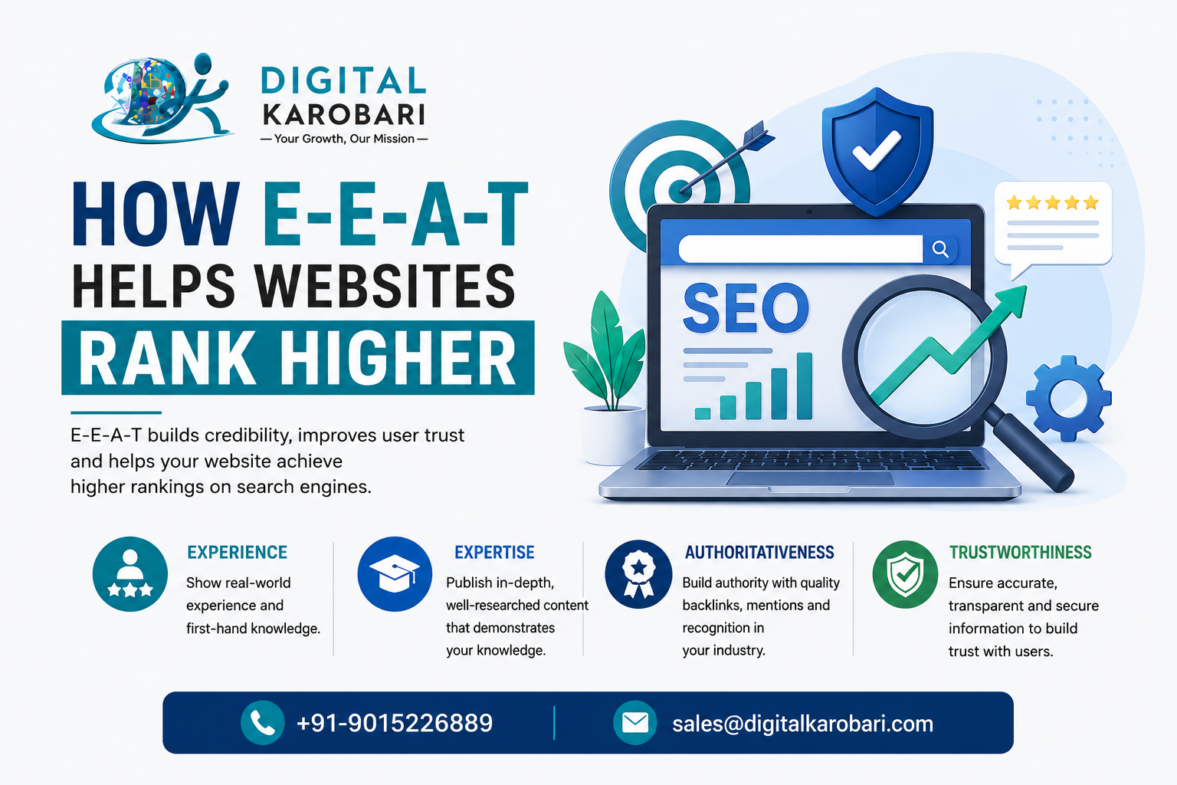
    Search engine optimization (SEO) is constantly evolving, and Google’s focus has shifted beyond keywords and backlinks to prioritize content quality and user trust. One of the most important concepts influencing modern SEO is E-E-A-T, which stands for Experience, Expertise, Authoritativeness, and Trustworthiness.
    Google wants to deliver accurate, reliable, and helpful information to users. Websites that demonstrate genuine experience, industry expertise, authority, and trust are more likely to perform well in search results, especially in competitive industries.
    At Digital Karobari, we help businesses create SEO strategies that align with Google’s latest guidelines, improving visibility, credibility, and long-term organic growth.

    What is E-E-A-T?

    E-E-A-T is a framework used by Google’s Search Quality Evaluators to assess the quality and credibility of web content. While it is not a direct ranking factor, it strongly influences how Google evaluates content quality and user value.
    The four components include:
    Experience – Demonstrating first-hand knowledge or practical involvement in the topic.
    Expertise – Showing professional knowledge or specialized skills.
    Authoritativeness – Being recognized as a trusted source within your industry.
    Trustworthiness – Providing accurate, transparent, and secure information.
    Together, these elements help build confidence with both search engines and users.

    Why E-E-A-T Matters for SEO

    Google’s primary goal is to provide users with the most relevant and trustworthy information. Websites with strong E-E-A-T signals are more likely to:
    Rank higher for competitive keywords
    Build user confidence
    Increase organic traffic
    Improve engagement metrics
    Generate more qualified leads
    Strengthen brand reputation
    For industries such as healthcare, finance, legal services, and education, E-E-A-T is especially important because users rely on accurate information to make important decisions.

    Understanding the Four Pillars of E-E-A-T

    Experience
    Google values content written by people who have practical, real-world experience.
    Examples include:
    Product reviews based on actual usage
    Case studies
    Customer success stories
    Personal insights
    Project portfolios
    Adding authentic experiences makes your content more valuable and trustworthy.

    Expertise
    Expertise refers to your knowledge and qualifications within a specific field.
    Ways to demonstrate expertise include:
    Publishing in-depth articles
    Sharing industry insights
    Providing accurate information
    Showcasing certifications
    Displaying professional credentials
    Well-researched content establishes your website as a reliable source.

    Authoritativeness
    Authority is built when others recognize your business as an industry leader.
    You can improve authority by:
    Earning quality backlinks
    Receiving positive reviews
    Publishing original research
    Being featured on reputable websites
    Maintaining a consistent content strategy
    Authority grows over time through credibility and recognition.

    Trustworthiness
    Trust is considered the most important aspect of E-E-A-T.
    Build trust by:
    Using HTTPS security
    Displaying contact information
    Publishing accurate content
    Providing transparent business details
    Showing customer testimonials
    Including clear privacy and refund policies
    A trustworthy website encourages both users and search engines to engage with your content.

    How to Improve Your Website’s E-E-A-T

    Publish High-Quality Content
    Create original, informative, and well-structured content that solves user problems.
    Add Author Information
    Include author bios with qualifications, experience, and expertise.
    Update Content Regularly
    Keep articles current with the latest trends, statistics, and industry developments.
    Build Quality Backlinks
    Earn links from trusted websites through valuable content and digital PR.
    Showcase Customer Reviews
    Positive reviews help establish trust and credibility.
    Improve Website Security
    Use SSL certificates, secure payment gateways, and transparent privacy policies.
    Include Case Studies
    Real-world examples demonstrate practical experience and successful outcomes.
    Strengthen Your About Page
    Clearly explain your company’s mission, experience, team, and achievements.

    Common Mistakes That Hurt E-E-A-T

    Many websites struggle to achieve strong search rankings because they overlook the principles of E-E-A-T. Publishing thin, duplicate, or AI-generated content without human review can reduce credibility and fail to provide real value to users. Using misleading headlines, sharing outdated or inaccurate information, and failing to cite reliable sources can weaken trust. Websites that lack author profiles, company details, customer reviews, or clear contact information often appear less credible to both users and search engines. Poor website security, broken links, excessive advertisements, and slow loading speeds can also negatively impact user experience and trustworthiness. Additionally, relying on low-quality backlinks or engaging in manipulative SEO practices can harm your website’s authority and long-term search performance.

    E-E-A-T and AI Content

    AI tools can help generate content efficiently, but human expertise remains essential. Google values content that demonstrates real experience, originality, and usefulness.
    To ensure AI-assisted content supports E-E-A-T:
    Fact-check every article
    Add expert insights
    Include real examples and case studies
    Update content regularly
    Maintain originality and authenticity
    Human review is key to producing content that earns trust and performs well in search results.

    Benefits of Strong E-E-A-T

    Building strong E-E-A-T offers significant long-term advantages for any business looking to grow its online presence. When your website consistently demonstrates real experience, expert knowledge, industry authority, and trustworthiness, it becomes more valuable to both users and search engines. This often leads to higher rankings on Google, increased organic traffic, longer user engagement, and improved conversion rates. A trustworthy website also encourages repeat visitors, strengthens brand reputation, and builds customer confidence. Over time, businesses with strong E-E-A-T are more likely to earn high-quality backlinks, positive reviews, and greater recognition within their industry, creating a sustainable foundation for long-term SEO success.

    How Digital Karobari Helps Improve E-E-A-T

    At Digital Karobari, we help businesses strengthen every aspect of E-E-A-T through strategic SEO and content marketing solutions. Our team creates high-quality, user-focused content backed by thorough research, industry insights, and SEO best practices to establish expertise and credibility. We optimize website structure, improve technical SEO, enhance page speed, implement secure HTTPS protocols, and ensure a seamless user experience that builds trust with both visitors and search engines. Our services also include authority-building strategies such as ethical link building, digital PR, reputation management, and local SEO to increase your brand’s online visibility. By continuously monitoring performance, updating content, and aligning with Google’s latest search guidelines, Digital Karobari helps businesses build lasting authority, improve search rankings, and achieve sustainable organic growth.

    Conclusion

    E-E-A-T has become an essential part of successful SEO. By focusing on real experience, expert knowledge, industry authority, and user trust, businesses can improve search rankings while building meaningful relationships with their audience.
    Instead of chasing short-term SEO tactics, invest in creating valuable content, maintaining transparency, and demonstrating genuine expertise. These efforts will help your website achieve sustainable growth and long-term success.
    Partner with Digital Karobari to develop an SEO strategy that aligns with Google’s best practices and positions your business as a trusted leader in your industry.

    Build Trust. Improve Rankings. Grow Your Business.

    Your website deserves more than just traffic—it deserves credibility that converts visitors into customers.
    Digital Karobari helps businesses strengthen their E-E-A-T with data-driven SEO strategies, high-quality content, technical optimization, and authority-building campaigns that align with Google’s latest search guidelines.
    Our SEO Services Include:
    Comprehensive SEO Audits
    On-Page & Technical SEO
    Content Marketing & Blogging
    Local SEO Optimization
    High-Quality Link Building
    Digital PR & Brand Authority
    Website Performance Optimization
    Monthly SEO Reporting
    Ready to improve your Google rankings? Contact Digital Karobari today and let our SEO experts help your website earn trust, authority, and long-term organic growth.
    Company Name: Digital Karobari
    🌐: https://digitalkarobari.
    📞: +91-9015226889

    Frequently Asked Questions (FAQs)

    1. What does E-E-A-T stand for?
      E-E-A-T stands for Experience, Expertise, Authoritativeness, and Trustworthiness, a framework Google uses to evaluate content quality.
    2. Is E-E-A-T a Google ranking factor?
      E-E-A-T is not a direct ranking factor, but it significantly influences how Google assesses the quality and credibility of content.
    3. Why is E-E-A-T important for SEO?
      Strong E-E-A-T helps improve user trust, content quality, search visibility, and long-term organic rankings.
    4. How can I improve my website’s E-E-A-T?
      Create high-quality content, showcase author expertise, earn quality backlinks, maintain website security, publish case studies, and update content regularly.
    5. Does E-E-A-T apply to all websites?
      Yes. Every website benefits from demonstrating experience, expertise, authority, and trust, especially businesses in competitive industries.
    6. Can AI-generated content meet E-E-A-T standards?
      Yes, if it is reviewed by experts, fact-checked, enriched with original insights, and provides genuine value to readers.
    7. How long does it take to improve E-E-A-T?
      Building strong E-E-A-T is an ongoing process that typically takes several months of consistent content creation, optimization, and reputation building.
    8. How can Digital Karobari help improve my website’s E-E-A-T?
      Digital Karobari provides SEO, content marketing, technical optimization, digital PR, and reputation management services to strengthen your website’s credibility and improve search performance.