Introduction
SEO has changed significantly over the years. Earlier, ranking on Google was largely associated with finding the right keywords and using them strategically across a webpage. While keywords are still important, modern search engines have become much better at understanding what users actually want when they search.
This is where search intent becomes important.
A website may target high-volume keywords, but if its content does not satisfy the reason behind the search, it may struggle to rank or convert visitors into customers. On the other hand, content built around the right search intent can attract highly relevant users, even when the keyword itself has lower search volume.
So, what matters more for SEO—search intent or keywords? The answer is that both work together, but search intent should guide your keyword strategy and content creation.
What Is Search Intent?
Search intent refers to the reason behind a user’s search query. In simple terms, it answers the question:
“What is the user trying to accomplish with this search?”
For example, someone searching for:
“what is SEO” is probably looking for information.
“best SEO tools” is comparing different options.
“buy SEO software” has a strong purchasing intent.
“Digital Karobari SEO services” is likely looking for a specific brand or service.
Understanding this purpose helps marketers create content that directly matches what users expect to find.
What Are Keywords in SEO?
Keywords are the words or phrases people enter into search engines to find information, products or services.
Examples include:
SEO services
digital marketing agency
social media marketing
SEO tips for beginners
Google Ads agency
content marketing strategy
Keywords help search engines understand the topic of a webpage. They also help businesses identify what potential customers are searching for.
However, simply inserting a keyword repeatedly into an article does not guarantee better rankings.
The goal isn’t to use a keyword as many times as possible. The goal is to create the most useful content for the person searching that keyword.
Search Intent vs. Keywords: What’s the Difference?
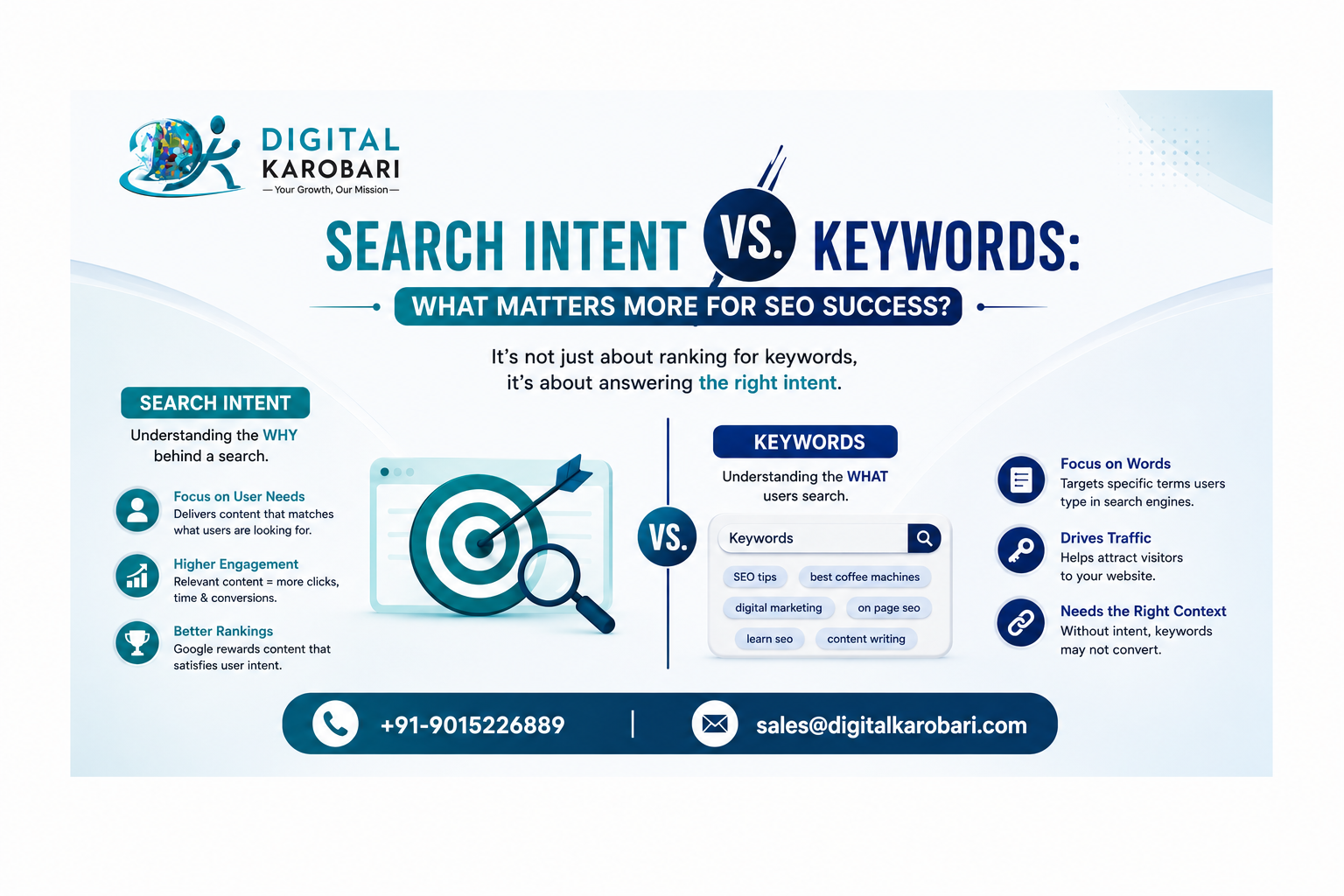
Keywords tell you what people search for, while search intent helps you understand why they search for it.
For example, consider the keyword:
“SEO agency”
Someone searching this phrase could be:
Looking for an SEO agency
Comparing different agencies
Researching SEO services
Trying to understand what an SEO agency does
Preparing to hire an agency
The keyword alone doesn’t provide the complete picture.
Understanding intent allows marketers to determine what type of content would best satisfy the searcher.
The Four Main Types of Search Intent
Informational Intent
Users with informational intent want to learn something.
Examples:
What is SEO?
How does Google Ads work?
How to improve website rankings
Benefits of social media marketing
Blog posts, guides, tutorials and educational resources are usually effective for these searches.
Navigational Intent
Users already have a specific website, company or destination in mind.
Examples:
Digital Karobari
Facebook login
Google Search Console
Digital Karobari SEO services
For these searches, users generally want to reach a particular website or page.
Commercial Investigation Intent
Users are researching before making a purchase decision.
Examples:
Best SEO agency in Mumbai
SEO vs Google Ads
Best digital marketing services
SEO agency pricing
Comparison articles, service pages, reviews and detailed guides can work well for this intent.
Transactional Intent
Users are ready to take action.
Examples:
Hire SEO agency
Buy SEO software
Digital marketing services
Google Ads management services
Service pages, product pages and landing pages are generally more appropriate for transactional searches.
Why Search Intent Matters More Than Keyword Density
Keyword density used to receive considerable attention in SEO. Today, focusing excessively on how many times a keyword appears can lead to unnatural and low-quality content.
Instead, marketers should focus on:
Understanding the user’s question
Providing complete information
Covering relevant subtopics
Answering related questions
Using natural language
Creating an easy-to-navigate page
Providing a clear next step
For example, if someone searches “how to do SEO for a small business,” they probably don’t want to read a page that repeatedly uses the phrase “small business SEO.”
They want practical information about keyword research, local SEO, technical SEO, content creation, link building and performance tracking.
That is why intent-focused content is generally more valuable than keyword-focused content.
How Keywords and Search Intent Work Together
This doesn’t mean keywords are no longer important.
Keywords remain useful for discovering:
What your audience searches for
Topics worth creating content around
Customer problems
Search demand
Relevant terminology
Content opportunities
The difference is in how you use them.
Instead of starting with:
“How many times should I use this keyword?”
Start with:
“What does someone searching this keyword actually want?”
Then create content that satisfies that need.
Example: Keyword vs. Search Intent
Suppose your target keyword is:
“social media marketing strategy”
A keyword-focused article might simply repeat the phrase throughout the content.
An intent-focused article would recognize that the searcher probably wants to learn how to create and implement a social media strategy.
The article could therefore cover:
Identifying the target audience
Selecting social media platforms
Creating content pillars
Building a posting schedule
Using paid and organic strategies
Tracking engagement
Measuring conversions
Improving the strategy based on analytics
This provides significantly more value than simply repeating the target keyword.
How to Identify Search Intent Before Writing Content
Before creating an SEO article, follow these steps.
Study the Search Results
Search your target keyword on Google and examine the pages that appear.
Look at:
Content type
Page format
Search-result titles
Common topics
Frequently answered questions
Whether results are mostly blogs, product pages, service pages or category pages
The existing search results can provide useful clues about what users expect.
Look at Related Searches
Related searches and question-based searches can reveal additional information users want.
For example, a search around SEO may lead to questions about:
SEO cost
SEO techniques
SEO tools
SEO benefits
SEO strategy
These can help you expand your content naturally.
Match Content Type With Intent
The format of your page should match the user’s goal.
Search Intent Suitable Content
Informational Blog, guide, tutorial
Navigational Brand or specific page
Commercial Comparison, review, service guide
Transactional Service/product/landing page
How to Build an Intent-Focused Keyword Strategy
A strong SEO strategy combines keyword research with intent analysis.
Step 1: Find Relevant Keywords
Use keyword research to identify phrases related to your products, services and customer problems.
Step 2: Group Keywords by Intent
Don’t organize keywords only by search volume. Group them according to whether they are informational, navigational, commercial or transactional.
Step 3: Create the Right Content
Match every keyword group with an appropriate content format.
Step 4: Cover the Topic Completely
Include relevant questions, supporting topics and useful examples rather than forcing exact-match keywords into every paragraph.
Step 5: Add Internal Links
Connect informational content with relevant service pages and other useful resources. This can help users move naturally through the customer journey.
Step 6: Measure Performance
Track more than rankings. Look at:
Organic traffic
Engagement
Leads
Conversions
Click-through rate
Relevant keyword visibility
Landing-page performance
Common Mistakes to Avoid
Focusing Only on Search Volume
A keyword with thousands of searches isn’t necessarily valuable if it doesn’t attract your target audience.
Creating Content Without Understanding Intent
Even well-written content can perform poorly if it doesn’t answer what users are actually looking for.
Keyword Stuffing
Repeating keywords unnaturally can make content difficult to read and reduce its usefulness.
Using the Wrong Page Type
A blog post may not satisfy someone who is ready to hire a service, while a sales page may not adequately answer someone looking for educational information.
Ignoring the Customer Journey
Users may interact with several types of content before becoming customers. Your SEO strategy should support them throughout that journey.
So, What Matters More: Search Intent or Keywords?
Search intent should take priority, but keywords remain essential.
Think of keywords as the starting point and search intent as the direction.
Keywords tell you what people are typing into search engines. Search intent helps you understand what they expect to find after clicking a result.
A successful SEO strategy therefore doesn’t choose between keywords and search intent. Instead, it combines both:
Keyword Research → Intent Analysis → Relevant Content → Better User Experience → Business Results
When you understand what your audience wants and create content that genuinely satisfies that need, your SEO strategy becomes more useful, relevant and conversion-focused.
Want to attract the right audience through SEO?
Don’t just target keywords—build a strategy around what your customers are actually searching for. Digital Karobari can help your business develop an intent-focused SEO strategy designed to improve online visibility, attract relevant traffic and generate better business opportunities.
Get in touch with Digital Karobari today and turn your search traffic into meaningful results.
Company Name: Digital Karobari
🌐: https://digitalkarobari.
📞: +91-9015226889
FAQs
- Is search intent more important than keywords for SEO?
Search intent should guide your SEO strategy, while keywords help identify what users are searching for. Both are important, but targeting the right intent is essential for creating relevant content. - What are the four types of search intent?
The four commonly used categories are informational, navigational, commercial investigation and transactional intent. - Are keywords still important for SEO?
Yes. Keywords help search engines and marketers understand the subject of a page and identify relevant search opportunities. However, they should be used naturally rather than through keyword stuffing. - How can I determine the search intent of a keyword?
Search the keyword and study the current results. Look at the types of pages ranking, the questions they answer and the information users appear to expect. - Does search volume matter more than search intent?
No. High search volume doesn’t automatically mean high business value. A lower-volume keyword with strong commercial or transactional intent may generate more relevant leads. - Can one keyword have multiple search intents?
Yes. Some keywords are ambiguous and may represent different user needs. Analyzing the search results can help identify the dominant intent. - How does search intent affect content creation?
It determines what type of content you should create, what questions to answer, how detailed the page should be and what action you want users to take next. - What is the best SEO strategy for businesses?
A strong strategy combines keyword research, search-intent analysis, helpful content, technical SEO, internal linking, authority building and continuous performance measurement.