Tag: Google Ads services

  • Omnichannel Marketing Strategy Explained: A Complete Guide for Business Growth | Digital Karobari

    Omnichannel Marketing Strategy Explained: A Complete Guide for Business Growth | Digital Karobari

    Introduction

    Today’s customers interact with businesses through multiple channels before making a purchase. They may discover a brand on social media, visit its website, read online reviews, receive promotional emails, and finally make a purchase through an online store or physical location. This changing customer journey has made Omnichannel Marketing one of the most effective strategies for businesses looking to improve customer experience and increase sales.
    Unlike traditional marketing, where each platform operates independently, omnichannel marketing creates a seamless and consistent experience across every customer touchpoint. Whether customers engage with your business on mobile, desktop, social media, email, or in-store, they receive the same brand message and personalized experience.
    At Digital Karobari, we help businesses implement effective omnichannel marketing strategies that improve customer engagement, strengthen brand loyalty, and drive measurable business growth.

    What is Omnichannel Marketing?

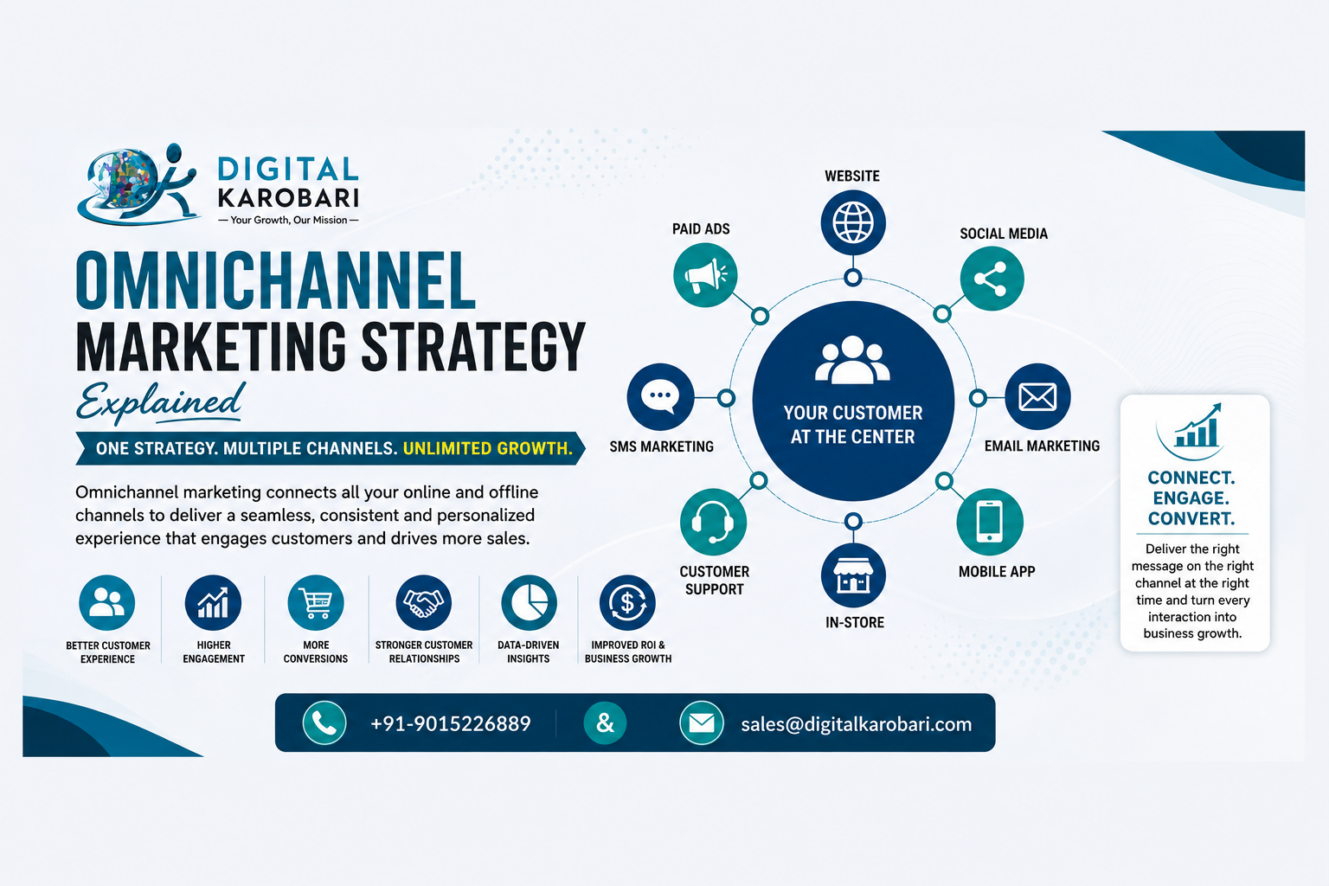
    Omnichannel marketing is a customer-centric marketing strategy that integrates multiple online and offline channels to deliver a consistent and personalized brand experience. Instead of treating each platform separately, all channels work together to create a unified customer journey.
    These channels may include:
    Business Website
    Social Media Platforms
    Email Marketing
    Google Search
    Google Ads
    Mobile Applications
    SMS Marketing
    WhatsApp Marketing
    Online Marketplaces
    Physical Stores
    Customer Support
    The primary goal is to ensure customers enjoy a smooth experience regardless of where or how they interact with your business.

    Why Omnichannel Marketing Matters

    Modern consumers expect businesses to recognize them across different platforms and provide a consistent experience. A customer may browse products on a smartphone, continue researching on a laptop, and complete the purchase later through an app or website. If the experience is disconnected, businesses risk losing potential customers.
    An effective omnichannel strategy improves customer satisfaction, strengthens trust, increases engagement, and creates more opportunities for conversions. It also allows businesses to better understand customer behavior by collecting data from multiple touchpoints.

    Benefits of Omnichannel Marketing

    Better Customer Experience
    Customers enjoy a seamless journey across multiple channels without interruptions. Consistent messaging and branding build trust and encourage long-term relationships.

    Increased Customer Engagement
    Businesses can interact with customers through their preferred communication channels, improving response rates and engagement.

    Higher Conversion Rates
    Providing relevant content and personalized recommendations across channels helps guide customers toward purchasing decisions, resulting in increased sales.

    Improved Customer Retention
    Consistent follow-ups, personalized offers, loyalty programs, and targeted communication encourage repeat purchases and strengthen customer loyalty.

    Better Data Insights
    Combining customer data from websites, social media, email campaigns, CRM systems, and mobile apps helps businesses better understand customer preferences and optimize future marketing campaigns.

    Key Components of an Omnichannel Marketing Strategy

    Understand Your Customer Journey
    Analyze how customers discover, research, compare, and purchase your products or services. Mapping the customer journey helps identify opportunities to improve the overall experience.

    Maintain Consistent Branding
    Your logo, messaging, visuals, tone of voice, and offers should remain consistent across all digital and offline channels to build brand recognition and trust.

    Personalize Customer Communication
    Use customer data to deliver personalized recommendations, product suggestions, email campaigns, and promotional offers based on user behavior and interests.

    Integrate Marketing Channels
    Connect your website, CRM, email marketing platform, social media accounts, Google Ads, WhatsApp, and analytics tools to ensure all channels work together efficiently.

    Use Marketing Automation
    Automated workflows can send welcome emails, abandoned cart reminders, product recommendations, appointment confirmations, and follow-up messages, improving customer engagement while saving time.

    Monitor Performance
    Track key metrics such as website traffic, conversion rate, customer lifetime value, engagement rate, email performance, social media interactions, and return on investment (ROI). Continuous optimization ensures better campaign performance.

    Best Practices for Omnichannel Marketing

    Businesses should focus on delivering value rather than simply promoting products. Ensure that every communication is relevant, timely, and personalized. Optimize websites for mobile devices, maintain active social media profiles, respond quickly to customer inquiries, and use analytics to improve decision-making. Regularly test campaigns, refine messaging, and update strategies based on customer feedback and performance data.

    Common Omnichannel Marketing Mistakes

    Many businesses fail to integrate their marketing channels, resulting in inconsistent messaging and disconnected customer experiences. Other common mistakes include ignoring customer data, sending generic emails, neglecting mobile optimization, failing to personalize content, and not measuring campaign performance. Without proper planning and coordination, businesses may miss valuable opportunities to engage customers effectively.

    Tools for Omnichannel Marketing

    Several tools help businesses manage omnichannel marketing efficiently. Popular platforms include HubSpot, Salesforce, Google Analytics 4, Meta Business Suite, Mailchimp, Klaviyo, Zoho CRM, WhatsApp Business API, Google Ads, and Canva for content creation. These tools enable businesses to automate campaigns, track customer interactions, and optimize marketing performance.

    Why Choose Digital Karobari for Omnichannel Marketing?

    At Digital Karobari, we create customized omnichannel marketing strategies that help businesses connect with customers across every digital touchpoint. Our experienced team combines SEO, Google Ads, Social Media Marketing, Email Marketing, WhatsApp Marketing, Content Marketing, and Analytics to deliver a seamless customer experience that drives engagement and sales. By using data-driven insights and the latest digital marketing tools, we help businesses improve brand visibility, generate qualified leads, and achieve long-term growth.

    Conclusion

    Omnichannel marketing is no longer optional for businesses that want to stay competitive in today’s digital landscape. Customers expect consistent experiences across websites, social media, email, mobile apps, and other platforms. Businesses that successfully integrate these channels can improve customer satisfaction, strengthen brand loyalty, and increase conversions. By implementing a well-planned omnichannel strategy and partnering with experts like Digital Karobari, businesses can create meaningful customer experiences that lead to sustainable growth and long-term success.

    Build a Seamless Customer Experience with Digital Karobari

    Want to engage customers across every digital touchpoint and increase your sales? Digital Karobari offers expert omnichannel marketing solutions that integrate SEO, Google Ads, Social Media Marketing, Email Marketing, WhatsApp Marketing, and Content Marketing into one powerful strategy. Our data-driven approach helps businesses deliver personalized customer experiences, generate quality leads, and maximize marketing ROI.
    Contact Digital Karobari today and create an omnichannel marketing strategy that drives measurable business growth.
    Company Name: Digital Karobari
    ๐ŸŒ: https://digitalkarobari.
    ๐Ÿ“ž: +91-9015226889

    Frequently Asked Questions (FAQs)

    1. What is omnichannel marketing?
      Omnichannel marketing is a strategy that integrates multiple online and offline channels to provide customers with a seamless and consistent brand experience.
    2. How is omnichannel marketing different from multichannel marketing?
      Multichannel marketing uses multiple platforms independently, while omnichannel marketing connects all channels to create one unified customer journey.
    3. Why is omnichannel marketing important?
      It improves customer experience, increases engagement, boosts conversions, strengthens brand loyalty, and helps businesses deliver personalized interactions across all touchpoints.
    4. Which channels are included in an omnichannel marketing strategy?
      Common channels include websites, social media, email marketing, Google Ads, WhatsApp, SMS, mobile apps, CRM systems, online marketplaces, and physical stores.
    5. What tools are commonly used for omnichannel marketing?
      Businesses often use Google Analytics 4, HubSpot, Salesforce, Zoho CRM, Mailchimp, Meta Business Suite, WhatsApp Business API, Google Ads, and marketing automation platforms.
    6. How can Digital Karobari help with omnichannel marketing?
      Digital Karobari develops customized omnichannel marketing strategies by integrating SEO, Google Ads, Social Media Marketing, Email Marketing, Content Marketing, and Analytics to improve customer engagement and business growth.
  • Top 10 PPC Mistakes That Waste Your Advertising Budget

    Top 10 PPC Mistakes That Waste Your Advertising Budget

    Introduction

    Pay-Per-Click (PPC) advertising is one of the fastest ways to generate leads, increase website traffic, and grow your business online. Platforms like Google Ads and Microsoft Advertising allow businesses to connect with customers who are actively searching for products and services.

    However, many businesses fail to achieve their desired results because of poor campaign management and avoidable mistakes. Without the right strategy, PPC campaigns can quickly consume advertising budgets without generating meaningful returns.

    If you’re investing in paid advertising, understanding these common PPC mistakes can help you improve campaign performance, reduce wasted spending, and maximize your return on investment.

    At Digital Karobari, we help businesses create high-converting PPC campaigns that focus on measurable growth, lead generation, and sustainable business success.


    Why PPC Campaign Optimization Matters

    A successful PPC campaign is not simply about running ads.

    It requires:

    โœ” Strategic keyword targeting

    โœ” Effective ad copy

    โœ” Optimized landing pages

    โœ” Conversion tracking

    โœ” Continuous performance monitoring

    โœ” Budget management

    Even small mistakes can significantly impact campaign profitability.


    Top 10 PPC Mistakes That Waste Your Advertising Budget

    1. Targeting Broad and Irrelevant Keywords

    One of the most common PPC mistakes is selecting keywords that are too broad.

    For example:

    โŒ “Marketing”

    โŒ “Software”

    โŒ “Shoes”

    These keywords often attract users with different intentions, resulting in irrelevant clicks and wasted ad spend.

    Better Approach

    โœ” Focus on specific keywords

    โœ” Target buyer-intent searches

    โœ” Use long-tail keywords

    โœ” Analyze search intent

    Digital Karobari conducts in-depth keyword research to attract high-quality traffic that converts.


    2. Ignoring Negative Keywords

    Many advertisers overlook the importance of negative keywords.

    Negative keywords prevent ads from appearing for irrelevant searches.

    Example:

    A business selling premium software may want to exclude:

    • Free
    • Download
    • Crack
    • Tutorial

    Without negative keywords, businesses often pay for clicks that never convert.

    Benefits

    โœ” Reduced wasted spend

    โœ” Better click quality

    โœ” Improved conversion rates

    โœ” Higher campaign efficiency


    3. Sending Traffic to Poor Landing Pages

    A great advertisement can still fail if the landing page is ineffective.

    Common issues include:

    โŒ Slow loading speed

    โŒ Poor mobile experience

    โŒ Weak call-to-action

    โŒ Confusing layout

    โŒ Lack of trust signals

    Visitors should immediately understand what action they need to take.

    Digital Karobari helps optimize landing pages to improve conversion performance and user experience.


    4. Not Tracking Conversions

    Many businesses focus only on clicks and impressions.

    However, clicks do not necessarily generate revenue.

    Without conversion tracking, you cannot determine:

    • Which keywords generate leads
    • Which ads drive sales
    • Which campaigns produce the highest ROI

    Essential Metrics

    โœ” Lead submissions

    โœ” Phone calls

    โœ” Purchases

    โœ” Form completions

    โœ” Appointment bookings

    Accurate tracking helps make smarter advertising decisions.


    5. Poor Audience Targeting

    Showing ads to the wrong audience can quickly waste your budget.

    Common targeting mistakes include:

    โŒ Incorrect locations

    โŒ Broad demographics

    โŒ Unqualified audiences

    โŒ Wrong customer segments

    Effective audience targeting ensures your ads reach people most likely to convert.


    6. Neglecting Mobile Optimization

    A large percentage of PPC traffic comes from smartphones.

    If your website is not mobile-friendly, you risk losing valuable customers.

    Mobile optimization should include:

    โœ” Fast loading pages

    โœ” Mobile-responsive design

    โœ” Click-to-call functionality

    โœ” Easy navigation

    โœ” Simple lead forms

    A smooth mobile experience often leads to higher conversion rates.


    7. Running Ads Without A/B Testing

    Many businesses create one ad and never test alternatives.

    This limits opportunities for improvement.

    Elements to test include:

    • Headlines
    • Descriptions
    • Calls-to-action
    • Landing pages
    • Ad extensions

    Small adjustments can significantly increase click-through rates and conversions.


    8. Ignoring Quality Score

    Google uses Quality Score to evaluate ad relevance and user experience.

    A low Quality Score often leads to:

    โŒ Higher cost per click

    โŒ Lower ad positions

    โŒ Reduced visibility

    Improving Quality Score requires:

    โœ” Relevant keywords

    โœ” Strong ad copy

    โœ” Optimized landing pages

    โœ” Positive user experience

    Digital Karobari continuously optimizes campaigns to improve Quality Scores and reduce advertising costs.


    9. Setting and Forgetting Campaigns

    PPC campaigns require ongoing management.

    Many businesses launch campaigns and rarely review performance.

    This can result in:

    โŒ Budget waste

    โŒ Declining performance

    โŒ Missed opportunities

    โŒ Higher acquisition costs

    Successful campaigns require regular optimization, monitoring, and adjustments.


    10. Focusing Only on Clicks Instead of ROI

    More clicks do not always mean better results.

    The true goal of PPC advertising is:

    ๐Ÿ“ž More leads

    ๐Ÿ’ฐ More sales

    ๐Ÿ“ˆ Higher revenue

    ๐ŸŽฏ Better ROI

    Businesses should focus on profitability rather than vanity metrics.

    Digital Karobari helps clients track performance based on actual business outcomes.


    Additional PPC Best Practices

    To maximize advertising performance, businesses should also:

    โœ” Use ad extensions

    โœ” Optimize bidding strategies

    โœ” Improve landing page experience

    โœ” Monitor competitor activity

    โœ” Review search term reports

    โœ” Retarget previous visitors

    โœ” Analyze campaign performance regularly

    These practices contribute to stronger long-term results.


    Benefits of Professional PPC Management

    Working with experienced PPC specialists provides several advantages:

    ๐Ÿ“ˆ Higher Conversion Rates

    ๐ŸŽฏ Better Audience Targeting

    ๐Ÿ’ฐ Reduced Cost Per Lead

    ๐Ÿš€ Faster Business Growth

    ๐Ÿ“Š Accurate Reporting

    ๐Ÿ”„ Continuous Campaign Optimization

    Professional management often delivers significantly better returns than self-managed campaigns.


    Why Businesses Choose Digital Karobari for PPC Advertising

    Digital Karobari helps businesses generate quality leads through strategic and data-driven PPC advertising campaigns.

    Our PPC services include:

    โœ” Google Ads Management

    โœ” Search Campaign Optimization

    โœ” Display Advertising

    โœ” Remarketing Campaigns

    โœ” Landing Page Optimization

    โœ” Conversion Tracking Setup

    โœ” Performance Reporting

    โœ” Budget Optimization

    Our goal is simple: maximize your advertising investment while driving measurable business growth.


    Results You Can Expect

    With a professionally managed PPC campaign from Digital Karobari, businesses can achieve:

    ๐Ÿ“ˆ Increased Qualified Traffic

    ๐Ÿ“ž More Customer Enquiries

    ๐Ÿ’ฐ Better Return on Ad Spend (ROAS)

    ๐ŸŽฏ Higher Conversion Rates

    ๐Ÿš€ Improved Brand Visibility

    ๐Ÿ“Š Sustainable Lead Generation


    ๐Ÿš€ Maximize Your PPC Advertising ROI with Digital Karobari

    Are your advertising campaigns generating results or simply consuming your budget?

    Company Name: Digital Karobari

    Website: https://www.digitalkarobari.com/ppc-advertising

    Phone: +91-9015226889

    ๐Ÿ‘‰ Contact Digital Karobari today for a PPC campaign audit and discover how to improve performance, reduce wasted spend, and generate more leads.


    FAQ Section

    1. What is the biggest PPC mistake businesses make?

    Targeting broad keywords without proper optimization is one of the most common causes of wasted advertising spend.

    2. Why are negative keywords important?

    Negative keywords prevent ads from showing for irrelevant searches, helping improve campaign efficiency and reduce unnecessary costs.

    3. How often should PPC campaigns be optimized?

    Campaigns should be monitored regularly and optimized weekly or monthly depending on budget and performance.

    4. What is a good PPC conversion rate?

    Conversion rates vary by industry, but ongoing optimization helps improve lead quality and overall campaign effectiveness.

    5. Does PPC work for small businesses?

    Yes. PPC can help small businesses generate targeted traffic and leads quickly when managed correctly.

    6. Why choose Digital Karobari for PPC advertising?

    Digital Karobari provides data-driven PPC management focused on increasing conversions, lowering advertising costs, and maximizing ROI.