Tag: GEO

  • Why Your Brand Needs a Search Strategy, Not Just an SEO Strategy

    Why Your Brand Needs a Search Strategy, Not Just an SEO Strategy

    Search has changed. Earlier, businesses mainly focused on ranking their website on Google for important keywords. Today, customers discover brands through traditional search engines, AI-powered search, social platforms, YouTube, reviews, business listings, communities, and other digital touchpoints.
    That means ranking on Google is still important, but it is no longer the entire search journey.
    A modern brand needs a broader search strategy that connects SEO, content, brand authority, user intent, local visibility, digital PR, social discovery and AI search. Recent industry discussions similarly point toward a shift from rankings alone toward broader visibility and how consistently a brand is understood across search and AI-driven discovery.
    For businesses working with an agency such as Digital Karobari, this shift creates an opportunity to move from simply chasing keywords to building long-term digital visibility.

    What Is a Search Strategy?

    A search strategy is a broader plan for making your brand discoverable whenever potential customers are researching a problem, product, service or solution online.
    Traditional SEO often asks:
    “How can we rank this page for this keyword?”
    A search strategy asks:
    “Where is our customer searching, what are they looking for, and how can our brand become the most useful and trustworthy answer?”
    This can include:
    Traditional SEO
    Local SEO
    Content marketing
    Technical SEO
    Brand searches
    AI search optimization
    Answer Engine Optimization (AEO)
    Generative Engine Optimization (GEO)

    Social search
    YouTube optimization
    Digital PR
    Reviews and reputation
    Industry publications
    Conversion optimization
    The objective isn’t simply to generate impressions. It is to build search visibility that supports awareness, trust, leads and revenue.

    SEO Is Still Important — But It Is Only One Part

    This doesn’t mean SEO is becoming irrelevant.
    Google search remains an important discovery channel, and strong technical foundations, useful content, internal linking, structured information and authority still matter.
    The difference is that customers increasingly move between multiple discovery environments before making a decision.
    For example, a potential customer might:
    Search Google for a problem.
    Read an article.
    Watch a YouTube video.
    Search the brand name.
    Check reviews.
    Compare competitors.
    Ask an AI tool for recommendations.
    Visit the company’s website.
    Contact the business.
    If your strategy only focuses on step one, you may miss many of the other opportunities.
    Modern search therefore requires a connected visibility strategy rather than isolated SEO activities.

    Search Behaviour Is No Longer Limited to Google

    People don’t always begin their research on a traditional search engine.
    Depending on the product or service, users may discover information through:
    Google
    YouTube
    Instagram
    LinkedIn
    Reddit and online communities
    Google Maps
    Marketplace platforms
    AI assistants
    Industry websites
    Reviews
    Brand websites
    For example, someone looking for a digital marketing agency might search:
    “best digital marketing agency in Mumbai”
    But they could also search:
    “how to improve website leads”
    or ask an AI assistant:
    “Which digital marketing agencies can help a small business generate leads?”
    These are different search experiences, but they can lead to the same buying decision.
    Your brand needs to be prepared for all of them.

    Search Strategy Starts With Search Intent

    Keywords are useful, but keywords alone don’t explain what a customer wants.
    Consider the search:
    “SEO agency Mumbai”
    This has a strong commercial intent.
    Now compare it with:
    “how does SEO work?”
    This is primarily informational.
    Another search:
    “SEO agency pricing”
    is closer to the consideration stage.
    A strong search strategy maps content and landing pages to different stages of the customer journey.
    Informational Intent
    Users want to learn.
    Examples:
    What is SEO?
    How does PPC work?
    How does digital marketing generate leads?
    Commercial Investigation
    Users are comparing options.
    Examples:
    Best SEO agency for small businesses
    SEO vs PPC
    Digital marketing agency vs freelancer
    Transactional Intent
    Users are ready to take action.
    Examples:
    Hire SEO agency
    Digital marketing services Mumbai
    PPC management company
    Your content strategy should address all three.

    Build a Strong Brand Entity

    Search engines and AI systems need to understand who your brand is, what you offer and why you are relevant.
    Your brand information should be consistent across:
    Website
    About page
    Service pages
    Author profiles
    Social media
    Business listings
    Industry directories
    Reviews
    PR mentions
    Third-party publications
    For example, if one website describes your company as a digital marketing agency, another calls it a web development company, and another describes completely different services, the overall brand signal becomes less consistent.
    Clear positioning helps both users and machines understand your business.
    Industry research increasingly emphasizes entity clarity, semantic relationships and consistent brand information as important components of modern search visibility.

    Create Content Around Topics, Not Just Keywords

    Publishing one article for every keyword isn’t a sustainable content strategy.
    Instead, brands should build topic clusters.
    For example, a digital marketing agency could create a central topic around:
    Digital Marketing
    Then build supporting content around:
    SEO
    Local SEO
    PPC
    Social media marketing
    Content marketing
    Performance marketing
    Conversion optimization
    AI marketing
    Marketing analytics
    These pages can be connected through internal links.
    This creates a clearer relationship between your services and supporting educational content.
    A strategic content structure can also help establish topical authority rather than producing disconnected articles simply to target individual keywords.

    Optimize for AI Search

    One of the biggest reasons brands need a broader search strategy is the growth of AI-powered discovery.
    Users can now ask AI systems questions such as:
    “What are the best digital marketing strategies for a small business?”
    Instead of receiving a traditional list of ten blue links, the user may receive a summarized answer.
    That changes the visibility objective.
    The goal becomes not only:
    “Can my website rank?”
    but also:
    “Does reliable information about my brand exist across the web that AI systems can understand and potentially reference?”
    AI search optimization involves areas such as:
    Clear and useful content
    Strong topical relevance
    Structured information
    Consistent brand descriptions
    Author expertise
    First-hand experience
    Third-party mentions
    Digital PR
    Reviews
    Internal linking
    Structured data
    Strong website architecture
    AI search is increasingly being treated as a broader discovery environment rather than simply another variation of traditional rankings.

    Your Website Should Answer Real Customer Questions

    A search strategy should connect your content directly to customer problems.
    Instead of creating an article simply because a keyword has search volume, ask:
    What does the customer need to know before contacting us?
    For a digital marketing company, that might include:
    Why isn’t my website generating leads?
    SEO or PPC — which should I choose?
    How much should I spend on digital marketing?
    How long does SEO take?
    How can I reduce my cost per lead?
    How can I improve my website conversion rate?
    How can AI improve my marketing?
    These questions can become:
    Blog posts
    FAQs
    Guides
    Comparison pages
    Case studies
    Videos
    Social posts
    Landing pages
    One useful piece of information can therefore support multiple search channels.

    Don’t Ignore Branded Search

    One of the strongest signals that people know and trust your company is branded search.
    Compare:
    “SEO agency Mumbai”
    with:
    “Digital Karobari SEO services”
    The second query shows that the user already knows the brand.
    Building branded search demand requires more than SEO. It can involve:
    Content marketing
    Social media
    PR
    Thought leadership
    Video marketing
    Customer reviews
    Partnerships
    Case studies
    Consistent brand messaging
    The long-term goal is to move customers from discovering a generic category to actively searching for your brand.

    Build Authority Beyond Your Website

    Your website isn’t the only place where your brand reputation is built.
    Third-party sources can influence how customers perceive your business and can contribute to broader search visibility.
    Consider building a presence through:
    Industry publications
    Business directories
    Guest contributions
    PR coverage
    Interviews
    Podcasts
    Reviews
    Professional communities
    Social platforms
    Relevant business listings
    This is particularly important in an AI-driven search environment, where systems may synthesize information from multiple sources rather than relying exclusively on a single website.

    Connect Search Visibility With Conversion

    Getting discovered is only the first step.
    Imagine your website ranks well but has:
    Weak messaging
    Slow pages
    Confusing navigation
    Poor CTAs
    No trust signals
    Difficult contact forms
    Traffic may increase without meaningful business growth.
    That’s why a search strategy should connect SEO with CRO — Conversion Rate Optimization.
    A successful journey looks more like:
    Search → Click → Understand → Trust → Engage → Convert
    Rather than:
    Keyword → Ranking → Traffic
    This is why search performance should ultimately be evaluated against business outcomes, not rankings alone.

    Measure More Than Keyword Rankings

    Keyword rankings remain useful, but they shouldn’t be the only measurement.
    A broader search strategy can track:
    Visibility
    Organic impressions
    Keyword visibility
    Branded searches
    Local visibility
    AI search mentions/citations where measurable
    Engagement
    Organic traffic
    Engaged sessions
    Content engagement
    Returning visitors
    Business Performance
    Qualified leads
    Conversion rate
    Cost per acquisition
    Revenue
    Customer acquisition cost
    Brand Growth
    Brand searches
    Reviews
    Mentions
    Referrals
    Third-party coverage
    The more your measurement connects search activity to business results, the easier it becomes to identify which strategies actually deserve more investment.

    SEO Strategy vs Search Strategy

    SEO Strategy Search Strategy
    Primarily focuses on search engines Focuses on the complete discovery journey
    Keyword rankings are central Visibility and business outcomes are central
    Website-focused Website + AI + social + third-party platforms
    Mostly organic search Organic, AI, local, social and other discovery channels
    Focuses heavily on rankings Focuses on visibility, trust and conversions
    Content targets keywords Content targets customer questions and intent
    Backlinks are important Authority, mentions, reputation and citations all matter
    Traffic is a major KPI Qualified leads and revenue become important KPIs
    The takeaway: SEO should be a component of your search strategy—not the entire strategy.

    How Digital Karobari Can Help Build a Modern Search Strategy

    A modern search strategy requires multiple digital marketing disciplines working together.
    Digital Karobari can help businesses build a connected strategy around:
    SEO
    Content marketing
    Performance marketing
    Social media marketing
    Website optimization
    Conversion optimization
    Brand visibility
    AI-focused search strategies
    Instead of treating each channel as a separate activity, businesses can connect these channels around a common objective: being discovered, trusted and chosen by the right customers.

    Conclusion

    The future of search isn’t simply about ranking number one for a keyword.
    It’s about being visible wherever your customers are researching, being clearly understood when they discover you, and providing enough value and credibility to become part of their final decision.
    Traditional SEO remains an important foundation. But as discovery expands across AI platforms, social networks, video, reviews, local search and other digital environments, brands need a much broader approach.
    The winning question is no longer:
    “How do we rank for this keyword?”
    It is:
    “How do we become the brand customers discover and trust throughout their entire search journey?”
    That is the difference between an SEO strategy and a modern search strategy.

    Ready to Move Beyond Traditional SEO?

    Don’t let your brand compete only for keyword rankings. Build a search strategy designed for Google, AI search, social discovery and the complete customer journey.
    Partner with Digital Karobari to build a stronger, more connected digital visibility strategy.
    Get in touch with Digital Karobari today and turn search visibility into meaningful business growth.
    Company Name: Digital Karobari
    🌐: https://digitalkarobari.
    📞: +91-9015226889

    Frequently Asked Questions

    1. What is a search strategy?
      A search strategy is a comprehensive approach to making a brand discoverable across search engines, AI platforms, social media, local search, content platforms and other places where customers research products and services.
    2. Is SEO still important in 2026?
      Yes. SEO remains an important foundation for organic visibility. However, brands can benefit from combining SEO with content, brand building, local visibility, AI search optimization, digital PR and conversion optimization.
    3. What is the difference between SEO and search strategy?
      SEO primarily focuses on improving visibility in search engines. A search strategy takes a broader approach by considering multiple discovery channels, customer intent, brand visibility, AI search, content and conversions.
    4. Does AI search replace SEO?
      No. AI search changes the discovery environment but does not eliminate the need for strong SEO foundations. Technical accessibility, useful content, authority and clear information remain important.
    5. What is GEO?
      GEO, or Generative Engine Optimization, refers to strategies designed to improve a brand’s visibility and representation within AI-generated search experiences.
    6. Why is branded search important?
      Branded searches indicate that users are actively looking for your company rather than simply searching for a generic product or service. Growing branded demand can strengthen awareness and help create a more durable brand presence.
    7. How can businesses prepare for AI search?
      Businesses should create clear, authoritative content, maintain consistent brand information, demonstrate expertise, improve technical accessibility, build relevant third-party authority and structure content so that important information is easy to understand.
    8. How long does it take to build search visibility?
      There is no fixed timeline. Results depend on competition, website authority, content quality, technical health, industry, existing brand awareness and the scope of the strategy. SEO and brand visibility are generally long-term investments.
    9. Should a business focus on SEO or PPC?
      It doesn’t have to be either/or. SEO can support long-term organic visibility, while PPC can provide targeted visibility and data more quickly. The right mix depends on business goals, competition, budget and customer journey.
    10. Can a digital marketing agency help with a search strategy?
      Yes. A digital marketing agency can combine SEO, content, paid advertising, social media, website optimization, brand visibility and other channels into a coordinated search strategy.
  • How Generative Engine Optimization (GEO) Is Replacing Traditional SEO in 2026

    How Generative Engine Optimization (GEO) Is Replacing Traditional SEO in 2026

    Introduction

    The world of search is undergoing a major transformation. For years, businesses relied on Search Engine Optimization (SEO) to improve rankings on Google and drive organic traffic. However, with the rapid adoption of AI-powered search platforms such as ChatGPT, Google AI Overviews, Gemini, Perplexity AI, and Microsoft Copilot, the rules of digital visibility are changing.
    In 2026, Generative Engine Optimization (GEO) is emerging as the next evolution of SEO. Instead of optimizing content solely for search engine rankings, businesses now need to optimize for AI-generated answers and recommendations.
    At Digital Karobari, we help businesses adapt to this new era by combining traditional SEO strategies with advanced GEO techniques to maximize online visibility and lead generation.

    What Is Generative Engine Optimization (GEO)?

    Generative Engine Optimization (GEO) is the process of optimizing content so that AI-powered search engines and generative AI platforms can easily understand, reference, and include your information in their responses.
    Unlike traditional search engines that display a list of links, generative engines provide direct answers by gathering information from multiple trusted sources.
    Examples of generative search platforms include:
    ChatGPT Search
    Google AI Overviews
    Gemini
    Perplexity AI
    Microsoft Copilot
    GEO focuses on making your content the source that AI platforms trust and cite.

    Why Search Is Changing in 2026

    Consumer behavior is evolving rapidly.
    Today’s users prefer:
    Instant answers
    Conversational interactions
    Voice search
    AI-powered recommendations
    Personalized search experiences
    Instead of clicking through multiple search results, users increasingly receive complete answers directly from AI tools.
    This shift is reducing traditional click-through rates while increasing the importance of content authority and relevance.

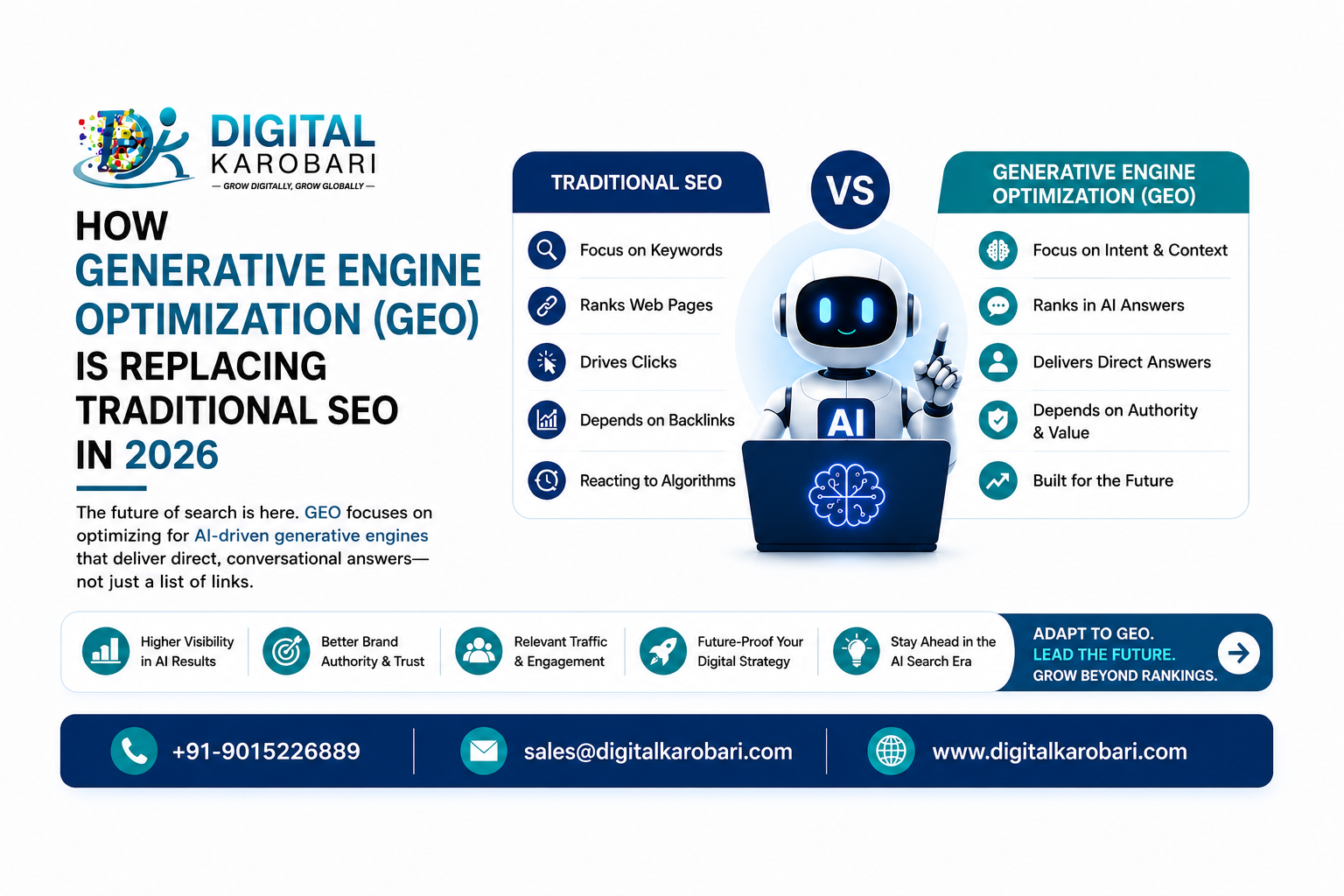
    Traditional SEO vs GEO

    Traditional SEO Generative Engine Optimization
    Focuses on rankings Focuses on AI citations
    Keyword-driven Context and intent-driven
    Optimizes webpages Optimizes answers and expertise
    Relies on backlinks Relies on authority and trust
    Targets search engines Targets AI engines and assistants
    While SEO remains important, GEO is becoming essential for maintaining online visibility.

    Why GEO Is Replacing Traditional SEO

    AI Search Delivers Direct Answers
    Users now receive answers directly from AI systems without visiting multiple websites.
    Businesses that optimize for GEO increase their chances of being included in these AI-generated responses.

    User Intent Matters More Than Keywords
    Traditional SEO often focused heavily on exact-match keywords.
    Generative AI understands:
    Context
    Search intent
    User behavior
    Conversational language
    Content must now answer questions naturally and comprehensively.

    Authority Is More Important Than Ever
    AI platforms prioritize trusted sources.
    Businesses need:
    Expert content
    Credible information
    Accurate data
    Industry authority
    High-quality content becomes the foundation of GEO success.

    Conversational Search Is Growing
    Users now search using questions such as:
    “Which digital marketing strategy generates the best ROI for startups?”
    rather than:
    “digital marketing strategy”
    GEO focuses on creating content that matches these conversational queries.

    AI Search Is Becoming the New Discovery Channel
    Millions of users now use AI tools daily for:
    Product research
    Business recommendations
    Educational content
    Service provider selection
    Businesses that ignore GEO risk losing visibility in these emerging channels.

    Key GEO Strategies for 2026

    Create Answer-Focused Content
    Write content that directly answers user questions.
    Examples:
    What is GEO?
    How does GEO work?
    Why is GEO important for businesses?

    Build Topical Authority
    Create comprehensive content around your niche.
    For example, a digital marketing company should publish content covering:
    SEO
    GEO
    Content Marketing
    PPC Advertising
    Social Media Marketing
    AI Marketing
    This signals expertise to AI systems.

    Optimize for AI Readability
    Use:
    Clear headings
    Short paragraphs
    Bullet points
    FAQs
    Structured content
    AI platforms prefer easily understandable information.

    Implement Structured Data
    Schema markup helps AI engines understand website content more effectively.
    Structured data improves content discoverability and context.

    Focus on E-E-A-T
    Google’s E-E-A-T framework remains crucial:
    Experience
    Expertise
    Authoritativeness
    Trustworthiness
    These signals help AI engines determine credibility.

    Benefits of GEO for Businesses

    Increased Brand Visibility
    Appear in AI-generated recommendations and responses.
    Better Lead Generation
    Reach users during the decision-making process.
    Enhanced Authority
    Position your business as an industry expert.
    Future-Proof Marketing
    Prepare for the next generation of search technology.
    Competitive Advantage
    Gain visibility before competitors fully adopt GEO strategies.

    Industries That Benefit Most from GEO

    Digital Marketing
    E-commerce
    Healthcare
    Finance
    Education
    Technology
    Real Estate
    Legal Services
    Any business that relies on online visibility can benefit from GEO.

    How Digital Karobari Helps Businesses Succeed with GEO

    At Digital Karobari, we specialize in future-focused digital marketing strategies designed for both traditional search engines and AI-powered search platforms.
    Our services include:
    Generative Engine Optimization (GEO)
    Search Engine Optimization (SEO)
    Content Marketing
    Website Development
    Performance Marketing
    Social Media Marketing
    AI Search Visibility Optimization
    Local SEO Services
    Our team helps businesses create authoritative content that performs across Google, ChatGPT, Gemini, and other AI search platforms.

    Conclusion

    Generative Engine Optimization is rapidly becoming the future of digital visibility. As AI-powered search platforms continue to transform how users discover information, businesses must evolve beyond traditional SEO.
    By investing in GEO, organizations can increase authority, improve online visibility, attract qualified leads, and stay ahead in the AI-driven search ecosystem.
    Partner with Digital Karobari to develop a future-ready GEO strategy that helps your business thrive in 2026 and beyond.


    Prepare Your Business for the Future of AI Search


    Search is changing faster than ever. If your business wants to stay visible in Google AI Overviews, ChatGPT, Gemini, and other AI-powered platforms, it’s time to invest in Generative Engine Optimization.
    Digital Karobari helps businesses build powerful GEO and SEO strategies that increase visibility, generate leads, and drive long-term growth.
    Company Name: Digital Karobari
    🌐: https://digitalkarobari.
    📞: +91-9015226889
    🚀 Future-proof your online presence with GEO.

    Frequently Asked Questions (FAQs)

    1. What is Generative Engine Optimization (GEO)?
      GEO is the practice of optimizing content so AI-powered search engines can understand, reference, and include it in generated responses.
    2. How is GEO different from SEO?
      SEO focuses on ranking web pages, while GEO focuses on making content visible and usable by AI search platforms.
    3. Is traditional SEO still relevant in 2026?
      Yes. SEO remains important, but GEO is becoming an essential addition to digital marketing strategies.
    4. Which AI platforms use GEO principles?
      ChatGPT, Google AI Overviews, Gemini, Perplexity AI, and Microsoft Copilot all rely on content authority and relevance.
    5. How can businesses improve GEO performance?
      By creating high-quality content, answering user questions, implementing structured data, and building topical authority.
    6. Does GEO help with voice search?
      Yes. GEO improves visibility in voice assistants and AI-powered search experiences.
    7. Can small businesses benefit from GEO?
      Absolutely. GEO helps businesses of all sizes gain visibility in AI-generated recommendations.
    8. Why choose Digital Karobari for GEO services?
      Digital Karobari combines SEO, content marketing, and AI optimization strategies to improve visibility across traditional and AI-powered search platforms.
  • SEO, AEO, and GEO: The Future of Digital Visibility for Modern Businesses

    SEO, AEO, and GEO: The Future of Digital Visibility for Modern Businesses

    Search is evolving faster than ever. A few years ago, ranking on Google’s first page was the ultimate digital marketing goal. Today, visibility goes far beyond traditional rankings. Businesses now need to optimize not just for search engines, but also for answer engines and AI-powered generative platforms.

    This shift has introduced three major digital visibility strategies:

    • SEO (Search Engine Optimization)
    • AEO (Answer Engine Optimization)
    • GEO (Generative Engine Optimization)

    Each plays a critical role in how businesses are discovered online. At Digital Karobari, we help brands build strategies that align with this modern search ecosystem, ensuring visibility across traditional search results, AI-generated answers, and conversational platforms.

    This blog explains what SEO, AEO, and GEO are, why they matter, and how businesses can use them to stay competitive in the evolving digital landscape.

    Understanding SEO (Search Engine Optimization)

    What Is SEO?

    SEO (Search Engine Optimization) is the process of improving a website’s visibility in search engine results. It helps businesses rank for relevant keywords when users search on platforms like Google and Bing.

    SEO focuses on making websites more accessible, relevant, and valuable for users and search engines.

    The goal is simple:

    • Increase organic traffic
    • Improve online visibility
    • Drive qualified leads
    • Generate long-term business growth

    Why SEO Matters

    Most online journeys begin with a search engine. Whether users are looking for products, services, information, or local businesses, they rely heavily on search results.

    A strong SEO strategy helps businesses:

    • Reach users actively searching for solutions
    • Build trust and authority online
    • Generate sustainable traffic without relying entirely on paid ads
    • Improve website usability and performance

    SEO remains one of the most effective long-term digital marketing investments for businesses of all sizes.

    Key Components of SEO

    Keyword Research

    Understanding what users search for is the foundation of SEO. Businesses need to identify:

    • High-intent keywords
    • Informational search terms
    • Commercial and transactional queries
    • Local search phrases

    On-Page SEO

    This involves optimizing website content and structure, including:

    • Meta titles and descriptions
    • Heading structure
    • Internal linking
    • Content optimization
    • Image optimization

    Technical SEO

    Technical SEO ensures search engines can properly crawl and index a website.

    Important factors include:

    • Site speed
    • Mobile responsiveness
    • Secure HTTPS setup
    • XML sitemaps
    • Structured data

    Content Strategy

    Search engines reward websites that provide useful, high-quality content. Blogs, guides, FAQs, and landing pages help businesses attract and engage users.

    Understanding AEO (Answer Engine Optimization)

    What Is AEO?

    Answer Engine Optimization (AEO) focuses on optimizing content so it can be directly used in answer-based search experiences.

    Modern users increasingly expect immediate answers rather than browsing multiple web pages. Search engines and AI systems now provide summarized responses directly within search interfaces.

    AEO helps businesses structure their content so it becomes eligible for:

    • Featured snippets
    • Voice search responses
    • AI-generated summaries
    • FAQ-based results

    Why AEO Matters

    User behavior has changed dramatically.

    People now search using:

    • Conversational questions
    • Voice commands
    • Long-tail queries
    • Natural language prompts

    Examples include:

    • “What is local SEO?”
    • “How does AEO work?”
    • “Best way to improve website traffic”

    AEO helps businesses position their content as trusted answers for these queries.

    Important Elements of AEO

    Question-Focused Content

    Content should directly answer common user questions clearly and naturally.

    Structured Formatting

    Well-organized content improves answer visibility:

    • FAQ sections
    • Short definitions
    • Step-by-step explanations
    • Bullet points

    Voice Search Optimization

    AEO supports voice-based search behavior by targeting conversational queries and natural phrasing.

    Schema Markup

    Structured data helps search engines understand content context and improve answer extraction.

    How Digital Karobari Approaches AEO

    At Digital Karobari, we optimize content not just for rankings but for visibility in answer-based search experiences.

    Our AEO strategies focus on:

    • User intent mapping
    • Conversational keyword optimization
    • Structured content architecture
    • Featured snippet optimization
    • Voice search readiness

    Understanding GEO (Generative Engine Optimization)

    What Is GEO?

    GEO (Generative Engine Optimization) is the process of optimizing content for AI-driven generative platforms and conversational AI systems.

    As generative AI tools become mainstream, users increasingly rely on AI-generated responses instead of traditional search listings.

    GEO helps businesses improve visibility within:

    • AI-generated search summaries
    • Conversational AI systems
    • AI-assisted recommendation platforms
    • Generative search environments

    Why GEO Matters

    Generative AI is changing how information is consumed online.

    Instead of browsing websites manually, users now ask AI systems for:

    • Recommendations
    • Product suggestions
    • Summaries
    • Comparisons
    • Insights

    These AI systems pull information from trusted, authoritative, and well-structured content sources.

    Businesses optimized for GEO have a stronger chance of being referenced in AI-generated responses.

    Core Components of GEO

    Contextual Content Depth

    AI systems favor detailed, informative content that thoroughly explains topics.

    Topical Authority

    Brands covering topics consistently and comprehensively establish stronger authority signals.

    Trust and Credibility

    Generative engines prioritize trustworthy sources with:

    • Accurate information
    • Expert-level insights
    • Reliable publishing practices

    Semantic Optimization

    GEO focuses heavily on meaning and context rather than keyword repetition.

    GEO and AI Visibility

    GEO strategies help businesses appear in:

    • AI-generated recommendations
    • Conversational search results
    • AI content summaries
    • Intelligent search assistants

    As AI search continues evolving, GEO will become essential for maintaining digital visibility.

    Why Businesses Need SEO, AEO, and GEO Together

    The digital landscape no longer revolves around one type of search behavior.

    Users now:

    • Search traditionally on Google
    • Ask direct questions to search engines
    • Use AI platforms for recommendations and insights

    Businesses that optimize for all three areas gain stronger visibility across multiple digital touchpoints.

    At Digital Karobari, we help businesses create future-ready strategies that combine:

    • Traditional SEO visibility
    • Answer-focused optimization
    • AI-driven content discoverability

    This integrated approach helps brands stay visible regardless of how search evolves.

    How Digital Karobari Helps Businesses Adapt

    Digital Karobari provides modern search optimization strategies designed for evolving user behavior and AI-driven search ecosystems.

    Our services include:

    • SEO strategy and implementation
    • AEO-focused content optimization
    • GEO-ready content architecture
    • Technical SEO improvements
    • Conversational content development
    • AI-focused content structuring
    • Search visibility enhancement

    We focus on building sustainable visibility that adapts to future search trends instead of relying on outdated tactics.

    Conclusion: The Future of Search Is Expanding

    SEO, AEO, and GEO represent the next phase of digital visibility. Businesses that adapt early will have a significant advantage in attracting users across traditional search engines, answer platforms, and AI-driven systems.

    The future of online discovery is no longer limited to rankings alone. Visibility now depends on how effectively your content communicates with users, search engines, and AI technologies simultaneously.

    At Digital Karobari, we help businesses navigate this transformation with strategies built for the future of search.

    If your brand wants to stay visible, trusted, and competitive in the evolving digital landscape, now is the time to invest in modern search optimization.