Tag: digital transformation

  • Cloud + AI: Building Smarter Business Infrastructure

    Cloud + AI: Building Smarter Business Infrastructure

    Businesses are rapidly moving beyond traditional IT infrastructure by combining cloud computing and artificial intelligence (AI) to create faster, smarter, and more scalable operations. For modern organizations, this combination can simplify data management, automate repetitive processes, improve decision-making, and create more responsive customer experiences. Digital Karobari helps businesses understand and adopt digital technologies that can support long-term growth and operational efficiency.

    How Cloud + AI Are Transforming Businesses

    Cloud platforms provide the computing power, storage, flexibility, and connectivity businesses need to manage digital operations. AI adds intelligence to this infrastructure by analyzing data, identifying patterns, automating tasks, and generating actionable insights.
    When integrated effectively, cloud and AI can help organizations build infrastructure that is not only scalable but also capable of adapting to changing business requirements.

    1. Scalable Business Infrastructure
      Cloud computing allows businesses to increase or reduce computing resources according to demand. Instead of investing heavily in physical servers and infrastructure, organizations can access computing resources through cloud platforms.
      AI workloads can also be scaled through cloud infrastructure, making it easier for businesses to experiment with machine learning, predictive analytics, generative AI, and automation without building an extensive in-house technology environment.
    2. Smarter Data Management
      Data is one of the most valuable resources for modern businesses. Cloud platforms provide centralized environments for storing and accessing business data, while AI can turn that data into useful insights.
      Businesses can use AI-powered analytics to identify customer trends, forecast demand, detect unusual activity, evaluate performance, and support strategic decisions.
    3. Intelligent Automation
      Combining AI with cloud infrastructure enables businesses to automate repetitive and time-consuming processes. From customer support and document processing to data analysis and workflow management, intelligent automation can reduce manual effort.
      Employees can then focus more on creative, strategic, and customer-focused responsibilities rather than repetitive administrative tasks.
    4. Better Customer Experiences
      AI-powered applications hosted on cloud infrastructure can help businesses provide faster and more personalized customer interactions. Chatbots, recommendation engines, virtual assistants, and predictive customer-service systems can operate at scale while using business data to deliver relevant responses.
      This can help organizations improve customer engagement while maintaining operational efficiency.
    5. Improved Business Decision-Making
      Traditional business decisions often depend on historical reports and manually analyzed information. Cloud-based AI systems can process large volumes of data more efficiently and provide insights that help decision-makers respond to market conditions.
      Predictive analytics can support areas such as sales forecasting, inventory planning, customer behavior analysis, risk management, and financial planning.
    6. Enhanced Security and Risk Management
      Cloud and AI can also contribute to stronger cybersecurity strategies. AI-based systems can analyze network activity, identify unusual patterns, and help organizations detect potential security threats.
      Cloud environments can provide centralized security controls, monitoring, access management, and backup capabilities. However, businesses still need appropriate security policies, identity controls, data protection measures, and regular monitoring

    Key Benefits of Cloud + AI


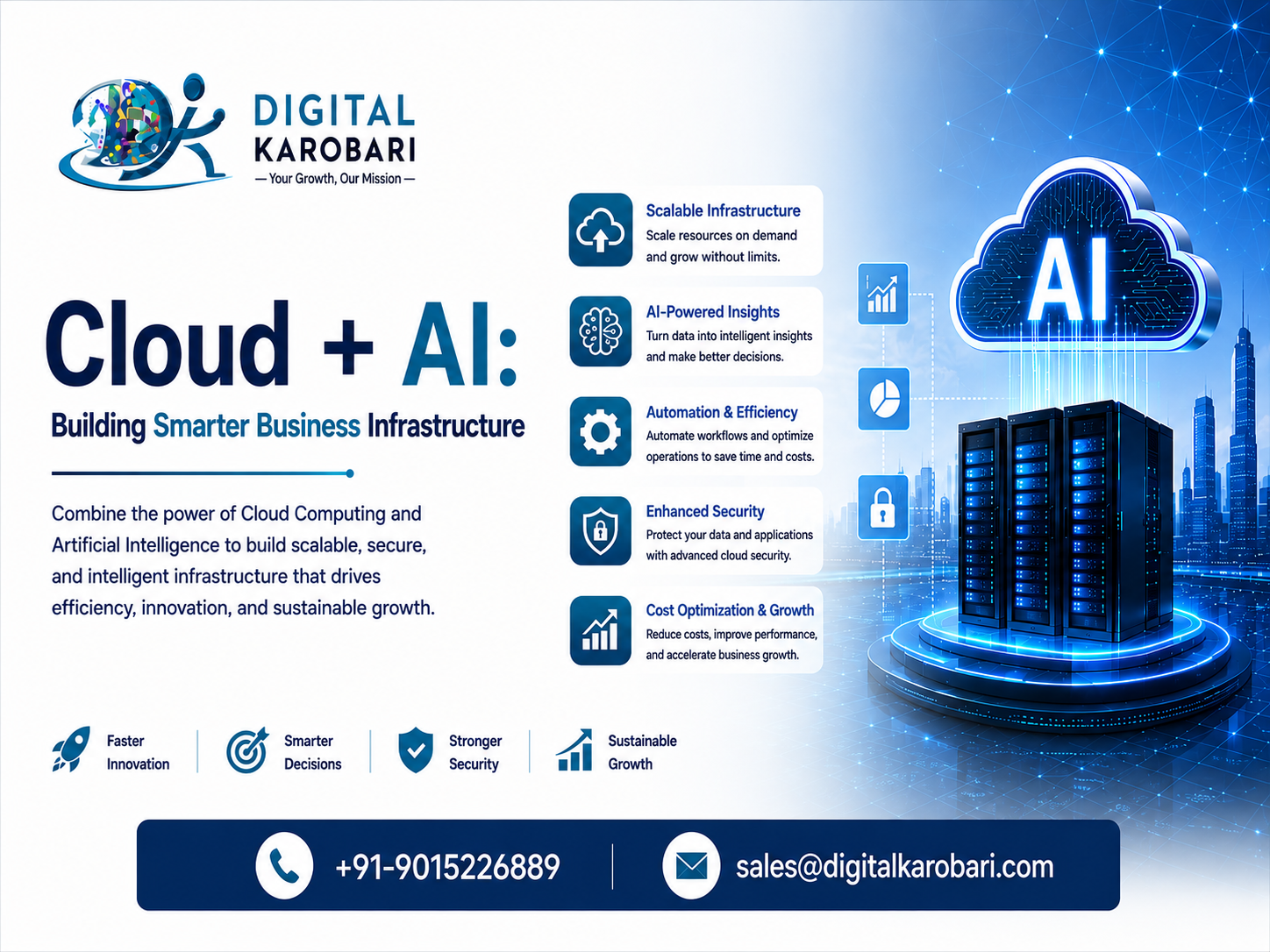
    Scalability: Resources can be adjusted according to business demand
    Automation: Reduces repetitive manual processes
    Data Analytics: Converts business data into actionable insights
    Customer Experience: Enables personalized and responsive interactions
    Cost Efficiency: Reduces dependence on extensive physical infrastructure
    Decision-Making: Supports faster, data-driven business decisions
    Security: Helps identify unusual activities and potential threats
    Innovation: Makes it easier to experiment with emerging AI technologies

    Challenges Businesses Should Consider

    While cloud and AI offer significant opportunities, successful implementation requires proper planning. Businesses should evaluate data privacy, cybersecurity, regulatory requirements, integration with existing systems, employee skills, AI accuracy, and infrastructure costs before deployment.
    Organizations should also determine which business processes genuinely benefit from AI rather than implementing AI simply because it is a growing technology trend. A clearly defined business objective can help ensure that cloud and AI investments deliver measurable value.

    Building a Future-Ready Infrastructure

    The future of business infrastructure will increasingly involve intelligent systems capable of learning from data, automating workflows, and adapting to changing requirements. Cloud computing provides the flexible foundation, while AI adds the intelligence needed to make that infrastructure more responsive.
    For businesses looking to digitally transform their operations, the combination of Cloud + AI can provide a foundation for improved productivity, smarter decision-making, enhanced customer experiences, and sustainable digital growth.
    Digital Karobari can help businesses explore digital transformation strategies and identify technology solutions aligned with their operational and growth objectives.

    Ready to Build a Smarter Digital Business?

    Explore how Digital Karobari can help your business adopt cloud, AI, automation, and other digital solutions to improve efficiency and prepare for the future. Connect with Digital Karobari today and start planning your smarter business infrastructure.
    Company Name: Digital Karobari
    🌐: https://digitalkarobari.
    📞: +91-9015226889

    FAQs

    1. What is Cloud + AI in business?
      Cloud + AI refers to combining cloud computing infrastructure with artificial intelligence technologies. This enables businesses to access scalable computing resources while using AI for automation, analytics, prediction, and intelligent decision-making.
    2. How can Cloud + AI help small businesses?
      Small businesses can use cloud-based AI tools without making major investments in physical infrastructure. They can automate repetitive tasks, analyze customer data, improve marketing activities, and access scalable digital solutions as the business grows.
    3. What are the main benefits of combining Cloud and AI?
      Key benefits include scalability, automation, improved data analysis, faster decision-making, personalized customer experiences, operational efficiency, and easier access to advanced AI technologies.
    4. Is Cloud + AI secure for business data?
      Cloud and AI environments can include advanced security capabilities, but security depends on proper implementation. Businesses should use strong access controls, encryption, monitoring, backup strategies, and appropriate data-governance practices.
    5. How can businesses start implementing Cloud + AI?
      Businesses can begin by identifying a specific operational challenge, assessing their existing infrastructure and data, selecting an appropriate cloud environment, and introducing AI into processes where it can deliver measurable business value.
  • Cloud-Based ERP vs. Traditional ERP: What Should Businesses Choose?

    Cloud-Based ERP vs. Traditional ERP: What Should Businesses Choose?

    Businesses today need accurate data, streamlined operations, and faster decision-making to remain competitive. An Enterprise Resource Planning (ERP) system brings key business functions such as finance, inventory, sales, purchasing, human resources, and operations together on a single platform.
    However, businesses often face an important decision: Should they invest in a traditional on-premise ERP system or move to a cloud-based ERP solution?
    Both approaches can help organizations manage their operations, but they differ significantly in terms of cost, accessibility, maintenance, scalability, and flexibility. Understanding these differences can help businesses choose an ERP model that fits their current requirements and future growth plans.

    What Is a Cloud-Based ERP?

    A cloud-based ERP is hosted on remote servers and accessed through the internet. Instead of purchasing and maintaining extensive hardware, businesses use the ERP system through a cloud provider.
    The provider generally manages infrastructure, software updates, security, backups, and system maintenance. Employees can access the ERP from authorized devices and locations, making it particularly useful for businesses with distributed teams or multiple locations.
    Cloud ERP can also make it easier for growing businesses to scale their operations because additional users, features, or resources can typically be added without installing new infrastructure.

    What Is a Traditional ERP?

    Traditional ERP, also known as on-premise ERP, is installed and operated on a company’s own servers and IT infrastructure. The organization is responsible for hardware, software installation, maintenance, upgrades, backups, and much of the system’s security management.
    This model can provide businesses with extensive control over their ERP environment. It may also be suitable for organizations with highly specific customization requirements or internal IT teams capable of managing complex infrastructure.
    However, the initial investment and ongoing maintenance requirements can be considerably higher.

    Cloud-Based ERP vs. Traditional ERP

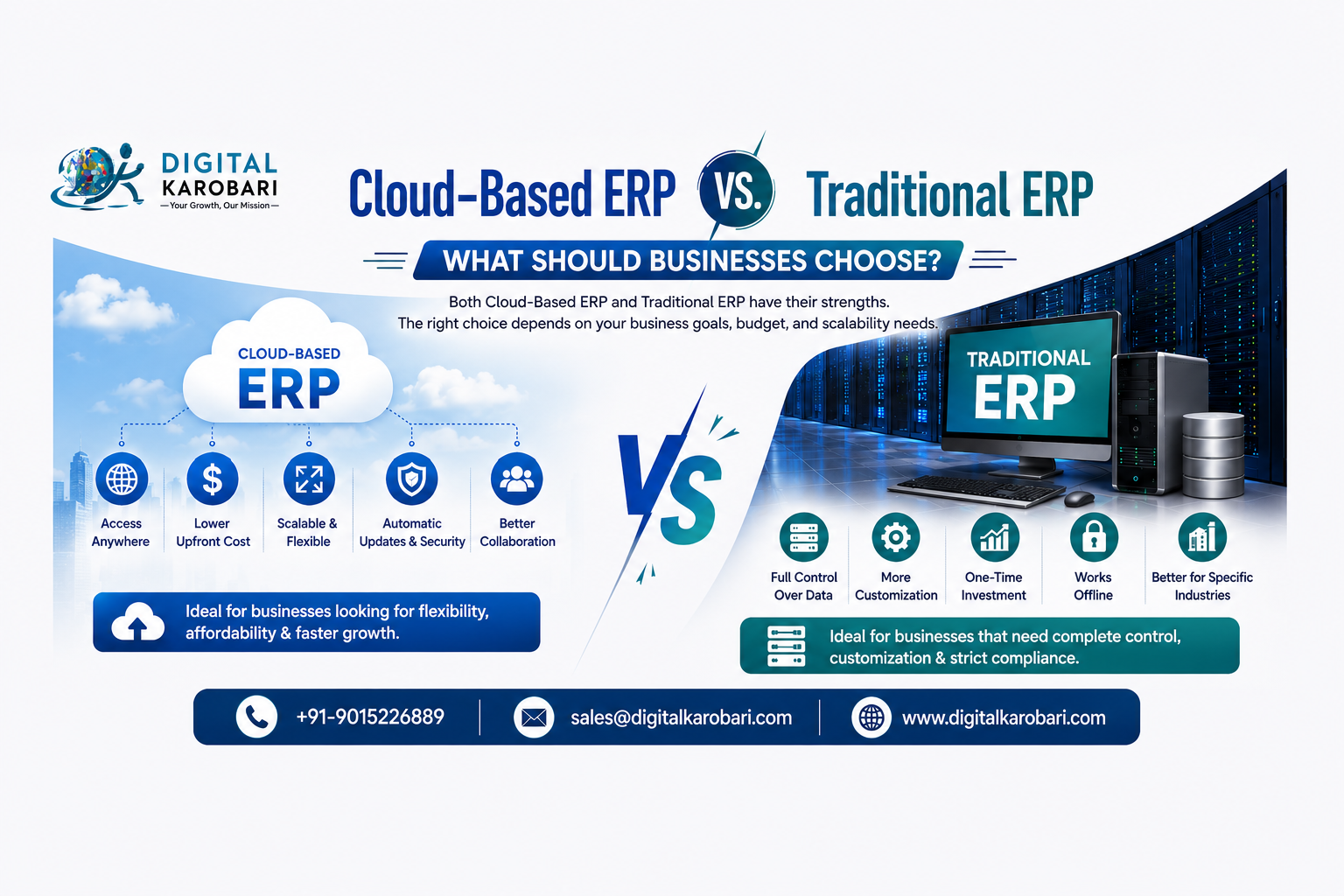
    Factor Cloud-Based ERP Traditional ERP
    Deployment Hosted in the cloud Installed on company infrastructure
    Initial Investment Generally lower Generally higher
    Accessibility Accessible through the internet Usually accessed through company network
    Maintenance Mostly managed by provider Managed by internal IT team
    Updates Usually handled by provider Organization manages upgrades
    Scalability Easier to scale May require additional hardware
    Infrastructure Minimal in-house infrastructure Requires servers and related hardware
    Remote Work Well suited for distributed teams Can require additional setup
    Customization Depends on the platform Often offers extensive customization
    IT Requirements Lower infrastructure burden Greater internal IT responsibility

    Benefits of Cloud-Based ERP

    1. Lower Infrastructure Requirements
      Cloud ERP reduces the need for businesses to purchase and maintain dedicated servers and other infrastructure. This can make ERP adoption more practical for small and medium-sized businesses.
    2. Access From Multiple Locations
      Authorized employees can access cloud ERP systems from different locations using an internet connection. This can support remote teams, branch offices, traveling employees, and businesses operating across multiple locations.
    3. Easier Scalability
      As a business grows, its ERP requirements can change. Cloud-based solutions can provide greater flexibility when adding users, locations, or capabilities.
    4. Simplified Maintenance
      Cloud ERP providers typically handle software maintenance, infrastructure management, and updates. This reduces the amount of technical work that needs to be handled internally.
    5. Faster Deployment
      Cloud ERP can often be deployed without the lengthy process of purchasing and configuring extensive physical infrastructure, helping businesses start using their system sooner.

    Benefits of Traditional ERP

    Traditional ERP still has advantages for certain organizations.
    Businesses that require extensive control over their infrastructure may prefer an on-premise solution. Organizations with specialized workflows, strict internal IT policies, or substantial technical resources may find this approach suitable.
    Traditional ERP can also offer significant customization possibilities, depending on the software and implementation partner. However, greater customization can also increase implementation complexity, maintenance requirements, and costs.

    Which ERP Is Better for Small and Medium Businesses?

    For many small and medium-sized businesses, cloud-based ERP can be an attractive option because it reduces infrastructure requirements and provides easier scalability.
    Instead of making a large upfront investment in servers and IT infrastructure, businesses can focus their resources on implementing the ERP system and improving business processes.
    However, the right choice depends on factors such as business size, industry requirements, budget, data policies, customization needs, and internal IT capabilities.

    Which ERP Should Large Enterprises Choose?

    Large organizations should evaluate both options carefully. A traditional ERP may be appropriate when an enterprise requires extensive control and highly customized infrastructure.
    On the other hand, cloud ERP can provide advantages for enterprises with multiple locations, distributed teams, rapidly changing requirements, or a need to scale resources efficiently.
    Rather than choosing an ERP solely based on company size, businesses should evaluate their processes, technical requirements, security policies, long-term goals, and total cost of ownership.

    How to Choose the Right ERP for Your Business

    Before selecting an ERP solution, businesses should consider:
    Current and future business requirements
    Number of employees and users
    Number of locations
    Budget and total cost of ownership
    Required integrations
    Customization requirements
    Data security and compliance needs
    Remote-access requirements
    Internal IT capabilities
    Scalability and future expansion
    It is also important to evaluate the ERP vendor, implementation support, training, data migration process, customer support, and integration capabilities.

    Conclusion

    The choice between cloud-based ERP and traditional ERP depends on what your business needs today and where it plans to go tomorrow.
    Cloud ERP can offer flexibility, accessibility, scalability, and reduced infrastructure responsibilities, while traditional ERP can provide greater control and extensive customization possibilities. Businesses should therefore compare both options based on their operational requirements rather than choosing one simply because it is newer or more popular.
    For businesses looking to modernize operations, the right ERP implementation can help connect departments, improve visibility, streamline processes, and support better decision-making.


    Ready to streamline your business operations with the right ERP solution?

    Explore how Digital Karobari can help your business adopt technology that improves efficiency, connects business processes, and supports sustainable growth. Contact Digital Karobari today to discuss your ERP and digital transformation requirements.
    Company Name: Digital Karobari
    🌐: https://digitalkarobari.
    📞: +91-9015226889

    FAQs

    1. What is the main difference between cloud ERP and traditional ERP?
      Cloud ERP is hosted on remote servers and accessed through the internet, while traditional ERP is installed and maintained on the company’s own infrastructure.
    2. Is cloud ERP cheaper than traditional ERP?
      Cloud ERP can require a lower initial infrastructure investment, but the overall cost depends on users, features, subscription terms, implementation, integrations, and other requirements.
    3. Is cloud ERP suitable for small businesses?
      Yes. Cloud ERP can be suitable for small businesses because it can reduce infrastructure requirements and provide scalable access to business management tools.
    4. Is traditional ERP more secure than cloud ERP?
      Neither model is automatically more secure. Security depends on factors such as system architecture, access controls, encryption, monitoring, backups, policies, and implementation practices.
    5. Can cloud ERP support remote employees?
      Yes. Cloud ERP can allow authorized employees to access business systems remotely, subject to the organization’s access and security policies.
    6. Which ERP is easier to scale?
      Cloud ERP is generally designed to make scaling users, resources, and capabilities easier, although the actual process depends on the ERP provider and pricing model.
    7. Can ERP software be customized?
      Yes. Both cloud and traditional ERP systems can offer customization or configuration options, but the level of customization varies by platform.